

68
3 Economic Framework of Conservation
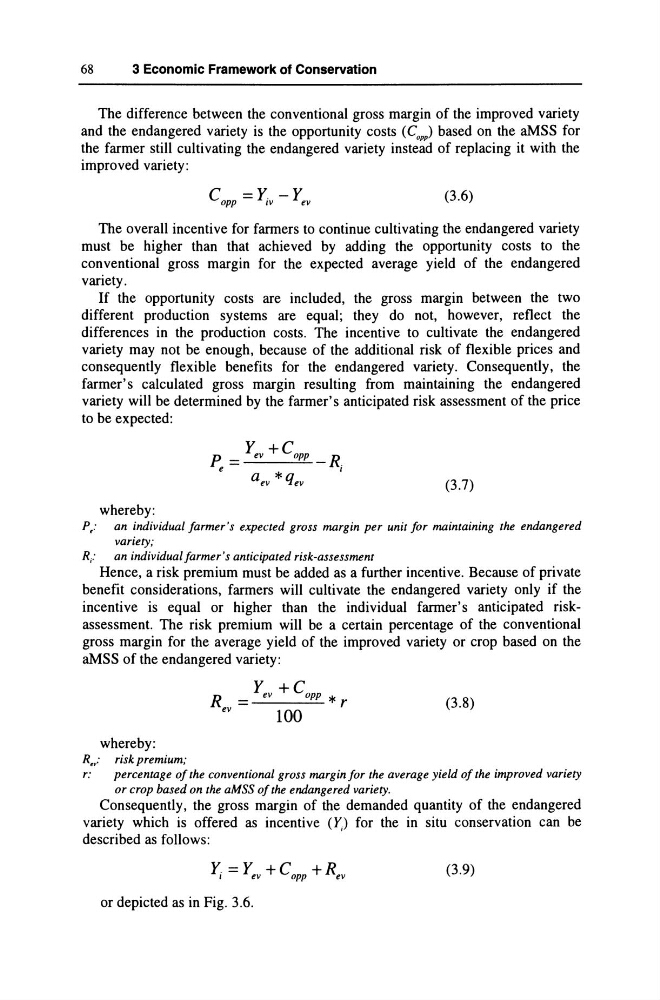
The difference between the conventional gross margin of the improved variety
and the endangered variety is the opportunity costs (C opp ) based on the aMSS for
the farmer still cultivating the endangered variety instead of replacing it with the
improved variety:
(3.6)
The overall incentive for farmers to continue cultivating the endangered variety
must be higher than that achieved by adding the opportunity costs to the
conventional gross margin for the expected average yield of the endangered
variety.
If the opportunity costs are included, the gross margin between the two
different production systems are equal; they do not, however, reflect the
differences in the production costs. The incentive to cultivate the endangered
variety may not be enough, because of the additional risk of flexible prices and
consequently flexible benefits for the endangered variety. Consequently, the
farmer's calculated gross margin resulting from maintaining the endangered
variety will be determined by the farmer's anticipated risk assessment of the price
to be expected:
Y ev +C opp
p =
-R.
e
*
I
aev qev
(3.7)
whereby:
P,: an individual farmer's expected gross margin per unit for maintaining the endangered
variety;
R;: an individualfarmer's anticipated risk-assessment
Hence, a risk premium must be added as a further incentive. Because of private
benefit considerations, farmers will cultivate the endangered variety only if the
incentive is equal or higher than the individual farmer's anticipated riskassessment. The risk premium will be a certain percentage of the conventional
gross margin for the average yield of the improved variety or crop based on the
aMSS of the endangered variety:
Y ev + C opp
R =
*r
ev
100
(3.8)
whereby:
R,,: risk premium;
r:
percentage of the conventional gross margin for the average yield of the improved variety
or crop based on the aMSS of the endangered variety.
Consequently, the gross margin of the demanded quantity of the endangered
variety which is offered as incentive (Y) for the in situ conservation can be
described as follows:
(3.9)
or depicted as in Fig. 3.6.
3 Economic Framework of Conservation
The difference between the conventional gross margin of the improved variety
and the endangered variety is the opportunity costs (C opp ) based on the aMSS for
the farmer still cultivating the endangered variety instead of replacing it with the
improved variety:
(3.6)
The overall incentive for farmers to continue cultivating the endangered variety
must be higher than that achieved by adding the opportunity costs to the
conventional gross margin for the expected average yield of the endangered
variety.
If the opportunity costs are included, the gross margin between the two
different production systems are equal; they do not, however, reflect the
differences in the production costs. The incentive to cultivate the endangered
variety may not be enough, because of the additional risk of flexible prices and
consequently flexible benefits for the endangered variety. Consequently, the
farmer's calculated gross margin resulting from maintaining the endangered
variety will be determined by the farmer's anticipated risk assessment of the price
to be expected:
Y ev +C opp
p =
-R.
e
*
I
aev qev
(3.7)
whereby:
P,: an individual farmer's expected gross margin per unit for maintaining the endangered
variety;
R;: an individualfarmer's anticipated risk-assessment
Hence, a risk premium must be added as a further incentive. Because of private
benefit considerations, farmers will cultivate the endangered variety only if the
incentive is equal or higher than the individual farmer's anticipated riskassessment. The risk premium will be a certain percentage of the conventional
gross margin for the average yield of the improved variety or crop based on the
aMSS of the endangered variety:
Y ev + C opp
R =
*r
ev
100
(3.8)
whereby:
R,,: risk premium;
r:
percentage of the conventional gross margin for the average yield of the improved variety
or crop based on the aMSS of the endangered variety.
Consequently, the gross margin of the demanded quantity of the endangered
variety which is offered as incentive (Y) for the in situ conservation can be
described as follows:
(3.9)
or depicted as in Fig. 3.6.