

3.4 Incentives for the Conservation of PGRFA
67
e.g., genetic drift etc. An aMSS can be defined for each crop 10, or on a more
general basis depending on other biological criteria (e.g., self- and crosspollinating plants, generative or vegetative propagated plants). As long as no other
measurement for agrobiodiversity is operational, e.g., the promoted "genetically
coded information", the in situ conservation of agrobiodiversity must conserve
traditional varieties and landraces. By following the rules of the safe minimum
standards, it is necessary to conserve all existing varieties in situ 11 (Hohl and
Tisdell, 1993; Bishop, 1978; Ciriacy-Wantrup, 1952).
The incentive system has to identify the aMSS for a specific endangered
variety, depending on the crop and the varietal specific population dynamics, as
well as other risk reduction issues. Knowing the average yield for that variety, the
resulting yield quantity can be calculated based on the aMSS. This yield quantity
is relevant in fixing the reference price. The approach is discussed in detail in the
following section.
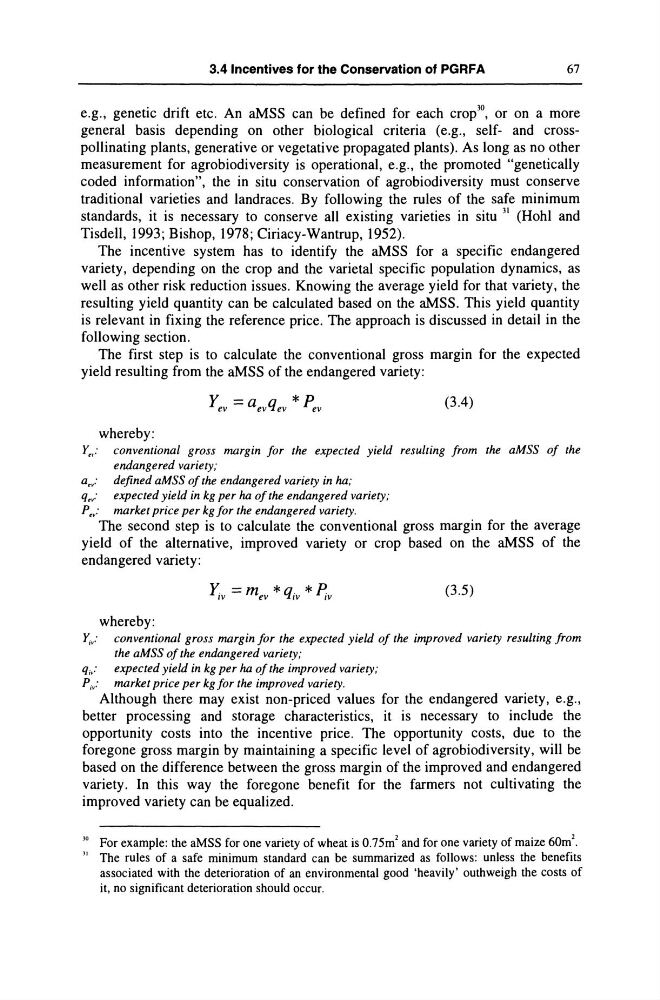
The first step is to calculate the conventional gross margin for the expected
yield resulting from the aMSS of the endangered variety:
(3.4)
whereby:
Y".: conventional gross margin for the expected yield resulting from the aMSS of the
endangered variety;
a,,: defined aMSS of the endangered variety in ha;
q",: expected yield in kg per ha of the endangered variety;
P,,: market price per kg for the endangered variety.
The second step is to calculate the conventional gross margin for the average
yield of the alternative, improved variety or crop based on the aMSS of the
endangered variety:
(3.5)
whereby:
y..: conventional gross margin for the expected yield of the improved variety resulting from
the aMSS of the endangered variety;
q;.: expected yield in kg per ha of the improved variety;
p;.: market price per kg for the improved variety.
Although there may exist non-priced values for the endangered variety, e.g.,
better processing and storage characteristics, it is necessary to include the
opportunity costs into the incentive price. The opportunity costs, due to the
foregone gross margin by maintaining a specific level of agrobiodiversity, will be
based on the difference between the gross margin of the improved and endangered
variety. In this way the foregone benefit for the farmers not cultivating the
improved variety can be equalized.
)0
For example: the aMSS for one variety of wheat is O.75m' and for one variety of maize 60m'.
" The rules of a safe minimum standard can be summarized as follows: unless the benefits
associated with the deterioration of an environmental good 'heavily' outhweigh the costs of
it, no significant deterioration should occur.
67
e.g., genetic drift etc. An aMSS can be defined for each crop 10, or on a more
general basis depending on other biological criteria (e.g., self- and crosspollinating plants, generative or vegetative propagated plants). As long as no other
measurement for agrobiodiversity is operational, e.g., the promoted "genetically
coded information", the in situ conservation of agrobiodiversity must conserve
traditional varieties and landraces. By following the rules of the safe minimum
standards, it is necessary to conserve all existing varieties in situ 11 (Hohl and
Tisdell, 1993; Bishop, 1978; Ciriacy-Wantrup, 1952).
The incentive system has to identify the aMSS for a specific endangered
variety, depending on the crop and the varietal specific population dynamics, as
well as other risk reduction issues. Knowing the average yield for that variety, the
resulting yield quantity can be calculated based on the aMSS. This yield quantity
is relevant in fixing the reference price. The approach is discussed in detail in the
following section.
The first step is to calculate the conventional gross margin for the expected
yield resulting from the aMSS of the endangered variety:
(3.4)
whereby:
Y".: conventional gross margin for the expected yield resulting from the aMSS of the
endangered variety;
a,,: defined aMSS of the endangered variety in ha;
q",: expected yield in kg per ha of the endangered variety;
P,,: market price per kg for the endangered variety.
The second step is to calculate the conventional gross margin for the average
yield of the alternative, improved variety or crop based on the aMSS of the
endangered variety:
(3.5)
whereby:
y..: conventional gross margin for the expected yield of the improved variety resulting from
the aMSS of the endangered variety;
q;.: expected yield in kg per ha of the improved variety;
p;.: market price per kg for the improved variety.
Although there may exist non-priced values for the endangered variety, e.g.,
better processing and storage characteristics, it is necessary to include the
opportunity costs into the incentive price. The opportunity costs, due to the
foregone gross margin by maintaining a specific level of agrobiodiversity, will be
based on the difference between the gross margin of the improved and endangered
variety. In this way the foregone benefit for the farmers not cultivating the
improved variety can be equalized.
)0
For example: the aMSS for one variety of wheat is O.75m' and for one variety of maize 60m'.
" The rules of a safe minimum standard can be summarized as follows: unless the benefits
associated with the deterioration of an environmental good 'heavily' outhweigh the costs of
it, no significant deterioration should occur.