

•
Applications in Genetics
nomenclature is used. The sensor probe is designed on the GG genotype. The
anchor probe contains no mismatches.
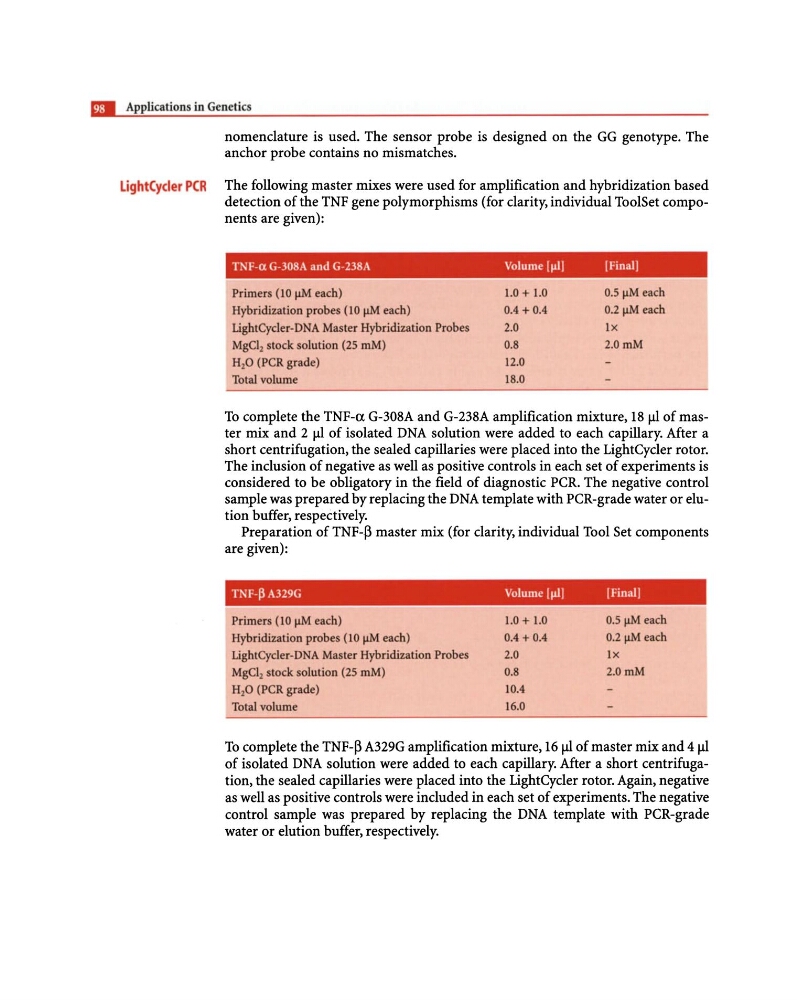
LightCycier PCR The following master mixes were used for amplification and hybridization based
detection of the TNF gene polymorphisms (for clarity, individual ToolSet components are given):
TNF-Cl G-30SA and G-23SA
Volume IJlII
[Final]
Primers (10 I!M each)
Hybrictization probes (10 JIM each)
LighlCycler-DNA Master Hybrictizarjon Probes
MgCI2 stock solution (25 mM)
H20 (PCR grade)
Total volume
1.0 + 1.0
0.4 + 0.4
2.0
O.S
12.0
18.0
0.5 JIM each
0.21!M each
Ix
2.0mM
To complete the TNF-a. G-308A and G-238A amplification mixture, 18 III of master mix and 2 j.!l of isolated DNA solution were added to each capillary. After a
short centrifugation, the sealed capillaries were placed into the LightCycler rotor.
The inclusion of negative as well as positive controls in each set of experiments is
considered to be obligatory in the field of diagnostic PCR. The negative control
sample was prepared by replacing the DNA template with PCR-grade water or elution buffer, respectively.
Preparation of TNF-~ master mix (for clarity, individual Tool Set components
are given):
TNF.~ A329G
Volume [Jill
[Final)
Primers (10 I!M each)
Hybrictization probes (10 JIM each)
LighlCycier-DNA Master Hybridization Probes
MgCI2 stock solution (25 mM)
H20 (PCR grade)
Total volume
1.0 + 1.0
0.4 + 0.4
2.0
O.S
10.4
16.0
0.51!M each
0.21!M each
Ix
2.0mM
To complete the TNF-~ A329G amplification mixture, 16 j.!l of master mix and 4 j.!l
of isolated DNA solution were added to each capillary. After a short centrifugation, the sealed capillaries were placed into the LightCycler rotor. Again, negative
as well as positive controls were included in each set of experiments. The negative
control sample was prepared by replacing the DNA template with PCR-grade
water or elution buffer, respectively.
Applications in Genetics
nomenclature is used. The sensor probe is designed on the GG genotype. The
anchor probe contains no mismatches.
LightCycier PCR The following master mixes were used for amplification and hybridization based
detection of the TNF gene polymorphisms (for clarity, individual ToolSet components are given):
TNF-Cl G-30SA and G-23SA
Volume IJlII
[Final]
Primers (10 I!M each)
Hybrictization probes (10 JIM each)
LighlCycler-DNA Master Hybrictizarjon Probes
MgCI2 stock solution (25 mM)
H20 (PCR grade)
Total volume
1.0 + 1.0
0.4 + 0.4
2.0
O.S
12.0
18.0
0.5 JIM each
0.21!M each
Ix
2.0mM
To complete the TNF-a. G-308A and G-238A amplification mixture, 18 III of master mix and 2 j.!l of isolated DNA solution were added to each capillary. After a
short centrifugation, the sealed capillaries were placed into the LightCycler rotor.
The inclusion of negative as well as positive controls in each set of experiments is
considered to be obligatory in the field of diagnostic PCR. The negative control
sample was prepared by replacing the DNA template with PCR-grade water or elution buffer, respectively.
Preparation of TNF-~ master mix (for clarity, individual Tool Set components
are given):
TNF.~ A329G
Volume [Jill
[Final)
Primers (10 I!M each)
Hybrictization probes (10 JIM each)
LighlCycier-DNA Master Hybridization Probes
MgCI2 stock solution (25 mM)
H20 (PCR grade)
Total volume
1.0 + 1.0
0.4 + 0.4
2.0
O.S
10.4
16.0
0.51!M each
0.21!M each
Ix
2.0mM
To complete the TNF-~ A329G amplification mixture, 16 j.!l of master mix and 4 j.!l
of isolated DNA solution were added to each capillary. After a short centrifugation, the sealed capillaries were placed into the LightCycler rotor. Again, negative
as well as positive controls were included in each set of experiments. The negative
control sample was prepared by replacing the DNA template with PCR-grade
water or elution buffer, respectively.