

571
Photosynthesis in Nature: A New Look
In the reactions above, release of O 2 occurs not from H 2 O but from H 2 O 2 .
Correspondingly, photosynthetic O 2 evolution would involve different stages that carry out a gradual accumulation of oxidizing equivalents in the
Mn-containing water-oxidizing complex (WOC) (Samuilov et al. 2001). The
WOC can exist in different oxidation states (S n , where high n indicates the most
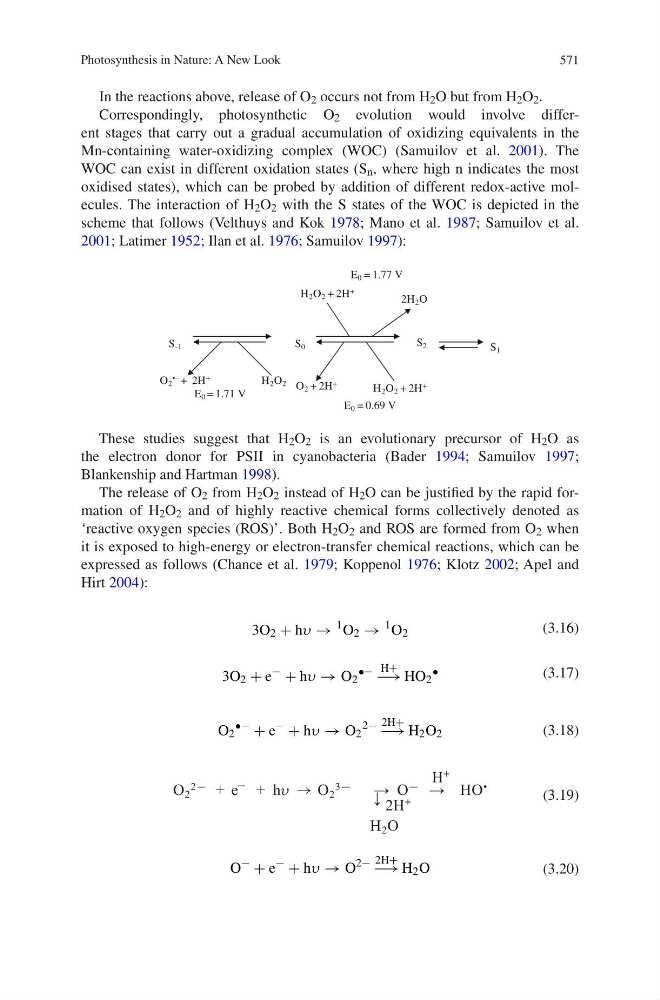
oxidised states), which can be probed by addition of different redox-active molecules. The interaction of H 2 O 2 with the S states of the WOC is depicted in the
scheme that follows (Velthuys and Kok 1978; Mano et al. 1987; Samuilov et al.
2001; Latimer 1952; Ilan et al. 1976; Samuilov 1997):
S -1
O 2
•– + 2H +
H 2 O 2
E 0 = 1.71 V
S 0
2H 2 O
H 2 O 2 + 2H +
O 2 + 2H +
H 2 O 2 + 2H +
S 2
S 1
E 0 = 0.69 V
E 0 = 1.77 V
These studies suggest that H 2 O 2 is an evolutionary precursor of H 2 O as
the electron donor for PSII in cyanobacteria (Bader 1994; Samuilov 1997;
Blankenship and Hartman 1998).
The release of O 2 from H 2 O 2 instead of H 2 O can be justified by the rapid formation of H 2 O 2 and of highly reactive chemical forms collectively denoted as
‘reactive oxygen species (ROS)’. Both H 2 O 2 and ROS are formed from O 2 when
it is exposed to high-energy or electron-transfer chemical reactions, which can be
expressed as follows (Chance et al. 1979; Koppenol 1976; Klotz 2002; Apel and
Hirt 2004):
(3.16)
3O 2 + hυ →
1 O 2 →
1 O 2
(3.17)
3O 2 + e
− + hυ → O 2
•− H+
−→ HO 2
•
(3.18)
O 2
•− + e
− + hυ → O 2
2− 2H+
−→ H 2 O 2
(3.19)
(3.20)
O
− + e
− + hυ → O
2− 2H+
−→ H 2 O