

572
K. M. G. Mostofa et al.
Singlet oxygen ( 1 O 2 ) and superoxide radical ion
O 2
•− are formed from the triplet state of O 2
3 O 2
in the presence of light (Eqs. 3.16, 3.17). The radical ion O 2
•−
then reacts with an hydrogen ion (H + ) to form the perhydroxyl radical (HO 2
• ) (Eq.
3.17). The species O 2
•− can also accept one more electron (e − ) to form peroxide
ion (O 2
2− ), which then combines with H + to generate hydrogen peroxide (H 2 O 2 )
(Eq. 3.18). Further acceptance of one e − by O 2
2− can form O 2
3− , which can then
produce H 2 O and an oxene ion (O − ) in the presence of H + (Eq. 3.19). The ion radical O − can produce the hydroxyl radical in the presence of H + (Eq. 3.19). Further
acceptance of one e − by O − can yield the oxide ion (O 2− ), which finally gives H 2 O
in the presence of H + (Eq. 3.20). This result shows that formation of water from O 2
is relatively more difficult than the process involving H 2 O 2 .
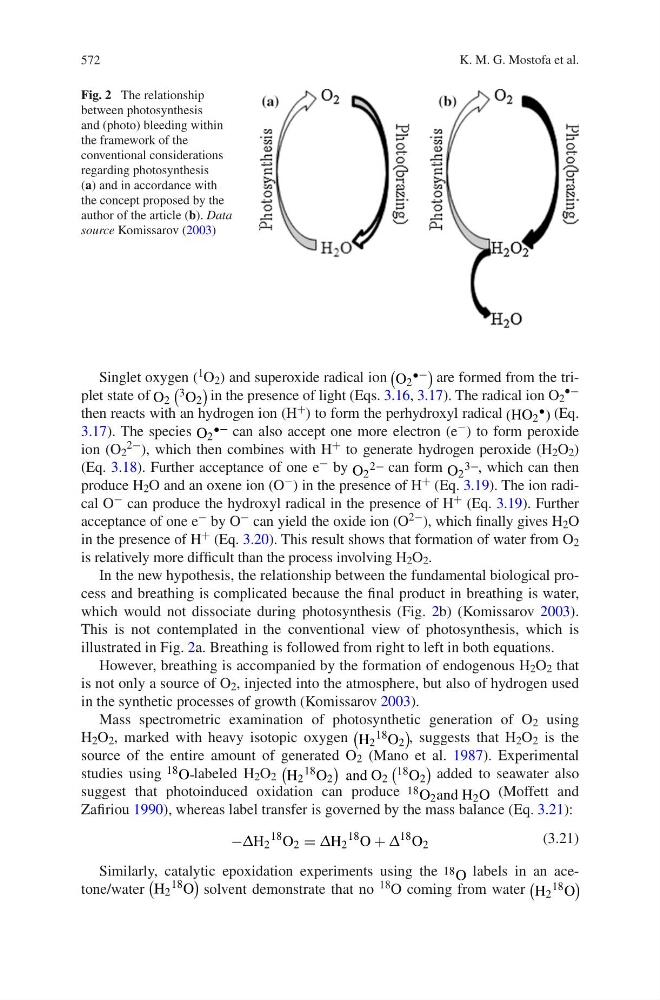
In the new hypothesis, the relationship between the fundamental biological process and breathing is complicated because the final product in breathing is water,
which would not dissociate during photosynthesis (Fig. 2b) (Komissarov 2003).
This is not contemplated in the conventional view of photosynthesis, which is
illustrated in Fig. 2a. Breathing is followed from right to left in both equations.
However, breathing is accompanied by the formation of endogenous H 2 O 2 that
is not only a source of O 2 , injected into the atmosphere, but also of hydrogen used
in the synthetic processes of growth (Komissarov 2003).
Mass spectrometric examination of photosynthetic generation of O 2 using
H 2 O 2 , marked with heavy isotopic oxygen
H 2
18 O 2
, suggests that H 2 O 2 is the
source of the entire amount of generated O 2 (Mano et al. 1987). Experimental
studies using 18 O-labeled H 2 O 2
H 2
18 O 2
and O 2
18 O 2
added to seawater also
suggest that photoinduced oxidation can produce 18 O 2 and H 2 O (Moffett and
Zafiriou 1990), whereas label transfer is governed by the mass balance (Eq. 3.21):
Similarly, catalytic epoxidation experiments using the 18 O labels in an acetone/water
H 2
18 O
solvent demonstrate that no 18 O coming from water
H 2
18 O
(3.21)
−∆H 2
18 O 2 = ∆H 2
18 O + ∆
18 O 2
Fig. 2 The relationship
between photosynthesis
and (photo) bleeding within
the framework of the
conventional considerations
regarding photosynthesis
(a) and in accordance with
the concept proposed by the
author of the article (b). Data
source Komissarov (2003)