

570
K. M. G. Mostofa et al.
where h is an electron vacancy (hole), generated in the pigment under the effect of
light. The generation of a single molecule of oxygen from water requires at least
four light quanta, each of which generates an ‘electron–hole’ couple. The electron
is used in the reaction (H + + e → H) required for the subsequent fixation of CO 2 .
Hylakoid particle preparations of the filamentous cyanobacterium Oscillatoria
chalybea in laboratory experiments using labeled 16 O 2 and 18 O 2 show the occurrence of at least three types of oxygen uptake: one is associated with PSII and the
S-state system, whereas the other two types apparently belong to the respiratory
pathway. The S-state system is involved in 18 O 2 production from H 2 O 2 (Bader and
Schmid 1988, 1989). Comparison of the relaxation kinetics of the first two flashes of
a sequence with the steady-state signals as well as the detailed analysis of the mass
spectrometric signals reveal that O 2 is evolved by various cyanobacteria through the
decomposition of H 2 O 2 , which requires only two light quanta (Bader 1994).
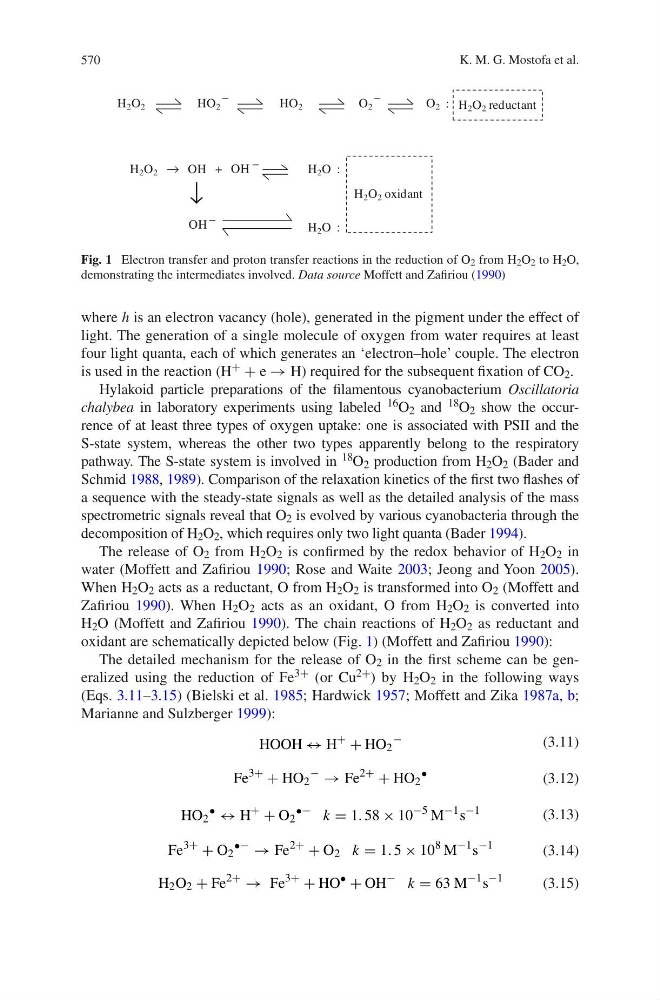
The release of O 2 from H 2 O 2 is confirmed by the redox behavior of H 2 O 2 in
water (Moffett and Zafiriou 1990; Rose and Waite 2003; Jeong and Yoon 2005).
When H 2 O 2 acts as a reductant, O from H 2 O 2 is transformed into O 2 (Moffett and
Zafiriou 1990). When H 2 O 2 acts as an oxidant, O from H 2 O 2 is converted into
H 2 O (Moffett and Zafiriou 1990). The chain reactions of H 2 O 2 as reductant and
oxidant are schematically depicted below (Fig. 1) (Moffett and Zafiriou 1990):
The detailed mechanism for the release of O 2 in the first scheme can be generalized using the reduction of Fe 3+ (or Cu 2+ ) by H 2 O 2 in the following ways
(Eqs. 3.11–3.15) (Bielski et al. 1985; Hardwick 1957; Moffett and Zika 1987a, b;
Marianne and Sulzberger 1999):
(3.11)
HOOH ↔ H
+ + HO 2
−
(3.12)
Fe
3+ + HO 2
− → Fe
2+ + HO 2
•
(3.13)
HO 2
• ↔ H
+ + O 2
•− k = 1. 58 × 10
−5 M
−1 s
−1
(3.14)
Fe
3+ + O 2
•− → Fe
2+ + O 2 k = 1. 5 × 10
8 M
−1 s
−1
(3.15)
H 2 O 2 + Fe
2+ → Fe
3+ + HO
• + OH
− k = 63 M
−1 s
−1
H 2 O 2
HO –
2
HO 2
O –
2
O 2 : H 2 O 2 reductant
H 2 O 2
OH +
H 2 O :
OH –
OH –
H 2 O :
H 2 O 2 oxidant
→
↓
Fig. 1 Electron transfer and proton transfer reactions in the reduction of O 2 from H 2 O 2 to H 2 O,
demonstrating the intermediates involved. Data source Moffett and Zafiriou (1990)