

297
Photoinduced and Microbial Degradation
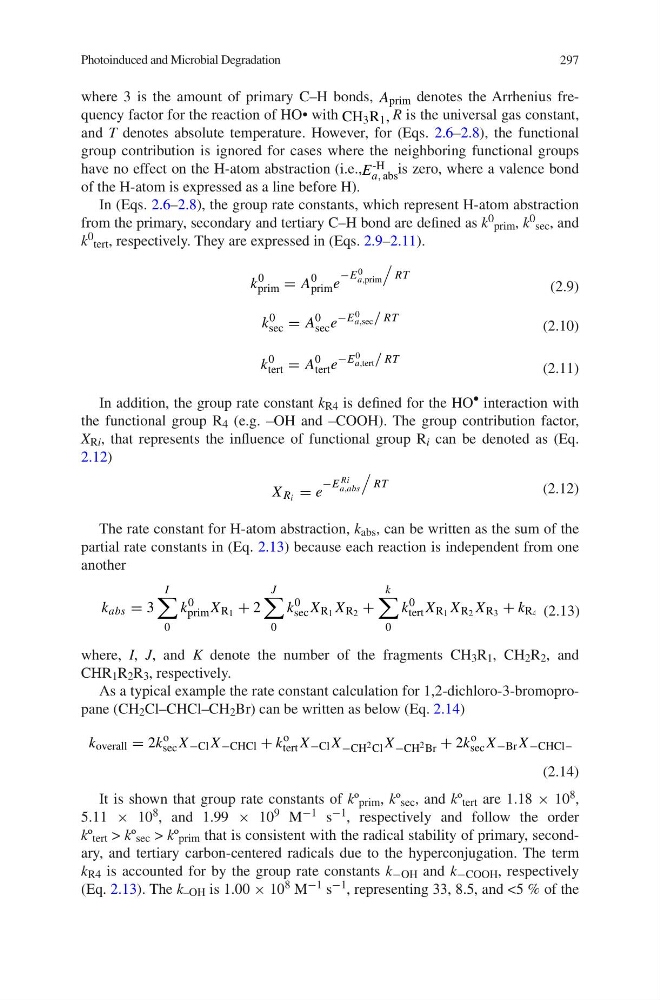
where 3 is the amount of primary C–H bonds, A prim denotes the Arrhenius frequency factor for the reaction of HO• with CH 3 R 1 , R is the universal gas constant,
and T denotes absolute temperature. However, for (Eqs. 2.6–2.8), the functional
group contribution is ignored for cases where the neighboring functional groups
have no effect on the H-atom abstraction (i.e.,E -H
a, abs
is zero, where a valence bond
of the H-atom is expressed as a line before H).
In (Eqs. 2.6–2.8), the group rate constants, which represent H-atom abstraction
from the primary, secondary and tertiary C–H bond are defined as k 0 prim , k 0 sec , and
k 0 tert , respectively. They are expressed in (Eqs. 2.9–2.11).
In addition, the group rate constant k R4 is defined for the HO
• interaction with
the functional group R 4 (e.g. –OH and –COOH). The group contribution factor,
X Ri , that represents the influence of functional group R i can be denoted as (Eq.
2.12)
The rate constant for H-atom abstraction, k abs , can be written as the sum of the
partial rate constants in (Eq. 2.13) because each reaction is independent from one
another
where, I, J, and K denote the number of the fragments CH 3 R 1 , CH 2 R 2 , and
CHR 1 R 2 R 3 , respectively.
As a typical example the rate constant calculation for 1,2-dichloro-3-bromopropane (CH 2 Cl–CHCl–CH 2 Br) can be written as below (Eq. 2.14)
It is shown that group rate constants of kº prim , kº sec , and kº tert are 1.18 × 10 8 ,
5.11 × 10 8 , and 1.99 × 10 9 M −1 s −1 , respectively and follow the order
kº tert > kº sec > kº prim that is consistent with the radical stability of primary, secondary, and tertiary carbon-centered radicals due to the hyperconjugation. The term
k R4 is accounted for by the group rate constants k −OH and k −COOH , respectively
(Eq. 2.13). The k –OH is 1.00 × 10 8 M −1 s −1 , representing 33, 8.5, and <5 % of the
(2.9)
k
0
prim = A
0
prim e
−E 0
a,prim
RT
(2.10)
k
0
sec = A
0
sec e
−E 0
a,sec
RT
(2.11)
k
0
tert = A
0
tert e
−E 0
a,tert
RT
(2.12)
X R i = e
−E Ri
a,abs
RT
(2.13)
k abs = 3
I
0
k
0
prim X R 1 + 2
J
0
k
0
sec X R 1 X R 2 +
k
0
k
0
tert X R 1 X R 2 X R 3 + k R 4
(2.14)
k overall = 2k
o
sec X −Cl X −CHCl + k
o
tert X −Cl X −CH 2 Cl X −CH 2 Br + 2k
o
sec X −Br X −CHCl−
Photoinduced and Microbial Degradation
where 3 is the amount of primary C–H bonds, A prim denotes the Arrhenius frequency factor for the reaction of HO• with CH 3 R 1 , R is the universal gas constant,
and T denotes absolute temperature. However, for (Eqs. 2.6–2.8), the functional
group contribution is ignored for cases where the neighboring functional groups
have no effect on the H-atom abstraction (i.e.,E -H
a, abs
is zero, where a valence bond
of the H-atom is expressed as a line before H).
In (Eqs. 2.6–2.8), the group rate constants, which represent H-atom abstraction
from the primary, secondary and tertiary C–H bond are defined as k 0 prim , k 0 sec , and
k 0 tert , respectively. They are expressed in (Eqs. 2.9–2.11).
In addition, the group rate constant k R4 is defined for the HO
• interaction with
the functional group R 4 (e.g. –OH and –COOH). The group contribution factor,
X Ri , that represents the influence of functional group R i can be denoted as (Eq.
2.12)
The rate constant for H-atom abstraction, k abs , can be written as the sum of the
partial rate constants in (Eq. 2.13) because each reaction is independent from one
another
where, I, J, and K denote the number of the fragments CH 3 R 1 , CH 2 R 2 , and
CHR 1 R 2 R 3 , respectively.
As a typical example the rate constant calculation for 1,2-dichloro-3-bromopropane (CH 2 Cl–CHCl–CH 2 Br) can be written as below (Eq. 2.14)
It is shown that group rate constants of kº prim , kº sec , and kº tert are 1.18 × 10 8 ,
5.11 × 10 8 , and 1.99 × 10 9 M −1 s −1 , respectively and follow the order
kº tert > kº sec > kº prim that is consistent with the radical stability of primary, secondary, and tertiary carbon-centered radicals due to the hyperconjugation. The term
k R4 is accounted for by the group rate constants k −OH and k −COOH , respectively
(Eq. 2.13). The k –OH is 1.00 × 10 8 M −1 s −1 , representing 33, 8.5, and <5 % of the
(2.9)
k
0
prim = A
0
prim e
−E 0
a,prim
RT
(2.10)
k
0
sec = A
0
sec e
−E 0
a,sec
RT
(2.11)
k
0
tert = A
0
tert e
−E 0
a,tert
RT
(2.12)
X R i = e
−E Ri
a,abs
RT
(2.13)
k abs = 3
I
0
k
0
prim X R 1 + 2
J
0
k
0
sec X R 1 X R 2 +
k
0
k
0
tert X R 1 X R 2 X R 3 + k R 4
(2.14)
k overall = 2k
o
sec X −Cl X −CHCl + k
o
tert X −Cl X −CH 2 Cl X −CH 2 Br + 2k
o
sec X −Br X −CHCl−