

298
K. M. G. Mostofa et al.
H-atom abstraction from the O–H bond in methanol, ethanol, and other alcohol
compounds, respectively, which is comparable with the experimental observations
(Asmus et al. 1973). The k –COOH is 7.0 × 10 5 M −1 s −1 , which is consistent with
experimental data for oxalic acid (Getoff et al. 1971).
It is demonstrated that the group contribution factors for the H-atom abstraction
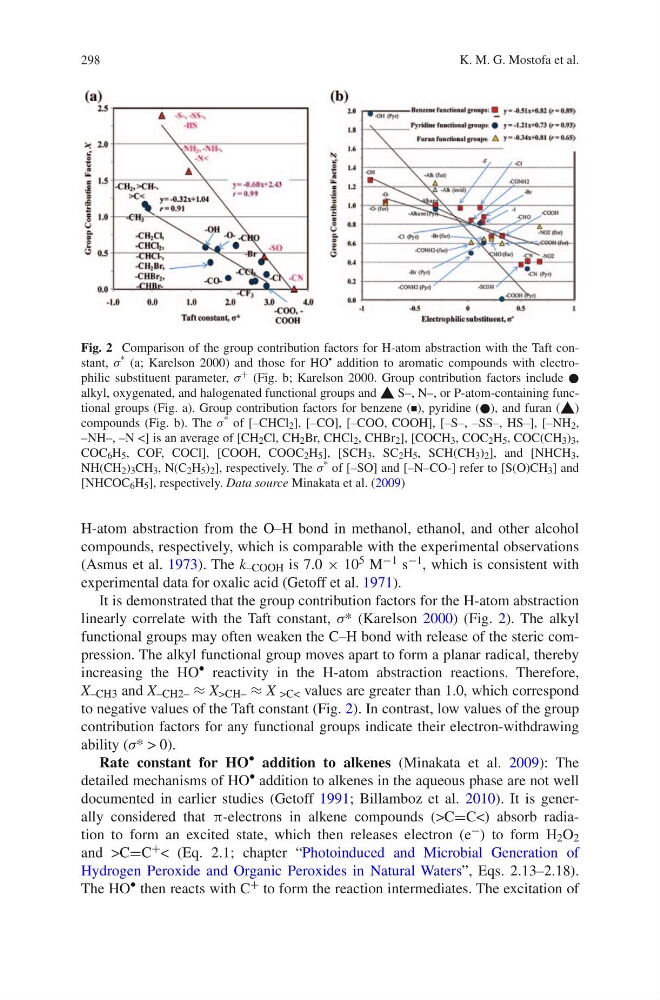
linearly correlate with the Taft constant, σ* (Karelson 2000) (Fig. 2). The alkyl
functional groups may often weaken the C–H bond with release of the steric compression. The alkyl functional group moves apart to form a planar radical, thereby
increasing the HO
• reactivity in the H-atom abstraction reactions. Therefore,
X –CH3 and X –CH2– ≈ X >CH– ≈ X >C< values are greater than 1.0, which correspond
to negative values of the Taft constant (Fig. 2). In contrast, low values of the group
contribution factors for any functional groups indicate their electron-withdrawing
ability (σ* > 0).
Rate constant for HO
•
addition to alkenes (Minakata et al. 2009): The
detailed mechanisms of HO
• addition to alkenes in the aqueous phase are not well
documented in earlier studies (Getoff 1991; Billamboz et al. 2010). It is generally considered that π-electrons in alkene compounds (>C=C<) absorb radiation to form an excited state, which then releases electron (e − ) to form H 2 O 2
and >C=C + < (Eq. 2.1; chapter “Photoinduced and Microbial Generation of
Hydrogen Peroxide and Organic Peroxides in Natural Waters”, Eqs. 2.13–2.18).
The HO
• then reacts with C + to form the reaction intermediates. The excitation of
Fig. 2 Comparison of the group contribution factors for H-atom abstraction with the Taft constant, σ * (a; Karelson 2000) and those for HO • addition to aromatic compounds with electrophilic substituent parameter, σ + (Fig. b; Karelson 2000. Group contribution factors include ●
alkyl, oxygenated, and halogenated functional groups and ▲ S–, N–, or P-atom-containing functional groups (Fig. a). Group contribution factors for benzene (▪), pyridine (●), and furan (▲)
compounds (Fig. b). The σ * of [–CHCl 2 ], [–CO], [–COO, COOH], [–S–, –SS–, HS–], [–NH 2 ,
–NH–, –N <] is an average of [CH 2 Cl, CH 2 Br, CHCl 2 , CHBr 2 ], [COCH 3 , COC 2 H 5 , COC(CH 3 ) 3 ,
COC 6 H 5 , COF, COCl], [COOH, COOC 2 H 5 ], [SCH 3 , SC 2 H 5 , SCH(CH 3 ) 2 ], and [NHCH 3 ,
NH(CH 2 ) 3 CH 3 , N(C 2 H 5 ) 2 ], respectively. The σ * of [–SO] and [–N–CO-] refer to [S(O)CH 3 ] and
[NHCOC 6 H 5 ], respectively. Data source Minakata et al. (2009)
K. M. G. Mostofa et al.
H-atom abstraction from the O–H bond in methanol, ethanol, and other alcohol
compounds, respectively, which is comparable with the experimental observations
(Asmus et al. 1973). The k –COOH is 7.0 × 10 5 M −1 s −1 , which is consistent with
experimental data for oxalic acid (Getoff et al. 1971).
It is demonstrated that the group contribution factors for the H-atom abstraction
linearly correlate with the Taft constant, σ* (Karelson 2000) (Fig. 2). The alkyl
functional groups may often weaken the C–H bond with release of the steric compression. The alkyl functional group moves apart to form a planar radical, thereby
increasing the HO
• reactivity in the H-atom abstraction reactions. Therefore,
X –CH3 and X –CH2– ≈ X >CH– ≈ X >C< values are greater than 1.0, which correspond
to negative values of the Taft constant (Fig. 2). In contrast, low values of the group
contribution factors for any functional groups indicate their electron-withdrawing
ability (σ* > 0).
Rate constant for HO
•
addition to alkenes (Minakata et al. 2009): The
detailed mechanisms of HO
• addition to alkenes in the aqueous phase are not well
documented in earlier studies (Getoff 1991; Billamboz et al. 2010). It is generally considered that π-electrons in alkene compounds (>C=C<) absorb radiation to form an excited state, which then releases electron (e − ) to form H 2 O 2
and >C=C + < (Eq. 2.1; chapter “Photoinduced and Microbial Generation of
Hydrogen Peroxide and Organic Peroxides in Natural Waters”, Eqs. 2.13–2.18).
The HO
• then reacts with C + to form the reaction intermediates. The excitation of
Fig. 2 Comparison of the group contribution factors for H-atom abstraction with the Taft constant, σ * (a; Karelson 2000) and those for HO • addition to aromatic compounds with electrophilic substituent parameter, σ + (Fig. b; Karelson 2000. Group contribution factors include ●
alkyl, oxygenated, and halogenated functional groups and ▲ S–, N–, or P-atom-containing functional groups (Fig. a). Group contribution factors for benzene (▪), pyridine (●), and furan (▲)
compounds (Fig. b). The σ * of [–CHCl 2 ], [–CO], [–COO, COOH], [–S–, –SS–, HS–], [–NH 2 ,
–NH–, –N <] is an average of [CH 2 Cl, CH 2 Br, CHCl 2 , CHBr 2 ], [COCH 3 , COC 2 H 5 , COC(CH 3 ) 3 ,
COC 6 H 5 , COF, COCl], [COOH, COOC 2 H 5 ], [SCH 3 , SC 2 H 5 , SCH(CH 3 ) 2 ], and [NHCH 3 ,
NH(CH 2 ) 3 CH 3 , N(C 2 H 5 ) 2 ], respectively. The σ * of [–SO] and [–N–CO-] refer to [S(O)CH 3 ] and
[NHCOC 6 H 5 ], respectively. Data source Minakata et al. (2009)