

296
K. M. G. Mostofa et al.
2.4.1 Reaction rate Constants by Functional Group Contribution
Method
Recently, it has been possible to determine the aqueous phase HO
• reaction rate constants by the functional GCM, which can be applied to the photoinduced degradation
of a given organic compound in aqueous media (Minakata et al. 2009). The GCM is
based on Benson’s thermochemical group additivity (Benson 1976). Under the principle of group additivity, it is hypothesized that an observed experimental rate constant
for a given organic compound is the combined rate of all elementary reactions involving HO
•
, which can be estimated using Arrhenius activation energy E a and frequency
factor A. Each reaction mechanism defines a base activation energy, E a º, and a functional group contribution of activation energy, E a
Ri . The latter results from the neighboring (i.e., α-position) and/or the next-nearest neighboring (i.e., β-position) functional
group (i.e., Ri). The GCM considers four reaction mechanisms that can be initiated by
HO
• in the aqueous phase, which include (1) H-atom abstraction, (2) HO
• addition to
C C doble bond(s) on alkenes, (3) HO
• addition to C=C doble bond(s) on aromatic
compounds, and (4) HO
• interaction with sulfur (S)-, nitrogen (N)-, or phosphorus
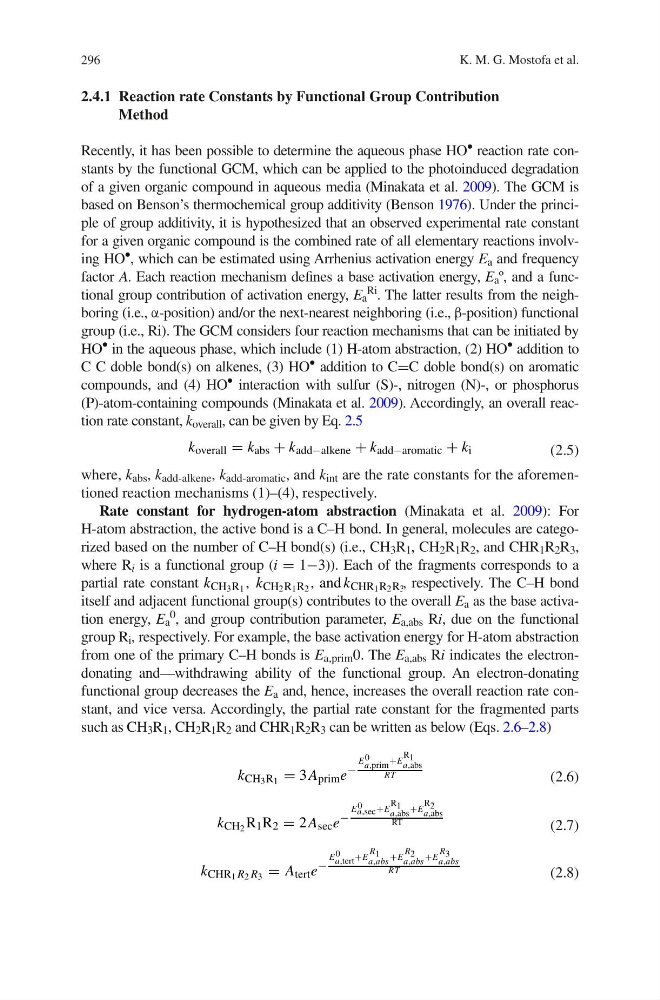
(P)-atom-containing compounds (Minakata et al. 2009). Accordingly, an overall reaction rate constant, k overall , can be given by Eq. 2.5
where, k abs , k add-alkene , k add-aromatic , and k int are the rate constants for the aforementioned reaction mechanisms (1)–(4), respectively.
Rate constant for hydrogen-atom abstraction (Minakata et al. 2009): For
H-atom abstraction, the active bond is a C–H bond. In general, molecules are categorized based on the number of C–H bond(s) (i.e., CH 3 R 1 , CH 2 R 1 R 2 , and CHR 1 R 2 R 3 ,
where R i is a functional group (i = 1−3)). Each of the fragments corresponds to a
partial rate constant k CH 3 R 1 , k CH 2 R 1 R 2 , and k CHR 1 R 2 R 3 , respectively. The C–H bond
itself and adjacent functional group(s) contributes to the overall E a as the base activation energy, E a
0 , and group contribution parameter, E a,abs Ri, due on the functional
group R i , respectively. For example, the base activation energy for H-atom abstraction
from one of the primary C–H bonds is E a,prim 0. The E a,abs Ri indicates the electrondonating and—withdrawing ability of the functional group. An electron-donating
functional group decreases the E a and, hence, increases the overall reaction rate constant, and vice versa. Accordingly, the partial rate constant for the fragmented parts
such as CH 3 R 1 , CH 2 R 1 R 2 and CHR 1 R 2 R 3 can be written as below (Eqs. 2.6–2.8)
(2.5)
k overall = k abs + k add−alkene + k add−aromatic + k int
(2.6)
k CH 3 R 1 = 3 A prim e
−
E 0
a,prim +E
R 1
a,abs
RT
(2.7)
k CH 2 R 1 R 2 = 2A sec e
−
E 0
a,sec +E
R 1
a,abs +E
R 2
a,abs
RT
(2.8)
k CHR 1 R 2 R 3 = A tert e
−
E 0
a,tert +E
R 1
a,abs +E
R 2
a,abs +E
R 3
a,abs
RT
K. M. G. Mostofa et al.
2.4.1 Reaction rate Constants by Functional Group Contribution
Method
Recently, it has been possible to determine the aqueous phase HO
• reaction rate constants by the functional GCM, which can be applied to the photoinduced degradation
of a given organic compound in aqueous media (Minakata et al. 2009). The GCM is
based on Benson’s thermochemical group additivity (Benson 1976). Under the principle of group additivity, it is hypothesized that an observed experimental rate constant
for a given organic compound is the combined rate of all elementary reactions involving HO
•
, which can be estimated using Arrhenius activation energy E a and frequency
factor A. Each reaction mechanism defines a base activation energy, E a º, and a functional group contribution of activation energy, E a
Ri . The latter results from the neighboring (i.e., α-position) and/or the next-nearest neighboring (i.e., β-position) functional
group (i.e., Ri). The GCM considers four reaction mechanisms that can be initiated by
HO
• in the aqueous phase, which include (1) H-atom abstraction, (2) HO
• addition to
C C doble bond(s) on alkenes, (3) HO
• addition to C=C doble bond(s) on aromatic
compounds, and (4) HO
• interaction with sulfur (S)-, nitrogen (N)-, or phosphorus
(P)-atom-containing compounds (Minakata et al. 2009). Accordingly, an overall reaction rate constant, k overall , can be given by Eq. 2.5
where, k abs , k add-alkene , k add-aromatic , and k int are the rate constants for the aforementioned reaction mechanisms (1)–(4), respectively.
Rate constant for hydrogen-atom abstraction (Minakata et al. 2009): For
H-atom abstraction, the active bond is a C–H bond. In general, molecules are categorized based on the number of C–H bond(s) (i.e., CH 3 R 1 , CH 2 R 1 R 2 , and CHR 1 R 2 R 3 ,
where R i is a functional group (i = 1−3)). Each of the fragments corresponds to a
partial rate constant k CH 3 R 1 , k CH 2 R 1 R 2 , and k CHR 1 R 2 R 3 , respectively. The C–H bond
itself and adjacent functional group(s) contributes to the overall E a as the base activation energy, E a
0 , and group contribution parameter, E a,abs Ri, due on the functional
group R i , respectively. For example, the base activation energy for H-atom abstraction
from one of the primary C–H bonds is E a,prim 0. The E a,abs Ri indicates the electrondonating and—withdrawing ability of the functional group. An electron-donating
functional group decreases the E a and, hence, increases the overall reaction rate constant, and vice versa. Accordingly, the partial rate constant for the fragmented parts
such as CH 3 R 1 , CH 2 R 1 R 2 and CHR 1 R 2 R 3 can be written as below (Eqs. 2.6–2.8)
(2.5)
k overall = k abs + k add−alkene + k add−aromatic + k int
(2.6)
k CH 3 R 1 = 3 A prim e
−
E 0
a,prim +E
R 1
a,abs
RT
(2.7)
k CH 2 R 1 R 2 = 2A sec e
−
E 0
a,sec +E
R 1
a,abs +E
R 2
a,abs
RT
(2.8)
k CHR 1 R 2 R 3 = A tert e
−
E 0
a,tert +E
R 1
a,abs +E
R 2
a,abs +E
R 3
a,abs
RT