

3. Irradiance and Lipid Production
59
large seasonal alterations in insolation and, as expected, lk is highest in the summer when light levels are high and lowest in the winter (Fig. 3.4A). Interestingly,
lk-lipid is remarkably high in the summer, and thus lipid production is light
saturated at levels 50-200% higher than overall photosynthesis in midsummer
(Fig. 3.4A). This result is particularly clear in Figure 3.4B, in which the light
saturation ratio U/lk-lipid) indicates that overall photosynthesis is light-saturated
at two to four times that of lipid synthesis in the winter but the reverse in summer.
The biological significance of this is that the lipid synthesis can take advantage of
increased light availability more than other biosynthetic activities, which suggests
that in the upper reaches of the epilimnion lipid synthesis is relatively great,
particularly in the summer.
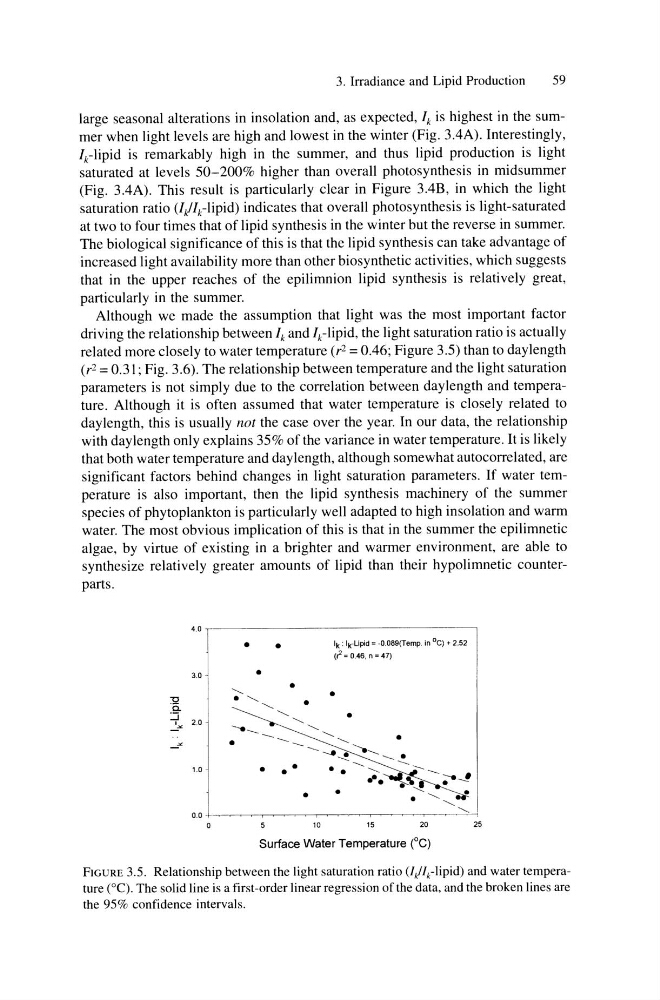
Although we made the assumption that light was the most important factor
driving the relationship between lk and lk-lipid, the light saturation ratio is actually
related more closely to water temperature (r 2 = 0.46; Figure 3.5) than to daylength
(r2 = 0.31; Fig. 3.6). The relationship between temperature and the light saturation
parameters is not simply due to the correlation between day length and temperature. Although it is often assumed that water temperature is closely related to
daylength, this is usually not the case over the year. In our data, the relationship
with daylength only explains 35% of the variance in water temperature. It is likely
that both water temperature and daylength, although somewhat autocorrelated, are
significant factors behind changes in light saturation parameters. If water temperature is also important, then the lipid synthesis machinery of the summer
species of phytoplankton is particularly well adapted to high insolation and warm
water. The most obvious implication of this is that in the summer the epilimnetic
algae, by virtue of existing in a brighter and warmer environment, are able to
synthesize relatively greater amounts of lipid than their hypolimnetic counterparts.
4.0
•
3.0
"0
'0.
:.J 2.0
.3
~
1.0
0.0
•
•
10
Ik: Ik-Upid = -O.089(Temp. in 0c) + 2.52
(r' = 0.46, n = 47)
15
20
Surface Water Temperature (oC)
25
FIGURE 3.5. Relationship between the light saturation ratio U,/lk-lipid) and water temperature (OC). The solid line is a first -order linear regression of the data, and the broken lines are
the 95% confidence intervals.
59
large seasonal alterations in insolation and, as expected, lk is highest in the summer when light levels are high and lowest in the winter (Fig. 3.4A). Interestingly,
lk-lipid is remarkably high in the summer, and thus lipid production is light
saturated at levels 50-200% higher than overall photosynthesis in midsummer
(Fig. 3.4A). This result is particularly clear in Figure 3.4B, in which the light
saturation ratio U/lk-lipid) indicates that overall photosynthesis is light-saturated
at two to four times that of lipid synthesis in the winter but the reverse in summer.
The biological significance of this is that the lipid synthesis can take advantage of
increased light availability more than other biosynthetic activities, which suggests
that in the upper reaches of the epilimnion lipid synthesis is relatively great,
particularly in the summer.
Although we made the assumption that light was the most important factor
driving the relationship between lk and lk-lipid, the light saturation ratio is actually
related more closely to water temperature (r 2 = 0.46; Figure 3.5) than to daylength
(r2 = 0.31; Fig. 3.6). The relationship between temperature and the light saturation
parameters is not simply due to the correlation between day length and temperature. Although it is often assumed that water temperature is closely related to
daylength, this is usually not the case over the year. In our data, the relationship
with daylength only explains 35% of the variance in water temperature. It is likely
that both water temperature and daylength, although somewhat autocorrelated, are
significant factors behind changes in light saturation parameters. If water temperature is also important, then the lipid synthesis machinery of the summer
species of phytoplankton is particularly well adapted to high insolation and warm
water. The most obvious implication of this is that in the summer the epilimnetic
algae, by virtue of existing in a brighter and warmer environment, are able to
synthesize relatively greater amounts of lipid than their hypolimnetic counterparts.
4.0
•
3.0
"0
'0.
:.J 2.0
.3
~
1.0
0.0
•
•
10
Ik: Ik-Upid = -O.089(Temp. in 0c) + 2.52
(r' = 0.46, n = 47)
15
20
Surface Water Temperature (oC)
25
FIGURE 3.5. Relationship between the light saturation ratio U,/lk-lipid) and water temperature (OC). The solid line is a first -order linear regression of the data, and the broken lines are
the 95% confidence intervals.