

3. Irradiance and Lipid Production
51
pattern (and SE, n = 8 dates) after 6 hours of incubation under saturating irradiance (150-600 J.1mol photons· m- 2 • s-') was 25% (10%) to protein, 13%
(9%) to LMW, 46% (16%) to polysaccharide, and 16% (11 %) to lipid, with both
average and SE expressed as percentage of total photosynthate. Of interest here is
the observation that allocation patterns also changed during the dark incubations.
To illustrate this, we have calculated the T2ffl ratio, where T1 denotes the
percentage of total photosynthate in a given class at the end of the light phase and
T2 is the corresponding value at the end of the dark period.
For phytoplankton previously exposed to saturating irradiance, the T2ffl ratios
for protein, LMW, and polysaccharide were generally consistent with a tendency
of phytoplankton to continue protein synthesis overnight, at the expense of polysaccharide and LMW reserves (Fig. 3.1). The general pattern corresponded to that
documented for several other freshwater and marine locations. Although not
highly obvious from Figure 3.1, the extent of overnight reallocation to protein was
quite variable among dates.
The lipids displayed T2ffl ratios that were sometimes significantly greater
than unity and sometimes significantly less (Hest, P <.05). There was no significant correlation between the T2 and TI values for percentage of photosynthate in
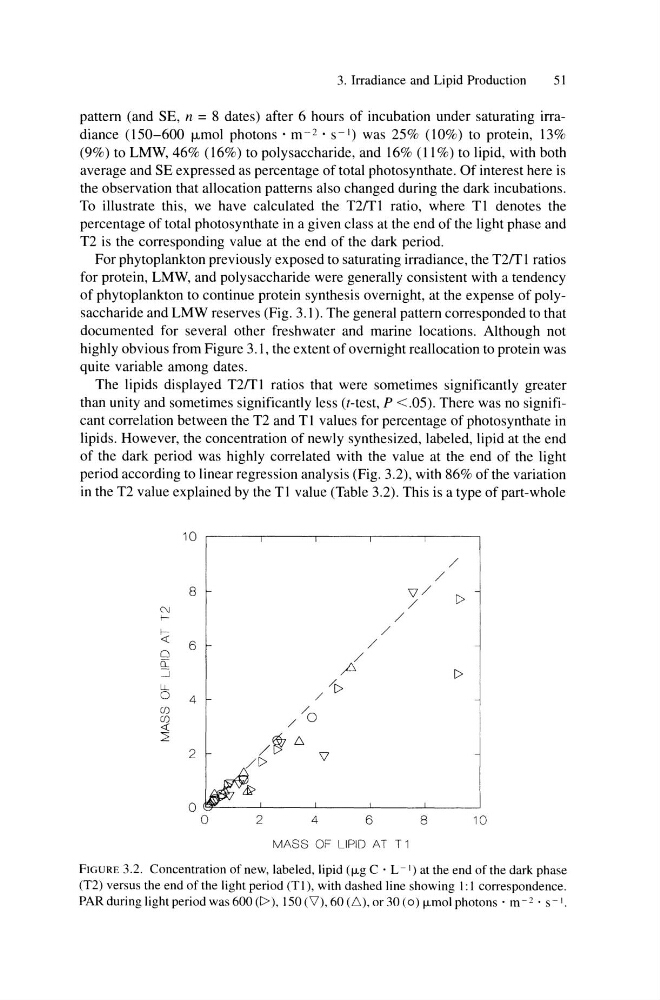
lipids. However, the concentration of newly synthesized, labeled, lipid at the end
of the dark period was highly correlated with the value at the end of the light
period according to linear regression analysis (Fig. 3.2), with 86% of the variation
in the T2 value explained by the T1 value (Table 3.2). This is a type of part-whole
10
/
/
8
V/
I>
N
/
f-/
f-/
« 6
/
0
/
0:::
P
~
I>
LL
/1>
0
4
/
(f)
/0
(f)
«
/
2
/~6
2
/1>
V
0 0
2
4
6
8
10
MASS OF LIPID AT T 1
FIGURE 3.2. Concentration of new, labeled, lipid (fLg C . L -I) at the end ofthe dark phase
(T2) versus the end of the light period (T 1), with dashed line showing 1: 1 correspondence.
PAR during light period was 600 (C», 150 (\7), 60 (6), or 30 (0) fLmol photons· m- 2 • S-I.
51
pattern (and SE, n = 8 dates) after 6 hours of incubation under saturating irradiance (150-600 J.1mol photons· m- 2 • s-') was 25% (10%) to protein, 13%
(9%) to LMW, 46% (16%) to polysaccharide, and 16% (11 %) to lipid, with both
average and SE expressed as percentage of total photosynthate. Of interest here is
the observation that allocation patterns also changed during the dark incubations.
To illustrate this, we have calculated the T2ffl ratio, where T1 denotes the
percentage of total photosynthate in a given class at the end of the light phase and
T2 is the corresponding value at the end of the dark period.
For phytoplankton previously exposed to saturating irradiance, the T2ffl ratios
for protein, LMW, and polysaccharide were generally consistent with a tendency
of phytoplankton to continue protein synthesis overnight, at the expense of polysaccharide and LMW reserves (Fig. 3.1). The general pattern corresponded to that
documented for several other freshwater and marine locations. Although not
highly obvious from Figure 3.1, the extent of overnight reallocation to protein was
quite variable among dates.
The lipids displayed T2ffl ratios that were sometimes significantly greater
than unity and sometimes significantly less (Hest, P <.05). There was no significant correlation between the T2 and TI values for percentage of photosynthate in
lipids. However, the concentration of newly synthesized, labeled, lipid at the end
of the dark period was highly correlated with the value at the end of the light
period according to linear regression analysis (Fig. 3.2), with 86% of the variation
in the T2 value explained by the T1 value (Table 3.2). This is a type of part-whole
10
/
/
8
V/
I>
N
/
f-/
f-/
« 6
/
0
/
0:::
P
~
I>
LL
/1>
0
4
/
(f)
/0
(f)
«
/
2
/~6
2
/1>
V
0 0
2
4
6
8
10
MASS OF LIPID AT T 1
FIGURE 3.2. Concentration of new, labeled, lipid (fLg C . L -I) at the end ofthe dark phase
(T2) versus the end of the light period (T 1), with dashed line showing 1: 1 correspondence.
PAR during light period was 600 (C», 150 (\7), 60 (6), or 30 (0) fLmol photons· m- 2 • S-I.