

14:0
16:0
18:0
16:1
18:1
20:1
22:1
18:2w6
20:4w6
18:3 w3
20:5 w3
22:5 w3
22:6w3
0
8. Lipids and Essential Fatty Acids in Aquatic Food Webs
191
Salmon feed
Fanned salmon
14:0
16:0
18:0
16:1
18:1
20:1
22:1
10
15
20
0
5
10
IS
20
% of total FA
% of total FA
14:0
16:0
18:0
16:1
18:1
20:1
22:1
18:2 w6
20:4 w6
18:3 w3
20:5 w3
22:5 w3
22:6 w3
Wild salmon
0:
I
P
:
tJ
I
I
I '
~
I
j
I
=:J
I
o
5
10
15
20
% of total FA
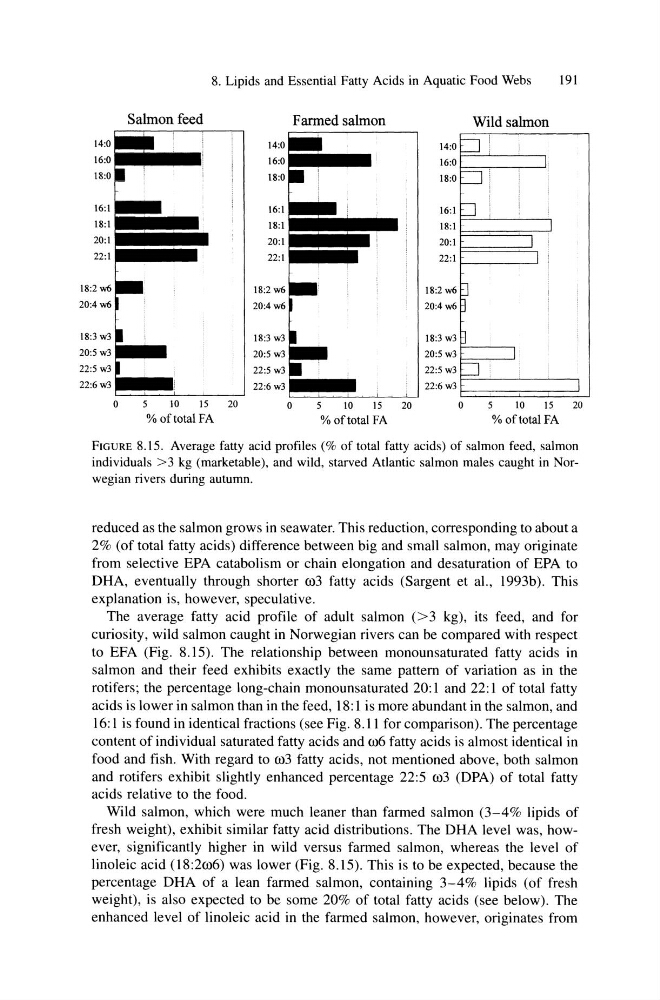
FIGURE 8.15. Average fatty acid profiles (% of total fatty acids) of salmon feed, salmon
individuals >3 kg (marketable), and wild, starved Atlantic salmon males caught in Norwegian rivers during autumn.
reduced as the salmon grows in seawater. This reduction, corresponding to about a
2% (of total fatty acids) difference between big and small salmon, may originate
from selective EPA catabolism or chain elongation and desaturation of EPA to
DHA, eventually through shorter 0)3 fatty acids (Sargent et a!., I 993b). This
explanation is, however, speculative.
The average fatty acid profile of adult salmon (>3 kg), its feed, and for
curiosity, wild salmon caught in Norwegian rivers can be compared with respect
to EFA (Fig. 8.15). The relationship between monounsaturated fatty acids in
salmon and their feed exhibits exactly the same pattern of variation as in the
rotifers; the percentage long-chain monounsaturated 20: I and 22: 1 of total fatty
acids is lower in salmon than in the feed, 18: I is more abundant in the salmon, and
16: 1 is found in identical fractions (see Fig. 8.11 for comparison). The percentage
content of individual saturated fatty acids and 0)6 fatty acids is almost identical in
food and fish. With regard to 0)3 fatty acids, not mentioned above, both salmon
and rotifers exhibit slightly enhanced percentage 22:5 0)3 (DPA) of total fatty
acids relative to the food.
Wild salmon, which were much leaner than farmed salmon (3-4% lipids of
fresh weight), exhibit similar fatty acid distributions. The DHA level was, however, significantly higher in wild versus farmed salmon, whereas the level of
linoleic acid (18:20)6) was lower (Fig. 8.15). This is to be expected, because the
percentage DHA of a lean farmed salmon, containing 3-4% lipids (of fresh
weight), is also expected to be some 20% of total fatty acids (see below). The
enhanced level of linoleic acid in the farmed salmon, however, originates from
16:0
18:0
16:1
18:1
20:1
22:1
18:2w6
20:4w6
18:3 w3
20:5 w3
22:5 w3
22:6w3
0
8. Lipids and Essential Fatty Acids in Aquatic Food Webs
191
Salmon feed
Fanned salmon
14:0
16:0
18:0
16:1
18:1
20:1
22:1
10
15
20
0
5
10
IS
20
% of total FA
% of total FA
14:0
16:0
18:0
16:1
18:1
20:1
22:1
18:2 w6
20:4 w6
18:3 w3
20:5 w3
22:5 w3
22:6 w3
Wild salmon
0:
I
P
:
tJ
I
I
I '
~
I
j
I
=:J
I
o
5
10
15
20
% of total FA
FIGURE 8.15. Average fatty acid profiles (% of total fatty acids) of salmon feed, salmon
individuals >3 kg (marketable), and wild, starved Atlantic salmon males caught in Norwegian rivers during autumn.
reduced as the salmon grows in seawater. This reduction, corresponding to about a
2% (of total fatty acids) difference between big and small salmon, may originate
from selective EPA catabolism or chain elongation and desaturation of EPA to
DHA, eventually through shorter 0)3 fatty acids (Sargent et a!., I 993b). This
explanation is, however, speculative.
The average fatty acid profile of adult salmon (>3 kg), its feed, and for
curiosity, wild salmon caught in Norwegian rivers can be compared with respect
to EFA (Fig. 8.15). The relationship between monounsaturated fatty acids in
salmon and their feed exhibits exactly the same pattern of variation as in the
rotifers; the percentage long-chain monounsaturated 20: I and 22: 1 of total fatty
acids is lower in salmon than in the feed, 18: I is more abundant in the salmon, and
16: 1 is found in identical fractions (see Fig. 8.11 for comparison). The percentage
content of individual saturated fatty acids and 0)6 fatty acids is almost identical in
food and fish. With regard to 0)3 fatty acids, not mentioned above, both salmon
and rotifers exhibit slightly enhanced percentage 22:5 0)3 (DPA) of total fatty
acids relative to the food.
Wild salmon, which were much leaner than farmed salmon (3-4% lipids of
fresh weight), exhibit similar fatty acid distributions. The DHA level was, however, significantly higher in wild versus farmed salmon, whereas the level of
linoleic acid (18:20)6) was lower (Fig. 8.15). This is to be expected, because the
percentage DHA of a lean farmed salmon, containing 3-4% lipids (of fresh
weight), is also expected to be some 20% of total fatty acids (see below). The
enhanced level of linoleic acid in the farmed salmon, however, originates from