

192
Y. Olsen
plant oils added to the salmon feed in trace amounts (Fig. 8.15). This affects the
(03/(06 ratio of the salmon relatively strongly, and it demonstrates the effect that a
minor fraction of dietary lipids of terrestrial origin, common in food of freshwater
fishes, can have on the fatty acid composition of fish (Ahlgren et aI., 1994;
Henderson and Tocher, 1987).
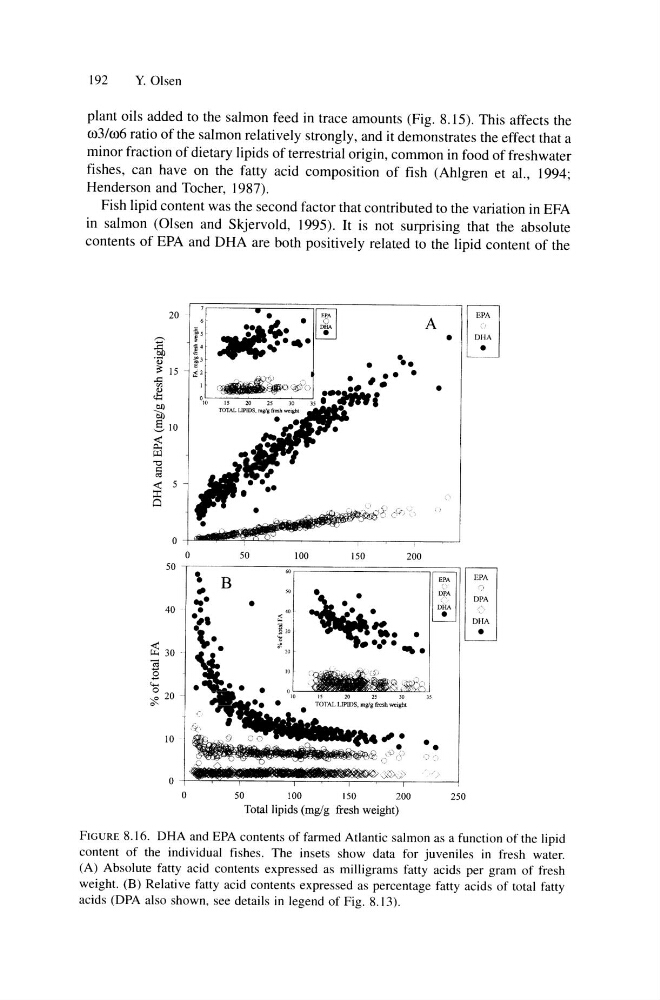
Fish lipid content was the second factor that contributed to the variation in EFA
in salmon (Olsen and Skjervold, 1995). It is not surprising that the absolute
contents of EPA and DHA are both positively related to the lipid content of the
20
•
50
100
150
200
EPA
EPA
~-,
~
DRA
OPA
•
DHA
<0
• •
•
:::
~ ..
OHA
~ )0
•
#
•••• • -..
50
100
150
200
250
Total lipids (mglg fresh weight)
FIGURE 8. I 6. DHA and EPA contents of farmed Atlantic salmon as a function of the lipid
content of the individual fishes. The insets show data for juveniles in fresh water.
(A) Absolute fatty acid contents expressed as milligrams fatty acids per gram of fresh
weight. (8) Relative fatty acid contents expressed as percentage fatty acids of total fatty
acids (DPA also shown, see details in legend of Fig. 8.13).
Y. Olsen
plant oils added to the salmon feed in trace amounts (Fig. 8.15). This affects the
(03/(06 ratio of the salmon relatively strongly, and it demonstrates the effect that a
minor fraction of dietary lipids of terrestrial origin, common in food of freshwater
fishes, can have on the fatty acid composition of fish (Ahlgren et aI., 1994;
Henderson and Tocher, 1987).
Fish lipid content was the second factor that contributed to the variation in EFA
in salmon (Olsen and Skjervold, 1995). It is not surprising that the absolute
contents of EPA and DHA are both positively related to the lipid content of the
20
•
50
100
150
200
EPA
EPA
~-,
~
DRA
OPA
•
DHA
<0
• •
•
:::
~ ..
OHA
~ )0
•
#
•••• • -..
50
100
150
200
250
Total lipids (mglg fresh weight)
FIGURE 8. I 6. DHA and EPA contents of farmed Atlantic salmon as a function of the lipid
content of the individual fishes. The insets show data for juveniles in fresh water.
(A) Absolute fatty acid contents expressed as milligrams fatty acids per gram of fresh
weight. (8) Relative fatty acid contents expressed as percentage fatty acids of total fatty
acids (DPA also shown, see details in legend of Fig. 8.13).