

182
Y. Olsen
'"
~ 150
u
:a
~
"Q 100
-= ~
= <:>
u
"::I 50
' s..
;:j
•
•
• ,
•
*
Total lipids
. ~""
. ~/
i-~-'--- .-.- •
., •
. , •
.' .
•
:
Phospholipids \ / )
50
100
ISO
200
2SO
300
350
Lipid content of feed (mglg DW)
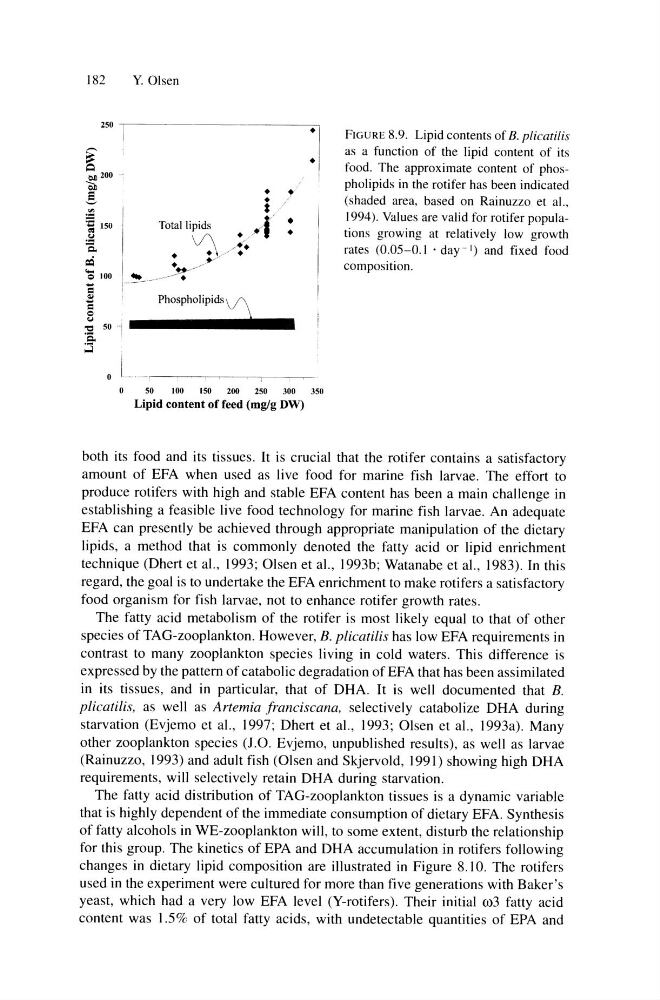
FIGURE 8.9. Lipid contents of B. plicatilis
as a function of the lipid content of its
food. The approximate content of phospholipids in the rotifer has been indicated
(shaded area, based on Rainuzzo et a!.,
1994). Values are valid for rotifer populations growing at relatively low growth
rates (0.05-0.1 . dar I) and fixed food
composition .
both its food and its tissues. It is crucial that the rotifer contains a satisfactory
amount of EFA when used as live food for marine fish larvae. The effort to
produce rotifers with high and stable EFA content has been a main challenge in
establishing a feasible live food technology for marine fish larvae. An adequate
EFA can presently be achieved through appropriate manipulation of the dietary
lipids, a method that is commonly denoted the fatty acid or lipid enrichment
technique (Dhert et aI., 1993; Olsen et aI., 1993b; Watanabe et aI., 1983). In this
regard, the goal is to undertake the EFA enrichment to make rotifers a satisfactory
food organism for fish larvae, not to enhance rotifer growth rates.
The fatty acid metabolism of the rotifer is most likely equal to that of other
species of TAG-zooplankton. However, B. plicatilis has low EFA requirements in
contrast to many zooplankton species living in cold waters. This difference is
expressed by the pattern of catabolic degradation of EFA that has been assimilated
in its tissues, and in particular, that of DHA. It is well documented that B.
plicatilis, as well as Artemia franciscana, selectively catabolize DHA during
starvation (Evjemo et aI., 1997; Dhert et aI., 1993; Olsen et aI., 1993a). Many
other zooplankton species (J.O. Evjemo, unpublished results), as well as larvae
(Rainuzzo, 1993) and adult fish (Olsen and Skjervold, 1991) showing high DHA
requirements, will selectively retain DHA during starvation.
The fatty acid distribution of TAG-zooplankton tissues is a dynamic variable
that is highly dependent of the immediate consumption of dietary EFA. Synthesis
of fatty alcohols in WE-zooplankton will, to some extent, disturb the relationship
for this group. The kinetics of EPA and DHA accumulation in rotifers following
changes in dietary lipid composition are illustrated in Figure 8.10. The rotifers
used in the experiment were cultured for more than five generations with Baker's
yeast, which had a very low EFA level (Y-rotifers). Their initial 0)3 fatty acid
content was 1.5% of total fatty acids, with undetectable quantities of EPA and
Y. Olsen
'"
~ 150
u
:a
~
"Q 100
-= ~
= <:>
u
"::I 50
' s..
;:j
•
•
• ,
•
*
Total lipids
. ~""
. ~/
i-~-'--- .-.- •
., •
. , •
.' .
•
:
Phospholipids \ / )
50
100
ISO
200
2SO
300
350
Lipid content of feed (mglg DW)
FIGURE 8.9. Lipid contents of B. plicatilis
as a function of the lipid content of its
food. The approximate content of phospholipids in the rotifer has been indicated
(shaded area, based on Rainuzzo et a!.,
1994). Values are valid for rotifer populations growing at relatively low growth
rates (0.05-0.1 . dar I) and fixed food
composition .
both its food and its tissues. It is crucial that the rotifer contains a satisfactory
amount of EFA when used as live food for marine fish larvae. The effort to
produce rotifers with high and stable EFA content has been a main challenge in
establishing a feasible live food technology for marine fish larvae. An adequate
EFA can presently be achieved through appropriate manipulation of the dietary
lipids, a method that is commonly denoted the fatty acid or lipid enrichment
technique (Dhert et aI., 1993; Olsen et aI., 1993b; Watanabe et aI., 1983). In this
regard, the goal is to undertake the EFA enrichment to make rotifers a satisfactory
food organism for fish larvae, not to enhance rotifer growth rates.
The fatty acid metabolism of the rotifer is most likely equal to that of other
species of TAG-zooplankton. However, B. plicatilis has low EFA requirements in
contrast to many zooplankton species living in cold waters. This difference is
expressed by the pattern of catabolic degradation of EFA that has been assimilated
in its tissues, and in particular, that of DHA. It is well documented that B.
plicatilis, as well as Artemia franciscana, selectively catabolize DHA during
starvation (Evjemo et aI., 1997; Dhert et aI., 1993; Olsen et aI., 1993a). Many
other zooplankton species (J.O. Evjemo, unpublished results), as well as larvae
(Rainuzzo, 1993) and adult fish (Olsen and Skjervold, 1991) showing high DHA
requirements, will selectively retain DHA during starvation.
The fatty acid distribution of TAG-zooplankton tissues is a dynamic variable
that is highly dependent of the immediate consumption of dietary EFA. Synthesis
of fatty alcohols in WE-zooplankton will, to some extent, disturb the relationship
for this group. The kinetics of EPA and DHA accumulation in rotifers following
changes in dietary lipid composition are illustrated in Figure 8.10. The rotifers
used in the experiment were cultured for more than five generations with Baker's
yeast, which had a very low EFA level (Y-rotifers). Their initial 0)3 fatty acid
content was 1.5% of total fatty acids, with undetectable quantities of EPA and