

8. Lipids and Essential Fatty Acids in Aquatic Food Webs
181
Lean T AG~zooplankton
Young WE-zooplankton
Fat/old
WE-zooplankton
PhosphqJ.t;lli.lli . . a>..tJ:
.. relatively stable amount
.. high '% EFA
,. partly genetic control
IrAJicvlg!ycerides (TAG):
'" variable absolute content
.. composition dependent on diet
Wax esters (WE):
,. variable content
.. acid
dependent Oil diet
fatty acid composition
"alcohol
control
genetic
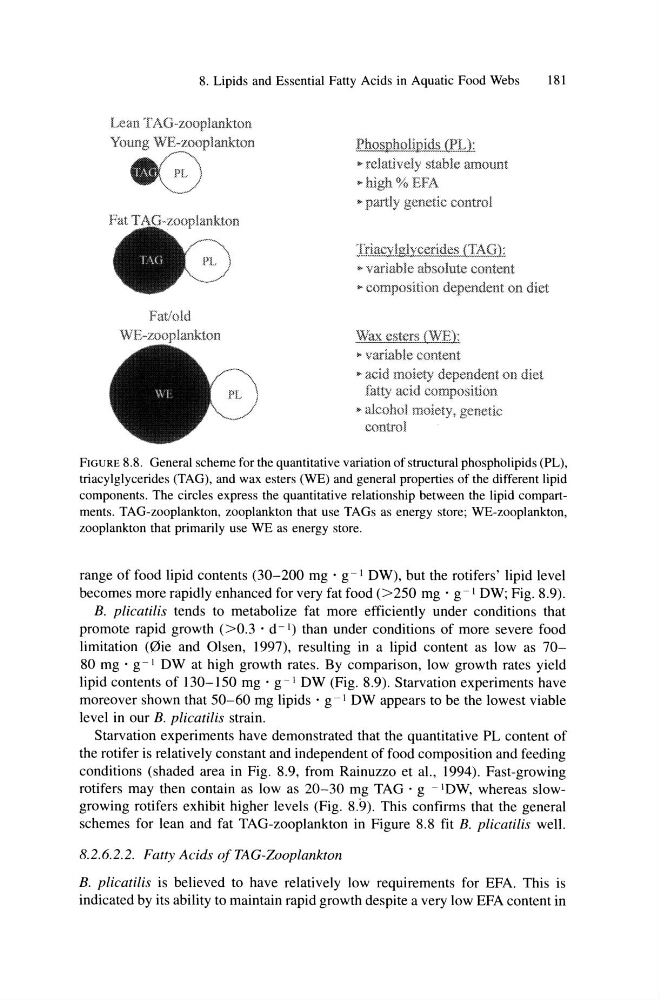
FIGURE 8.8. General scheme for the quantitative variation of structural phospholipids (PL),
triacylglycerides (TAG), and wax esters (WE) and general properties of the different lipid
components. The circles express the quantitative relationship between the lipid compartments. TAG-zooplankton, zooplankton that use TAGs as energy store; WE-zooplankton,
zooplankton that primarily use WE as energy store.
range of food lipid contents (30-200 mg . g-I DW), but the rotifers' lipid level
becomes more rapidly enhanced for very fat food (>250 mg . g-1 DW; Fig. 8.9).
B. plicatilis tends to metabolize fat more efficiently under conditions that
promote rapid growth (>0.3 . d- 1 ) than under conditions of more severe food
limitation (0ie and Olsen, 1997), resulting in a lipid content as low as 7080 mg . g-1 DW at high growth rates. By comparison, low growth rates yield
lipid contents of 130-150 mg' g-l DW (Fig. 8.9). Starvation experiments have
moreover shown that 50-60 mg lipids' g-l DW appears to be the lowest viable
level in our B. plicatilis strain.
Starvation experiments have demonstrated that the quantitative PL content of
the rotifer is relatively constant and independent of food composition and feeding
conditions (shaded area in Fig. 8.9, from Rainuzzo et aI., 1994). Fast-growing
rotifers may then contain as low as 20-30 mg TAG' g -lDW, whereas slowgrowing rotifers exhibit higher levels (Fig. 8.9). This confirms that the general
schemes for lean and fat TAG-zooplankton in Figure 8.8 fit B. plicatilis well.
8.2.6.2.2. Fatty Acids a/TAG-Zooplankton
B. plicatilis is believed to have relatively low requirements for EFA. This is
indicated by its ability to maintain rapid growth despite a very low EFA content in
181
Lean T AG~zooplankton
Young WE-zooplankton
Fat/old
WE-zooplankton
PhosphqJ.t;lli.lli . . a>..tJ:
.. relatively stable amount
.. high '% EFA
,. partly genetic control
IrAJicvlg!ycerides (TAG):
'" variable absolute content
.. composition dependent on diet
Wax esters (WE):
,. variable content
.. acid
dependent Oil diet
fatty acid composition
"alcohol
control
genetic
FIGURE 8.8. General scheme for the quantitative variation of structural phospholipids (PL),
triacylglycerides (TAG), and wax esters (WE) and general properties of the different lipid
components. The circles express the quantitative relationship between the lipid compartments. TAG-zooplankton, zooplankton that use TAGs as energy store; WE-zooplankton,
zooplankton that primarily use WE as energy store.
range of food lipid contents (30-200 mg . g-I DW), but the rotifers' lipid level
becomes more rapidly enhanced for very fat food (>250 mg . g-1 DW; Fig. 8.9).
B. plicatilis tends to metabolize fat more efficiently under conditions that
promote rapid growth (>0.3 . d- 1 ) than under conditions of more severe food
limitation (0ie and Olsen, 1997), resulting in a lipid content as low as 7080 mg . g-1 DW at high growth rates. By comparison, low growth rates yield
lipid contents of 130-150 mg' g-l DW (Fig. 8.9). Starvation experiments have
moreover shown that 50-60 mg lipids' g-l DW appears to be the lowest viable
level in our B. plicatilis strain.
Starvation experiments have demonstrated that the quantitative PL content of
the rotifer is relatively constant and independent of food composition and feeding
conditions (shaded area in Fig. 8.9, from Rainuzzo et aI., 1994). Fast-growing
rotifers may then contain as low as 20-30 mg TAG' g -lDW, whereas slowgrowing rotifers exhibit higher levels (Fig. 8.9). This confirms that the general
schemes for lean and fat TAG-zooplankton in Figure 8.8 fit B. plicatilis well.
8.2.6.2.2. Fatty Acids a/TAG-Zooplankton
B. plicatilis is believed to have relatively low requirements for EFA. This is
indicated by its ability to maintain rapid growth despite a very low EFA content in