

164
Y. Olsen
n-3/n-6
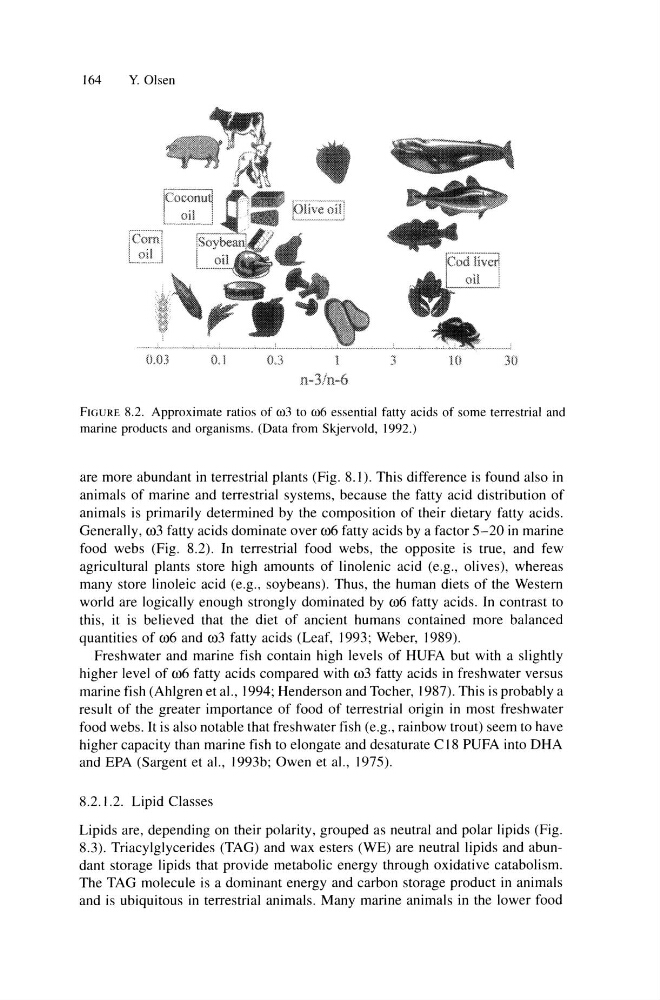
FIGURE 8.2. Approximate ratios of 0>3 to w6 essential fatty acids of some terrestrial and
marine products and organisms. (Data from Skjervold, 1992.)
are more abundant in terrestrial plants (Fig. 8.1). This difference is found also in
animals of marine and terrestrial systems, because the fatty acid distribution of
animals is primarily determined by the composition of their dietary fatty acids.
Generally, (03 fatty acids dominate over (06 fatty acids by a factor 5-20 in marine
food webs (Fig. 8.2). In terrestrial food webs, the opposite is true, and few
agricultural plants store high amounts of linolenic acid (e.g., olives), whereas
many store linoleic acid (e.g., soybeans). Thus, the human diets of the Western
world are logically enough strongly dominated by ro6 fatty acids. In contrast to
this, it is believed that the diet of ancient humans contained more balanced
quantities of ro6 and (03 fatty acids (Leaf, 1993; Weber, 1989).
Freshwater and marine fish contain high levels of HUFA but with a slightly
higher level of (06 fatty acids compared with (03 fatty acids in freshwater versus
marine fish (Ahlgren et aI., 1994; Henderson and Tocher, 1987). This is probably a
result of the greater importance of food of terrestrial origin in most freshwater
food webs. It is also notable that freshwater fish (e.g., rainbow trout) seem to have
higher capacity than marine fish to elongate and desaturate C 18 PUFA into DHA
and EPA (Sargent et aI., 1993b; Owen et aI., 1975).
8.2.1.2. Lipid Classes
Lipids are, depending on their polarity, grouped as neutral and polar lipids (Fig.
8.3). Triacylglycerides (TAG) and wax esters (WE) are neutral lipids and abundant storage lipids that provide metabolic energy through oxidative catabolism.
The TAG molecule is a dominant energy and carbon storage product in animals
and is ubiquitous in terrestrial animals. Many marine animals in the lower food
Y. Olsen
n-3/n-6
FIGURE 8.2. Approximate ratios of 0>3 to w6 essential fatty acids of some terrestrial and
marine products and organisms. (Data from Skjervold, 1992.)
are more abundant in terrestrial plants (Fig. 8.1). This difference is found also in
animals of marine and terrestrial systems, because the fatty acid distribution of
animals is primarily determined by the composition of their dietary fatty acids.
Generally, (03 fatty acids dominate over (06 fatty acids by a factor 5-20 in marine
food webs (Fig. 8.2). In terrestrial food webs, the opposite is true, and few
agricultural plants store high amounts of linolenic acid (e.g., olives), whereas
many store linoleic acid (e.g., soybeans). Thus, the human diets of the Western
world are logically enough strongly dominated by ro6 fatty acids. In contrast to
this, it is believed that the diet of ancient humans contained more balanced
quantities of ro6 and (03 fatty acids (Leaf, 1993; Weber, 1989).
Freshwater and marine fish contain high levels of HUFA but with a slightly
higher level of (06 fatty acids compared with (03 fatty acids in freshwater versus
marine fish (Ahlgren et aI., 1994; Henderson and Tocher, 1987). This is probably a
result of the greater importance of food of terrestrial origin in most freshwater
food webs. It is also notable that freshwater fish (e.g., rainbow trout) seem to have
higher capacity than marine fish to elongate and desaturate C 18 PUFA into DHA
and EPA (Sargent et aI., 1993b; Owen et aI., 1975).
8.2.1.2. Lipid Classes
Lipids are, depending on their polarity, grouped as neutral and polar lipids (Fig.
8.3). Triacylglycerides (TAG) and wax esters (WE) are neutral lipids and abundant storage lipids that provide metabolic energy through oxidative catabolism.
The TAG molecule is a dominant energy and carbon storage product in animals
and is ubiquitous in terrestrial animals. Many marine animals in the lower food