

8. Lipids and Essential Fatty Acids in Aquatic Food Webs
163
be grouped into those that cannot be synthesized de novo, although being essential
for animal growth and development (EFA) , and those that can be synthesized
(nonessential). The EFAs must be supplied in the food. Both animal and plant
cells can catabolize, elongate, and desaturate (dehydrogenate) fatty acids through
successive steps. Animal cells cannot, however, desaturate fatty acids at points
less than between carbon 9 and 10 from the methyl end (n-9 or 0)9), even though
they need such fatty acids to function adequately and to grow. This finding, which
may not be strictly true for all terrestrial animals, implies that all 0)6 and 0)3 fatty
acid bonds of marine origin have been formed by organisms of other kingdoms,
among which marine algae are believed to be most important. The importance of
bacteria in this regard is still an open question.
Many animals can elongate and desaturate the shorter C 18-precursors of 0)6
and 0)3 fatty acids, linoleic acid and linolenic acid, respectively. Many carnivorous animals have, however, little or no ability to modify C 18 fatty acids
through anabolic reactions, whereas they are able to modify C22 HUFA through
catabolic chain-shortening reactions (Sargent et aI., 1993b). It is nevertheless still
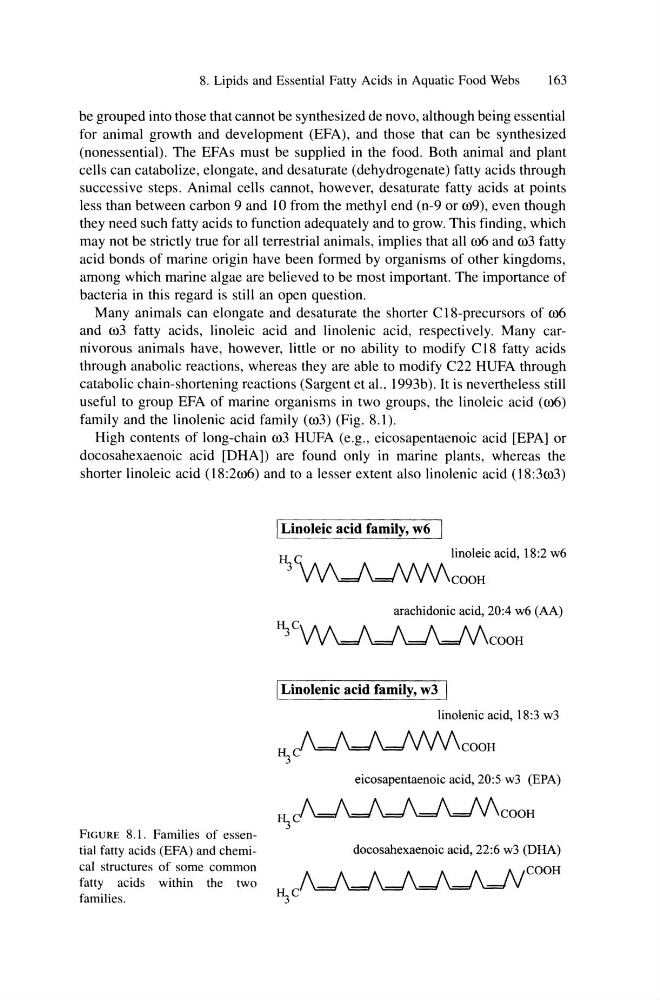
useful to group EFA of marine organisms in two groups, the linoleic acid (0)6)
family and the linolenic acid family (0)3) (Fig. 8.1).
High contents of long-chain 0)3 HUFA (e.g., eicosapentaenoic acid [EPA] or
docosahexaenoic acid [DHA]) are found only in marine plants, whereas the
shorter linoleic acid (18:20)6) and to a lesser extent also linolenic acid (18:30)3)
FIGURE 8.1. Families of essential fatty acids (EFA) and cheInical structures of some common
fatty acids within the two
families.
I Linoleic acid family, w6 I
H3 C\ "" " "" A. " linoleic acid, 18:2 w6
V V '==I '==I V V V \COOH
arachidonic acid, 20:4 w6 (AA)
I Linolenic acid family, w3 I
linolenic acid, 18:3 w3
H3~COOH
eicosapentaenoic acid, 20:5 w3 (EPA)
COOH
docosahexaenoic acid, 22:6 w3 (DHA)
COOH
~C
163
be grouped into those that cannot be synthesized de novo, although being essential
for animal growth and development (EFA) , and those that can be synthesized
(nonessential). The EFAs must be supplied in the food. Both animal and plant
cells can catabolize, elongate, and desaturate (dehydrogenate) fatty acids through
successive steps. Animal cells cannot, however, desaturate fatty acids at points
less than between carbon 9 and 10 from the methyl end (n-9 or 0)9), even though
they need such fatty acids to function adequately and to grow. This finding, which
may not be strictly true for all terrestrial animals, implies that all 0)6 and 0)3 fatty
acid bonds of marine origin have been formed by organisms of other kingdoms,
among which marine algae are believed to be most important. The importance of
bacteria in this regard is still an open question.
Many animals can elongate and desaturate the shorter C 18-precursors of 0)6
and 0)3 fatty acids, linoleic acid and linolenic acid, respectively. Many carnivorous animals have, however, little or no ability to modify C 18 fatty acids
through anabolic reactions, whereas they are able to modify C22 HUFA through
catabolic chain-shortening reactions (Sargent et aI., 1993b). It is nevertheless still
useful to group EFA of marine organisms in two groups, the linoleic acid (0)6)
family and the linolenic acid family (0)3) (Fig. 8.1).
High contents of long-chain 0)3 HUFA (e.g., eicosapentaenoic acid [EPA] or
docosahexaenoic acid [DHA]) are found only in marine plants, whereas the
shorter linoleic acid (18:20)6) and to a lesser extent also linolenic acid (18:30)3)
FIGURE 8.1. Families of essential fatty acids (EFA) and cheInical structures of some common
fatty acids within the two
families.
I Linoleic acid family, w6 I
H3 C\ "" " "" A. " linoleic acid, 18:2 w6
V V '==I '==I V V V \COOH
arachidonic acid, 20:4 w6 (AA)
I Linolenic acid family, w3 I
linolenic acid, 18:3 w3
H3~COOH
eicosapentaenoic acid, 20:5 w3 (EPA)
COOH
docosahexaenoic acid, 22:6 w3 (DHA)
COOH
~C