

8. Lipids and Essential Fatty Acids in Aquatic Food Webs
165
NEUTRAL LIPIDS:
Triacylglycerides
(di-, mono-, glyco-)
Wax esters
MAIN LIPID CLASSES
Q:COOH
:OH
POLAR LIPIDS:
Phospholipids
I"'=_P -<:!)
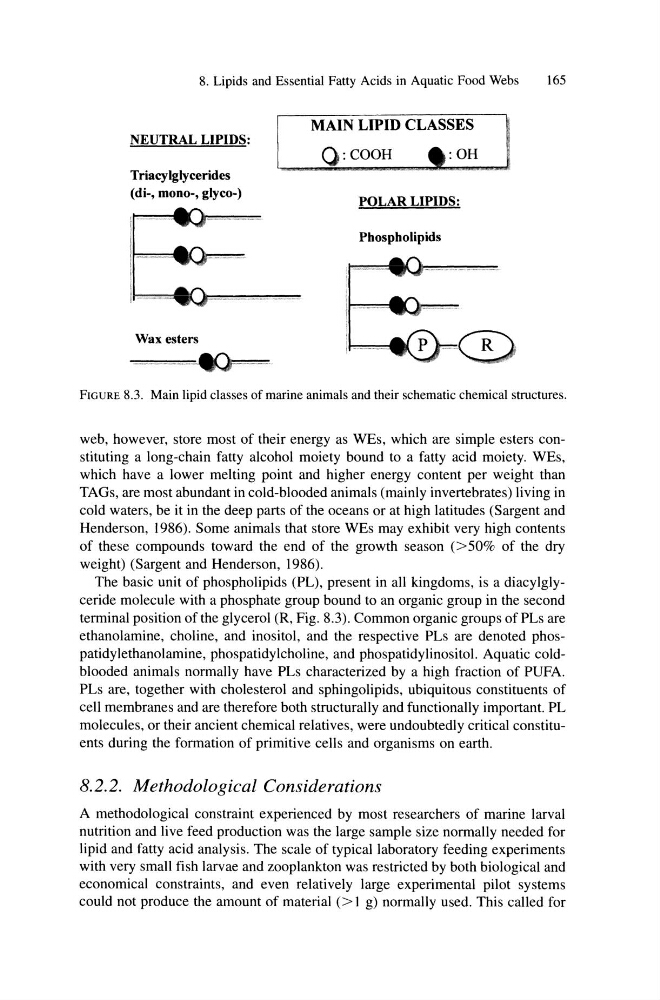
FIGURE 8.3. Main lipid classes of marine animals and their schematic chemical structures.
web, however, store most of their energy as WEs, which are simple esters constituting a long-chain fatty alcohol moiety bound to a fatty acid moiety. WEs,
which have a lower melting point and higher energy content per weight than
TAGs, are most abundant in cold-blooded animals (mainly invertebrates) living in
cold waters, be it in the deep parts of the oceans or at high latitudes (Sargent and
Henderson, 1986). Some animals that store WEs may exhibit very high contents
of these compounds toward the end of the growth season (>50% of the dry
weight) (Sargent and Henderson, 1986).
The basic unit of phospholipids (PL), present in all kingdoms, is a diacylglyceride molecule with a phosphate group bound to an organic group in the second
terminal position of the glycerol CR, Fig. 8.3). Common organic groups of PLs are
ethanolamine, choline, and inositol, and the respective PLs are denoted phospatidylethanolamine, phospatidylcholine, and phospatidylinositol. Aquatic coldblooded animals normally have PLs characterized by a high fraction of PUFA.
PLs are, together with cholesterol and sphingolipids, ubiquitous constituents of
cell membranes and are therefore both structurally and functionally important. PL
molecules, or their ancient chemical relatives, were undoubtedly critical constituents during the formation of primitive cells and organisms on earth.
8.2.2. Methodological Considerations
A methodological constraint experienced by most researchers of marine larval
nutrition and live feed production was the large sample size normally needed for
lipid and fatty acid analysis. The scale of typical laboratory feeding experiments
with very small fish larvae and zooplankton was restricted by both biological and
economical constraints, and even relatively large experimental pilot systems
could not produce the amount of material (> 1 g) normally used. This called for
165
NEUTRAL LIPIDS:
Triacylglycerides
(di-, mono-, glyco-)
Wax esters
MAIN LIPID CLASSES
Q:COOH
:OH
POLAR LIPIDS:
Phospholipids
I"'=_P -<:!)
FIGURE 8.3. Main lipid classes of marine animals and their schematic chemical structures.
web, however, store most of their energy as WEs, which are simple esters constituting a long-chain fatty alcohol moiety bound to a fatty acid moiety. WEs,
which have a lower melting point and higher energy content per weight than
TAGs, are most abundant in cold-blooded animals (mainly invertebrates) living in
cold waters, be it in the deep parts of the oceans or at high latitudes (Sargent and
Henderson, 1986). Some animals that store WEs may exhibit very high contents
of these compounds toward the end of the growth season (>50% of the dry
weight) (Sargent and Henderson, 1986).
The basic unit of phospholipids (PL), present in all kingdoms, is a diacylglyceride molecule with a phosphate group bound to an organic group in the second
terminal position of the glycerol CR, Fig. 8.3). Common organic groups of PLs are
ethanolamine, choline, and inositol, and the respective PLs are denoted phospatidylethanolamine, phospatidylcholine, and phospatidylinositol. Aquatic coldblooded animals normally have PLs characterized by a high fraction of PUFA.
PLs are, together with cholesterol and sphingolipids, ubiquitous constituents of
cell membranes and are therefore both structurally and functionally important. PL
molecules, or their ancient chemical relatives, were undoubtedly critical constituents during the formation of primitive cells and organisms on earth.
8.2.2. Methodological Considerations
A methodological constraint experienced by most researchers of marine larval
nutrition and live feed production was the large sample size normally needed for
lipid and fatty acid analysis. The scale of typical laboratory feeding experiments
with very small fish larvae and zooplankton was restricted by both biological and
economical constraints, and even relatively large experimental pilot systems
could not produce the amount of material (> 1 g) normally used. This called for