

52
dissolves fibrin but also activates tPA to form plasmin, thereby increasing inherent
fibrinolysis mechanism. Further, it shows higher specificity towards fibrin than
fibrinogen. The stability of NK in the gastrointestinal tract makes it a more suitable
candidate for oral administration as a potent cardiovascular disease neutraceutical.
NK supplementation is also reported to have advantages in the prevention of hypertension. NK was found to be safer in both animal and human healthy volunteers,
and oral consumption was not found to cause any side effects (Kim et al. 2008;
Lampe and English 2016).
2.2.2.2 Lumbrokinase (LK)
Lumbrokinases are a group of complex protease enzymes isolated from various species of earthworms. Earthworms were used as traditional medicine in Asian countries like China and Korea over thousands of years. They are also referred to as
earthworm powder enzymes as they were available in powder formulation.
Lumbrokinases are regarded as potential therapeutics against thrombosis. Enzymes
with fibrinolytic potential were first isolated and characterized in 1991 from an
earthworm species Lumbricus rubellus. Later fibrinolytic enzymes were isolated
from various species of earthworms such as Lumbricus bimastus, Eisenia fetida, E.
andrei, etc other than L. rubellus. Six fibrinolytic enzymes were isolated from L.
rubellus while seven enzymes were isolated from E. fetida. Lumbrokinase are more
fibrin specific compared to other thrombolytics such as tPA and urokinase. LK also
acts as a plasminogen activator by converting plasminogen into plasmin. Apart
from clot dissolution it also reduced platelet aggregation and thinning of blood by
reducing viscosity. Lumbrokinases have a molecular mass ranging from 20 to 35
KDa and show activity across a wide range of pH ranging from pH 1 to 11(Pan et al.
2010). LK is commercially available as Boluoke
®
and has been approved by the
China Food and Drug Administration. LK is widely used in China against coronary
heart disease, deep vein thrombosis, etc. It has also been used as an oral
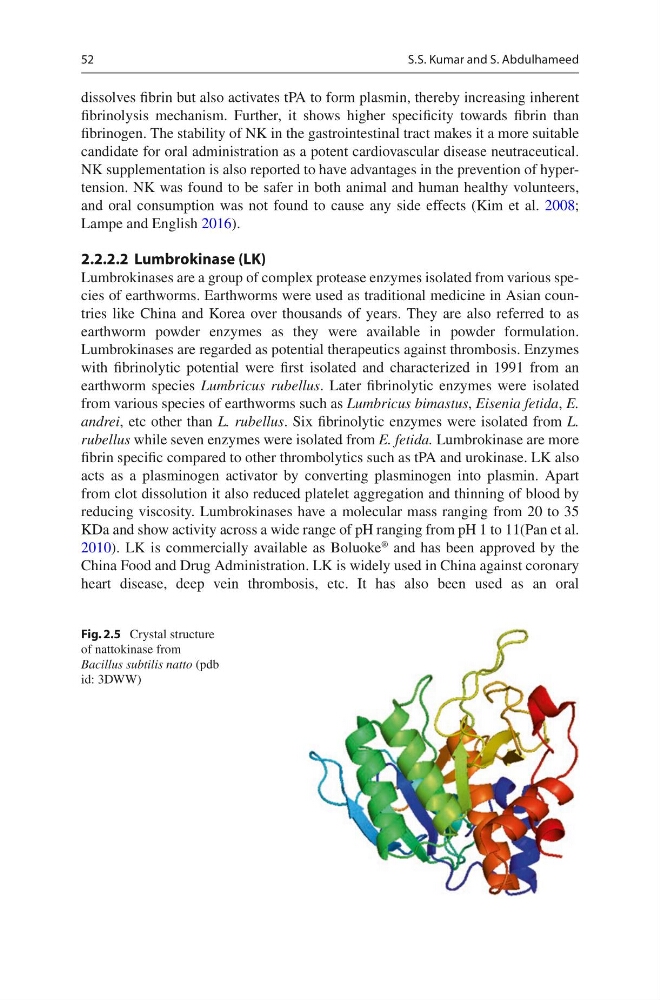
Fig. 2.5 Crystal structure
of nattokinase from
Bacillus subtilis natto (pdb
id: 3DWW)
S.S. Kumar and S. Abdulhameed
dissolves fibrin but also activates tPA to form plasmin, thereby increasing inherent
fibrinolysis mechanism. Further, it shows higher specificity towards fibrin than
fibrinogen. The stability of NK in the gastrointestinal tract makes it a more suitable
candidate for oral administration as a potent cardiovascular disease neutraceutical.
NK supplementation is also reported to have advantages in the prevention of hypertension. NK was found to be safer in both animal and human healthy volunteers,
and oral consumption was not found to cause any side effects (Kim et al. 2008;
Lampe and English 2016).
2.2.2.2 Lumbrokinase (LK)
Lumbrokinases are a group of complex protease enzymes isolated from various species of earthworms. Earthworms were used as traditional medicine in Asian countries like China and Korea over thousands of years. They are also referred to as
earthworm powder enzymes as they were available in powder formulation.
Lumbrokinases are regarded as potential therapeutics against thrombosis. Enzymes
with fibrinolytic potential were first isolated and characterized in 1991 from an
earthworm species Lumbricus rubellus. Later fibrinolytic enzymes were isolated
from various species of earthworms such as Lumbricus bimastus, Eisenia fetida, E.
andrei, etc other than L. rubellus. Six fibrinolytic enzymes were isolated from L.
rubellus while seven enzymes were isolated from E. fetida. Lumbrokinase are more
fibrin specific compared to other thrombolytics such as tPA and urokinase. LK also
acts as a plasminogen activator by converting plasminogen into plasmin. Apart
from clot dissolution it also reduced platelet aggregation and thinning of blood by
reducing viscosity. Lumbrokinases have a molecular mass ranging from 20 to 35
KDa and show activity across a wide range of pH ranging from pH 1 to 11(Pan et al.
2010). LK is commercially available as Boluoke
®
and has been approved by the
China Food and Drug Administration. LK is widely used in China against coronary
heart disease, deep vein thrombosis, etc. It has also been used as an oral
Fig. 2.5 Crystal structure
of nattokinase from
Bacillus subtilis natto (pdb
id: 3DWW)
S.S. Kumar and S. Abdulhameed