

51
2.2.1.8 Staphylokinase (SAK)
Staphylokinase (SAK) is an extracellular protein secreted by the majority of
Staphylococcus aureus strains. It is a tissue plasminogen activator (tPA) and forms
a complex with plasminogen to form plasmin. SAK is a monomer of 136 amino
acids without disulphide bridges. Recombinant staphylokinase has shown higher
fibrinolytic activity than fibrinogenolytic activity in comparison to streptokinase
(SK) (Collen and Van de Werf 1993). Many SAK variants (rSAK) are produced
with reduced immunogenicity by site-directed mutagenesis. They show higher
fibrin specificity with fewer bleeding complications but haemorrhage may still
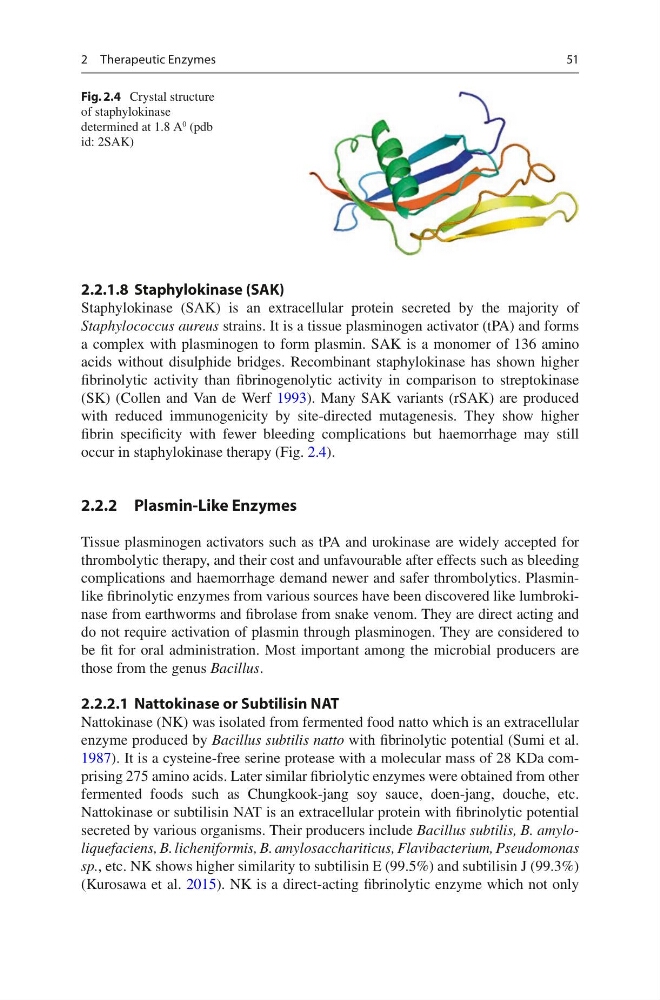
occur in staphylokinase therapy (Fig. 2.4).
2.2.2 Plasmin-Like Enzymes
Tissue plasminogen activators such as tPA and urokinase are widely accepted for
thrombolytic therapy, and their cost and unfavourable after effects such as bleeding
complications and haemorrhage demand newer and safer thrombolytics. Plasminlike fibrinolytic enzymes from various sources have been discovered like lumbrokinase from earthworms and fibrolase from snake venom. They are direct acting and
do not require activation of plasmin through plasminogen. They are considered to
be fit for oral administration. Most important among the microbial producers are
those from the genus Bacillus.
2.2.2.1 Nattokinase or Subtilisin NAT
Nattokinase (NK) was isolated from fermented food natto which is an extracellular
enzyme produced by Bacillus subtilis natto with fibrinolytic potential (Sumi et al.
1987). It is a cysteine-free serine protease with a molecular mass of 28 KDa comprising 275 amino acids. Later similar fibriolytic enzymes were obtained from other
fermented foods such as Chungkook-jang soy sauce, doen-jang, douche, etc.
Nattokinase or subtilisin NAT is an extracellular protein with fibrinolytic potential
secreted by various organisms. Their producers include Bacillus subtilis, B. amyloliquefaciens, B. licheniformis, B. amylosacchariticus, Flavibacterium, Pseudomonas
sp., etc. NK shows higher similarity to subtilisin E (99.5%) and subtilisin J (99.3%)
(Kurosawa et al. 2015). NK is a direct-acting fibrinolytic enzyme which not only
Fig. 2.4 Crystal structure
of staphylokinase
determined at 1.8 A
0 (pdb
id: 2SAK)
2 Therapeutic Enzymes
2.2.1.8 Staphylokinase (SAK)
Staphylokinase (SAK) is an extracellular protein secreted by the majority of
Staphylococcus aureus strains. It is a tissue plasminogen activator (tPA) and forms
a complex with plasminogen to form plasmin. SAK is a monomer of 136 amino
acids without disulphide bridges. Recombinant staphylokinase has shown higher
fibrinolytic activity than fibrinogenolytic activity in comparison to streptokinase
(SK) (Collen and Van de Werf 1993). Many SAK variants (rSAK) are produced
with reduced immunogenicity by site-directed mutagenesis. They show higher
fibrin specificity with fewer bleeding complications but haemorrhage may still
occur in staphylokinase therapy (Fig. 2.4).
2.2.2 Plasmin-Like Enzymes
Tissue plasminogen activators such as tPA and urokinase are widely accepted for
thrombolytic therapy, and their cost and unfavourable after effects such as bleeding
complications and haemorrhage demand newer and safer thrombolytics. Plasminlike fibrinolytic enzymes from various sources have been discovered like lumbrokinase from earthworms and fibrolase from snake venom. They are direct acting and
do not require activation of plasmin through plasminogen. They are considered to
be fit for oral administration. Most important among the microbial producers are
those from the genus Bacillus.
2.2.2.1 Nattokinase or Subtilisin NAT
Nattokinase (NK) was isolated from fermented food natto which is an extracellular
enzyme produced by Bacillus subtilis natto with fibrinolytic potential (Sumi et al.
1987). It is a cysteine-free serine protease with a molecular mass of 28 KDa comprising 275 amino acids. Later similar fibriolytic enzymes were obtained from other
fermented foods such as Chungkook-jang soy sauce, doen-jang, douche, etc.
Nattokinase or subtilisin NAT is an extracellular protein with fibrinolytic potential
secreted by various organisms. Their producers include Bacillus subtilis, B. amyloliquefaciens, B. licheniformis, B. amylosacchariticus, Flavibacterium, Pseudomonas
sp., etc. NK shows higher similarity to subtilisin E (99.5%) and subtilisin J (99.3%)
(Kurosawa et al. 2015). NK is a direct-acting fibrinolytic enzyme which not only
Fig. 2.4 Crystal structure
of staphylokinase
determined at 1.8 A
0 (pdb
id: 2SAK)
2 Therapeutic Enzymes