

433
found to bind TAR at unique GC-rich site GCUCU, unlike its natural preference for
AT-rich sites in B-DNA duplexes (Dassonneville et al. 1997). Recently, conjugation
approaches have been undertaken to enhance the affinity of TAR RNA binding drugs.
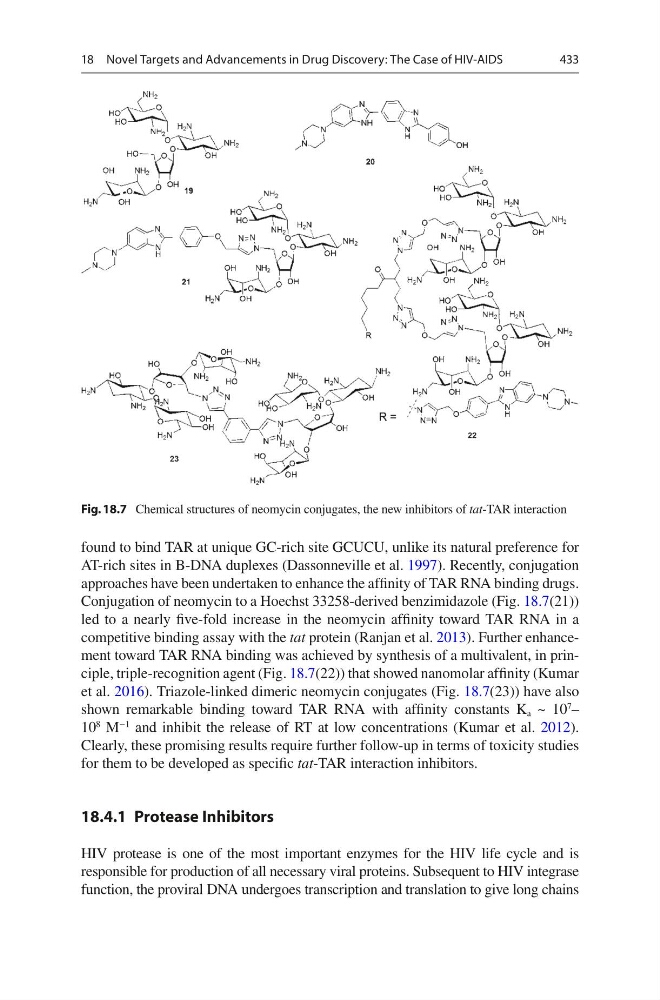
Conjugation of neomycin to a Hoechst 33258-derived benzimidazole (Fig. 18.7(21))
led to a nearly five-fold increase in the neomycin affinity toward TAR RNA in a
competitive binding assay with the tat protein (Ranjan et al. 2013). Further enhancement toward TAR RNA binding was achieved by synthesis of a multivalent, in principle, triple-recognition agent (Fig. 18.7(22)) that showed nanomolar affinity (Kumar
et al. 2016). Triazole-linked dimeric neomycin conjugates (Fig. 18.7(23)) have also
shown remarkable binding toward TAR RNA with affinity constants K a ~ 10
7
–
10
8
M
−1
and inhibit the release of RT at low concentrations (Kumar et al. 2012).
Clearly, these promising results require further follow- up in terms of toxicity studies
for them to be developed as specific tat-TAR interaction inhibitors.
18.4.1 Protease Inhibitors
HIV protease is one of the most important enzymes for the HIV life cycle and is
responsible for production of all necessary viral proteins. Subsequent to HIV integrase
function, the proviral DNA undergoes transcription and translation to give long chains
Fig. 18.7 Chemical structures of neomycin conjugates, the new inhibitors of tat-TAR interaction
18 Novel Targets and Advancements in Drug Discovery: The Case of HIV-AIDS
found to bind TAR at unique GC-rich site GCUCU, unlike its natural preference for
AT-rich sites in B-DNA duplexes (Dassonneville et al. 1997). Recently, conjugation
approaches have been undertaken to enhance the affinity of TAR RNA binding drugs.
Conjugation of neomycin to a Hoechst 33258-derived benzimidazole (Fig. 18.7(21))
led to a nearly five-fold increase in the neomycin affinity toward TAR RNA in a
competitive binding assay with the tat protein (Ranjan et al. 2013). Further enhancement toward TAR RNA binding was achieved by synthesis of a multivalent, in principle, triple-recognition agent (Fig. 18.7(22)) that showed nanomolar affinity (Kumar
et al. 2016). Triazole-linked dimeric neomycin conjugates (Fig. 18.7(23)) have also
shown remarkable binding toward TAR RNA with affinity constants K a ~ 10
7
–
10
8
M
−1
and inhibit the release of RT at low concentrations (Kumar et al. 2012).
Clearly, these promising results require further follow- up in terms of toxicity studies
for them to be developed as specific tat-TAR interaction inhibitors.
18.4.1 Protease Inhibitors
HIV protease is one of the most important enzymes for the HIV life cycle and is
responsible for production of all necessary viral proteins. Subsequent to HIV integrase
function, the proviral DNA undergoes transcription and translation to give long chains
Fig. 18.7 Chemical structures of neomycin conjugates, the new inhibitors of tat-TAR interaction
18 Novel Targets and Advancements in Drug Discovery: The Case of HIV-AIDS