

434
of proteins that contain Gag and Gag-Pol polyproteins. Protease cleaves the long polypeptides at nine processing sites to give mature active proteins eventually leading to
final digested products as new protease, RT (p51), RNAse H (p15), and integrase. Not
surprisingly, protease has been a central target of antiretroviral therapy.
The majority of FDA-approved anti-HIV drugs belong to the class of protease
inhibitors and have been an essential part of combination therapies. Despite the success of this class of retrovirus inhibitors, a number of efforts have been going on
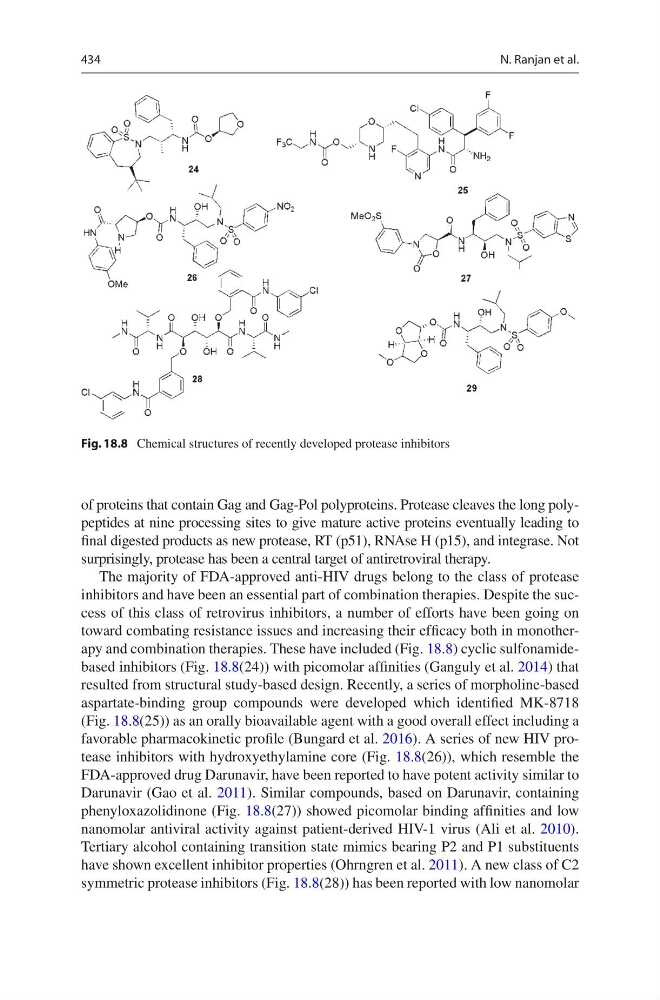
toward combating resistance issues and increasing their efficacy both in monotherapy and combination therapies. These have included (Fig. 18.8) cyclic sulfonamidebased inhibitors (Fig. 18.8(24)) with picomolar affinities (Ganguly et al. 2014) that
resulted from structural study-based design. Recently, a series of morpholine-based
aspartate-binding group compounds were developed which identified MK-8718
(Fig. 18.8(25)) as an orally bioavailable agent with a good overall effect including a
favorable pharmacokinetic profile (Bungard et al. 2016). A series of new HIV protease inhibitors with hydroxyethylamine core (Fig. 18.8(26)), which resemble the
FDA-approved drug Darunavir, have been reported to have potent activity similar to
Darunavir (Gao et al. 2011). Similar compounds, based on Darunavir, containing
phenyloxazolidinone (Fig. 18.8(27)) showed picomolar binding affinities and low
nanomolar antiviral activity against patient-derived HIV-1 virus (Ali et al. 2010).
Tertiary alcohol containing transition state mimics bearing P2 and P1 substituents
have shown excellent inhibitor properties (Ohrngren et al. 2011). A new class of C2
symmetric protease inhibitors (Fig. 18.8(28)) has been reported with low nanomolar
Fig. 18.8 Chemical structures of recently developed protease inhibitors
N. Ranjan et al.
of proteins that contain Gag and Gag-Pol polyproteins. Protease cleaves the long polypeptides at nine processing sites to give mature active proteins eventually leading to
final digested products as new protease, RT (p51), RNAse H (p15), and integrase. Not
surprisingly, protease has been a central target of antiretroviral therapy.
The majority of FDA-approved anti-HIV drugs belong to the class of protease
inhibitors and have been an essential part of combination therapies. Despite the success of this class of retrovirus inhibitors, a number of efforts have been going on
toward combating resistance issues and increasing their efficacy both in monotherapy and combination therapies. These have included (Fig. 18.8) cyclic sulfonamidebased inhibitors (Fig. 18.8(24)) with picomolar affinities (Ganguly et al. 2014) that
resulted from structural study-based design. Recently, a series of morpholine-based
aspartate-binding group compounds were developed which identified MK-8718
(Fig. 18.8(25)) as an orally bioavailable agent with a good overall effect including a
favorable pharmacokinetic profile (Bungard et al. 2016). A series of new HIV protease inhibitors with hydroxyethylamine core (Fig. 18.8(26)), which resemble the
FDA-approved drug Darunavir, have been reported to have potent activity similar to
Darunavir (Gao et al. 2011). Similar compounds, based on Darunavir, containing
phenyloxazolidinone (Fig. 18.8(27)) showed picomolar binding affinities and low
nanomolar antiviral activity against patient-derived HIV-1 virus (Ali et al. 2010).
Tertiary alcohol containing transition state mimics bearing P2 and P1 substituents
have shown excellent inhibitor properties (Ohrngren et al. 2011). A new class of C2
symmetric protease inhibitors (Fig. 18.8(28)) has been reported with low nanomolar
Fig. 18.8 Chemical structures of recently developed protease inhibitors
N. Ranjan et al.