

432
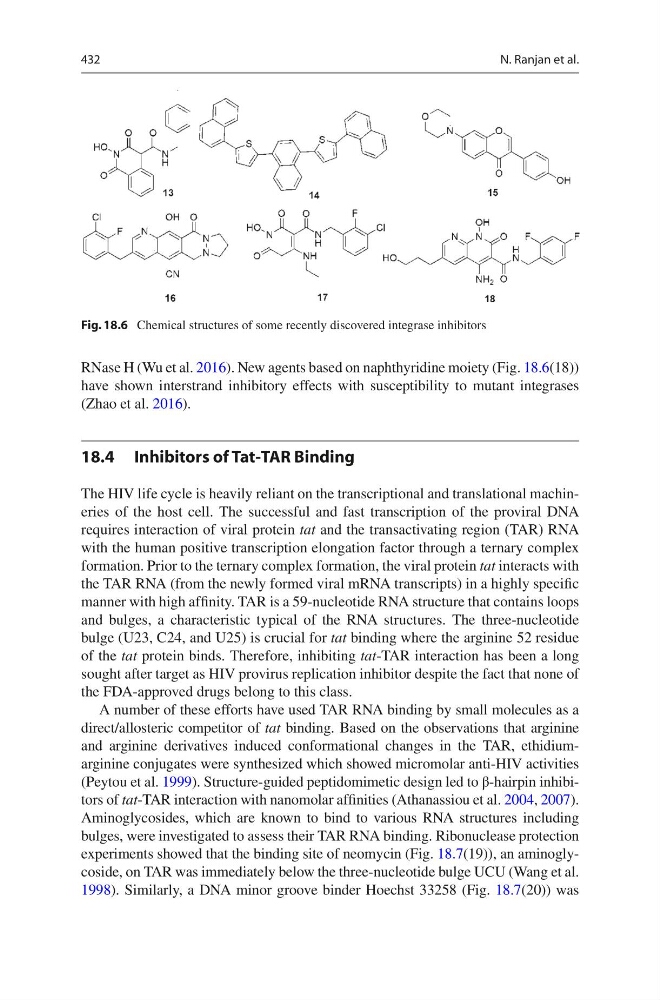
RNase H (Wu et al. 2016). New agents based on naphthyridine moiety (Fig. 18.6(18))
have shown interstrand inhibitory effects with susceptibility to mutant integrases
(Zhao et al. 2016).
18.4 Inhibitors of Tat-TAR Binding
The HIV life cycle is heavily reliant on the transcriptional and translational machineries of the host cell. The successful and fast transcription of the proviral DNA
requires interaction of viral protein tat and the transactivating region (TAR) RNA
with the human positive transcription elongation factor through a ternary complex
formation. Prior to the ternary complex formation, the viral protein tat interacts with
the TAR RNA (from the newly formed viral mRNA transcripts) in a highly specific
manner with high affinity. TAR is a 59-nucleotide RNA structure that contains loops
and bulges, a characteristic typical of the RNA structures. The three-nucleotide
bulge (U23, C24, and U25) is crucial for tat binding where the arginine 52 residue
of the tat protein binds. Therefore, inhibiting tat-TAR interaction has been a long
sought after target as HIV provirus replication inhibitor despite the fact that none of
the FDA-approved drugs belong to this class.
A number of these efforts have used TAR RNA binding by small molecules as a
direct/allosteric competitor of tat binding. Based on the observations that arginine
and arginine derivatives induced conformational changes in the TAR, ethidiumarginine conjugates were synthesized which showed micromolar anti-HIV activities
(Peytou et al. 1999). Structure-guided peptidomimetic design led to β-hairpin inhibitors of tat-TAR interaction with nanomolar affinities (Athanassiou et al. 2004, 2007).
Aminoglycosides, which are known to bind to various RNA structures including
bulges, were investigated to assess their TAR RNA binding. Ribonuclease protection
experiments showed that the binding site of neomycin (Fig. 18.7(19)), an aminoglycoside, on TAR was immediately below the three-nucleotide bulge UCU (Wang et al.
1998). Similarly, a DNA minor groove binder Hoechst 33258 (Fig. 18.7(20)) was
Fig. 18.6 Chemical structures of some recently discovered integrase inhibitors
N. Ranjan et al.
RNase H (Wu et al. 2016). New agents based on naphthyridine moiety (Fig. 18.6(18))
have shown interstrand inhibitory effects with susceptibility to mutant integrases
(Zhao et al. 2016).
18.4 Inhibitors of Tat-TAR Binding
The HIV life cycle is heavily reliant on the transcriptional and translational machineries of the host cell. The successful and fast transcription of the proviral DNA
requires interaction of viral protein tat and the transactivating region (TAR) RNA
with the human positive transcription elongation factor through a ternary complex
formation. Prior to the ternary complex formation, the viral protein tat interacts with
the TAR RNA (from the newly formed viral mRNA transcripts) in a highly specific
manner with high affinity. TAR is a 59-nucleotide RNA structure that contains loops
and bulges, a characteristic typical of the RNA structures. The three-nucleotide
bulge (U23, C24, and U25) is crucial for tat binding where the arginine 52 residue
of the tat protein binds. Therefore, inhibiting tat-TAR interaction has been a long
sought after target as HIV provirus replication inhibitor despite the fact that none of
the FDA-approved drugs belong to this class.
A number of these efforts have used TAR RNA binding by small molecules as a
direct/allosteric competitor of tat binding. Based on the observations that arginine
and arginine derivatives induced conformational changes in the TAR, ethidiumarginine conjugates were synthesized which showed micromolar anti-HIV activities
(Peytou et al. 1999). Structure-guided peptidomimetic design led to β-hairpin inhibitors of tat-TAR interaction with nanomolar affinities (Athanassiou et al. 2004, 2007).
Aminoglycosides, which are known to bind to various RNA structures including
bulges, were investigated to assess their TAR RNA binding. Ribonuclease protection
experiments showed that the binding site of neomycin (Fig. 18.7(19)), an aminoglycoside, on TAR was immediately below the three-nucleotide bulge UCU (Wang et al.
1998). Similarly, a DNA minor groove binder Hoechst 33258 (Fig. 18.7(20)) was
Fig. 18.6 Chemical structures of some recently discovered integrase inhibitors
N. Ranjan et al.