

431
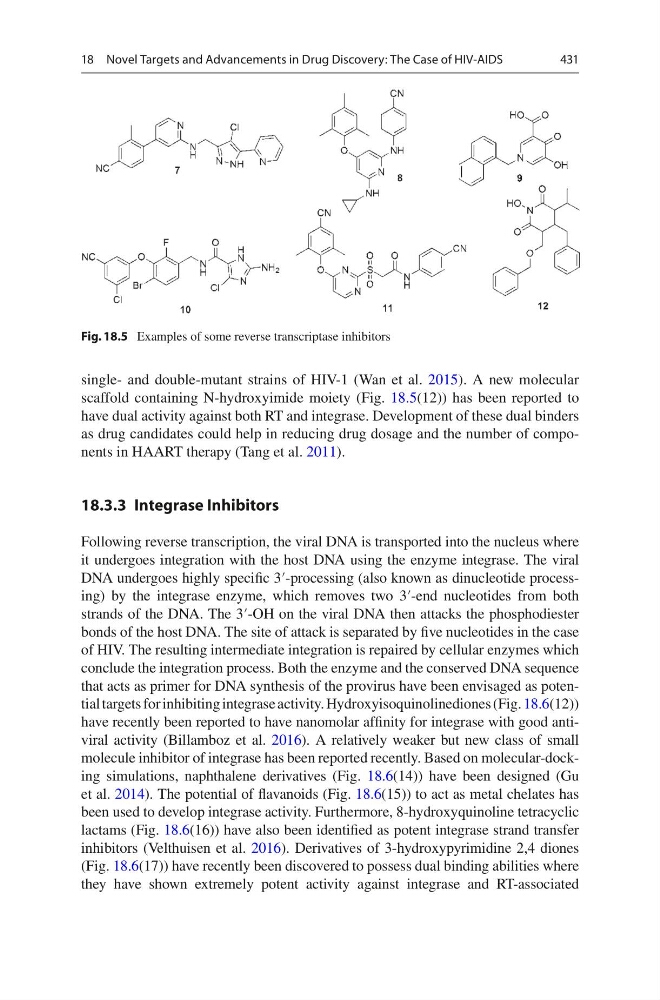
single- and double-mutant strains of HIV-1 (Wan et al. 2015). A new molecular
scaffold containing N-hydroxyimide moiety (Fig. 18.5(12)) has been reported to
have dual activity against both RT and integrase. Development of these dual binders
as drug candidates could help in reducing drug dosage and the number of components in HAART therapy (Tang et al. 2011).
18.3.3 Integrase Inhibitors
Following reverse transcription, the viral DNA is transported into the nucleus where
it undergoes integration with the host DNA using the enzyme integrase. The viral
DNA undergoes highly specific 3′-processing (also known as dinucleotide processing) by the integrase enzyme, which removes two 3′-end nucleotides from both
strands of the DNA. The 3′-OH on the viral DNA then attacks the phosphodiester
bonds of the host DNA. The site of attack is separated by five nucleotides in the case
of HIV. The resulting intermediate integration is repaired by cellular enzymes which
conclude the integration process. Both the enzyme and the conserved DNA sequence
that acts as primer for DNA synthesis of the provirus have been envisaged as potential targets for inhibiting integrase activity. Hydroxyisoquinolinediones (Fig. 18.6(12))
have recently been reported to have nanomolar affinity for integrase with good antiviral activity (Billamboz et al. 2016). A relatively weaker but new class of small
molecule inhibitor of integrase has been reported recently. Based on molecular-docking simulations, naphthalene derivatives (Fig. 18.6(14)) have been designed (Gu
et al. 2014). The potential of flavanoids (Fig. 18.6(15)) to act as metal chelates has
been used to develop integrase activity. Furthermore, 8- hydroxyquinoline tetracyclic
lactams (Fig. 18.6(16)) have also been identified as potent integrase strand transfer
inhibitors (Velthuisen et al. 2016). Derivatives of 3- hydroxypyrimidine 2,4 diones
(Fig. 18.6(17)) have recently been discovered to possess dual binding abilities where
they have shown extremely potent activity against integrase and RT-associated
Fig. 18.5 Examples of some reverse transcriptase inhibitors
18 Novel Targets and Advancements in Drug Discovery: The Case of HIV-AIDS
single- and double-mutant strains of HIV-1 (Wan et al. 2015). A new molecular
scaffold containing N-hydroxyimide moiety (Fig. 18.5(12)) has been reported to
have dual activity against both RT and integrase. Development of these dual binders
as drug candidates could help in reducing drug dosage and the number of components in HAART therapy (Tang et al. 2011).
18.3.3 Integrase Inhibitors
Following reverse transcription, the viral DNA is transported into the nucleus where
it undergoes integration with the host DNA using the enzyme integrase. The viral
DNA undergoes highly specific 3′-processing (also known as dinucleotide processing) by the integrase enzyme, which removes two 3′-end nucleotides from both
strands of the DNA. The 3′-OH on the viral DNA then attacks the phosphodiester
bonds of the host DNA. The site of attack is separated by five nucleotides in the case
of HIV. The resulting intermediate integration is repaired by cellular enzymes which
conclude the integration process. Both the enzyme and the conserved DNA sequence
that acts as primer for DNA synthesis of the provirus have been envisaged as potential targets for inhibiting integrase activity. Hydroxyisoquinolinediones (Fig. 18.6(12))
have recently been reported to have nanomolar affinity for integrase with good antiviral activity (Billamboz et al. 2016). A relatively weaker but new class of small
molecule inhibitor of integrase has been reported recently. Based on molecular-docking simulations, naphthalene derivatives (Fig. 18.6(14)) have been designed (Gu
et al. 2014). The potential of flavanoids (Fig. 18.6(15)) to act as metal chelates has
been used to develop integrase activity. Furthermore, 8- hydroxyquinoline tetracyclic
lactams (Fig. 18.6(16)) have also been identified as potent integrase strand transfer
inhibitors (Velthuisen et al. 2016). Derivatives of 3- hydroxypyrimidine 2,4 diones
(Fig. 18.6(17)) have recently been discovered to possess dual binding abilities where
they have shown extremely potent activity against integrase and RT-associated
Fig. 18.5 Examples of some reverse transcriptase inhibitors
18 Novel Targets and Advancements in Drug Discovery: The Case of HIV-AIDS