

421
Despite the advancement in the techniques involved in genetics, proteomics, and
high-throughput screening, there hasn’t been any increase in the rate of NCEs gaining marketing approval. Therefore, there are increasing concerns about the viability
of the current model of drug development (Munos 2009). The pharmaceutical
industry is looking for new biological targets and innovative ways of generating
NCEs and novel pharmacotherapy. One of the key steps in developing a new drug is
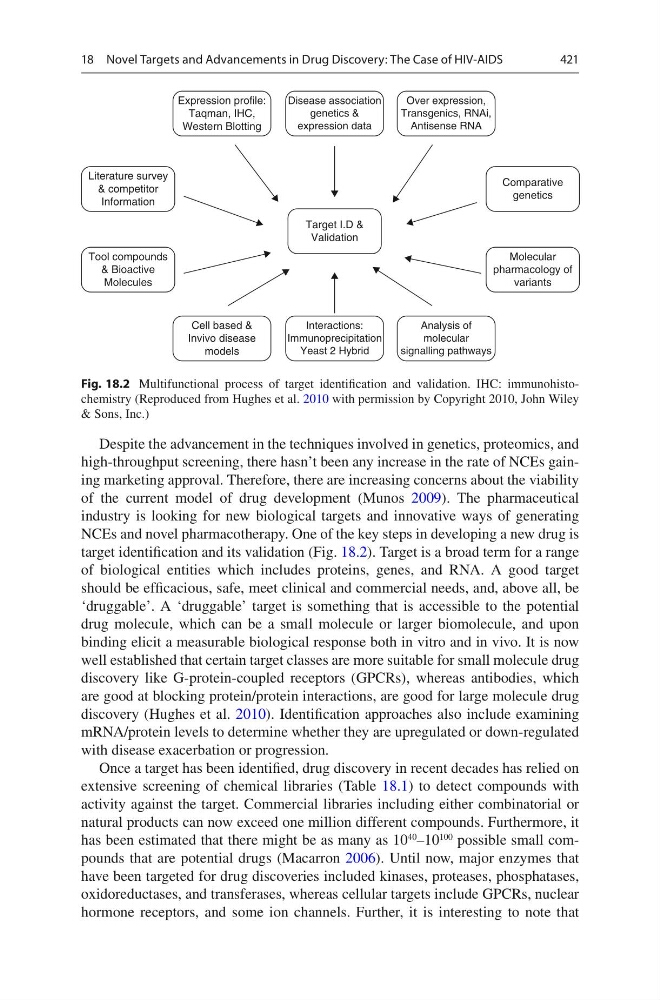
target identification and its validation (Fig. 18.2). Target is a broad term for a range
of biological entities which includes proteins, genes, and RNA. A good target
should be efficacious, safe, meet clinical and commercial needs, and, above all, be
‘druggable’. A ‘druggable’ target is something that is accessible to the potential
drug molecule, which can be a small molecule or larger biomolecule, and upon
binding elicit a measurable biological response both in vitro and in vivo. It is now
well established that certain target classes are more suitable for small molecule drug
discovery like G-protein-coupled receptors (GPCRs), whereas antibodies, which
are good at blocking protein/protein interactions, are good for large molecule drug
discovery (Hughes et al. 2010). Identification approaches also include examining
mRNA/protein levels to determine whether they are upregulated or down-regulated
with disease exacerbation or progression.
Once a target has been identified, drug discovery in recent decades has relied on
extensive screening of chemical libraries (Table 18.1) to detect compounds with
activity against the target. Commercial libraries including either combinatorial or
natural products can now exceed one million different compounds. Furthermore, it
has been estimated that there might be as many as 10
40
–10
100
possible small compounds that are potential drugs (Macarron 2006). Until now, major enzymes that
have been targeted for drug discoveries included kinases, proteases, phosphatases,
oxidoreductases, and transferases, whereas cellular targets include GPCRs, nuclear
hormone receptors, and some ion channels. Further, it is interesting to note that
Expression profile:
Taqman, IHC,
Western Blotting
Cell based &
Invivo disease
models
Interactions:
Immunoprecipitation
Yeast 2 Hybrid
Analysis of
molecular
signalling pathways
Literature survey
& competitor
Information
Comparative
genetics
Molecular
pharmacology of
variants
Tool compounds
& Bioactive
Molecules
Disease association
genetics &
expression data
Target I.D &
Validation
Over expression,
Transgenics, RNAi,
Antisense RNA
Fig. 18.2 Multifunctional process of target identification and validation. IHC: immunohistochemistry (Reproduced from Hughes et al. 2010 with permission by Copyright 2010, John Wiley
& Sons, Inc.)
18 Novel Targets and Advancements in Drug Discovery: The Case of HIV-AIDS
Despite the advancement in the techniques involved in genetics, proteomics, and
high-throughput screening, there hasn’t been any increase in the rate of NCEs gaining marketing approval. Therefore, there are increasing concerns about the viability
of the current model of drug development (Munos 2009). The pharmaceutical
industry is looking for new biological targets and innovative ways of generating
NCEs and novel pharmacotherapy. One of the key steps in developing a new drug is
target identification and its validation (Fig. 18.2). Target is a broad term for a range
of biological entities which includes proteins, genes, and RNA. A good target
should be efficacious, safe, meet clinical and commercial needs, and, above all, be
‘druggable’. A ‘druggable’ target is something that is accessible to the potential
drug molecule, which can be a small molecule or larger biomolecule, and upon
binding elicit a measurable biological response both in vitro and in vivo. It is now
well established that certain target classes are more suitable for small molecule drug
discovery like G-protein-coupled receptors (GPCRs), whereas antibodies, which
are good at blocking protein/protein interactions, are good for large molecule drug
discovery (Hughes et al. 2010). Identification approaches also include examining
mRNA/protein levels to determine whether they are upregulated or down-regulated
with disease exacerbation or progression.
Once a target has been identified, drug discovery in recent decades has relied on
extensive screening of chemical libraries (Table 18.1) to detect compounds with
activity against the target. Commercial libraries including either combinatorial or
natural products can now exceed one million different compounds. Furthermore, it
has been estimated that there might be as many as 10
40
–10
100
possible small compounds that are potential drugs (Macarron 2006). Until now, major enzymes that
have been targeted for drug discoveries included kinases, proteases, phosphatases,
oxidoreductases, and transferases, whereas cellular targets include GPCRs, nuclear
hormone receptors, and some ion channels. Further, it is interesting to note that
Expression profile:
Taqman, IHC,
Western Blotting
Cell based &
Invivo disease
models
Interactions:
Immunoprecipitation
Yeast 2 Hybrid
Analysis of
molecular
signalling pathways
Literature survey
& competitor
Information
Comparative
genetics
Molecular
pharmacology of
variants
Tool compounds
& Bioactive
Molecules
Disease association
genetics &
expression data
Target I.D &
Validation
Over expression,
Transgenics, RNAi,
Antisense RNA
Fig. 18.2 Multifunctional process of target identification and validation. IHC: immunohistochemistry (Reproduced from Hughes et al. 2010 with permission by Copyright 2010, John Wiley
& Sons, Inc.)
18 Novel Targets and Advancements in Drug Discovery: The Case of HIV-AIDS