

422
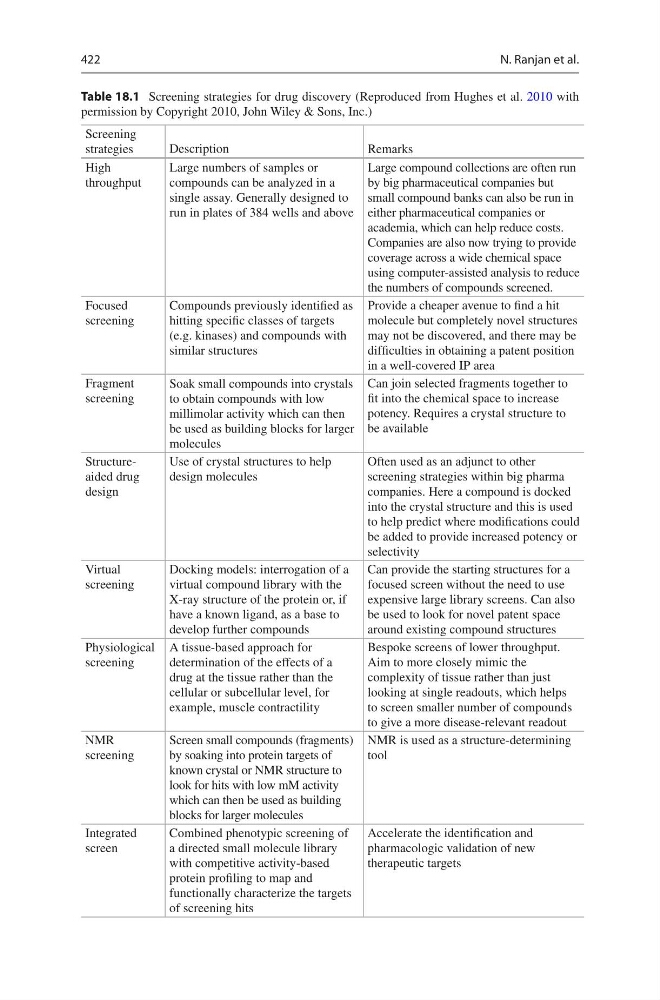
Table 18.1 Screening strategies for drug discovery (Reproduced from Hughes et al. 2010 with
permission by Copyright 2010, John Wiley & Sons, Inc.)
Screening
strategies
Description
Remarks
High
throughput
Large numbers of samples or
compounds can be analyzed in a
single assay. Generally designed to
run in plates of 384 wells and above
Large compound collections are often run
by big pharmaceutical companies but
small compound banks can also be run in
either pharmaceutical companies or
academia, which can help reduce costs.
Companies are also now trying to provide
coverage across a wide chemical space
using computer-assisted analysis to reduce
the numbers of compounds screened.
Focused
screening
Compounds previously identified as
hitting specific classes of targets
(e.g. kinases) and compounds with
similar structures
Provide a cheaper avenue to find a hit
molecule but completely novel structures
may not be discovered, and there may be
difficulties in obtaining a patent position
in a well-covered IP area
Fragment
screening
Soak small compounds into crystals
to obtain compounds with low
millimolar activity which can then
be used as building blocks for larger
molecules
Can join selected fragments together to
fit into the chemical space to increase
potency. Requires a crystal structure to
be available
Structureaided drug
design
Use of crystal structures to help
design molecules
Often used as an adjunct to other
screening strategies within big pharma
companies. Here a compound is docked
into the crystal structure and this is used
to help predict where modifications could
be added to provide increased potency or
selectivity
Virtual
screening
Docking models: interrogation of a
virtual compound library with the
X-ray structure of the protein or, if
have a known ligand, as a base to
develop further compounds
Can provide the starting structures for a
focused screen without the need to use
expensive large library screens. Can also
be used to look for novel patent space
around existing compound structures
Physiological
screening
A tissue-based approach for
determination of the effects of a
drug at the tissue rather than the
cellular or subcellular level, for
example, muscle contractility
Bespoke screens of lower throughput.
Aim to more closely mimic the
complexity of tissue rather than just
looking at single readouts, which helps
to screen smaller number of compounds
to give a more disease-relevant readout
NMR
screening
Screen small compounds (fragments)
by soaking into protein targets of
known crystal or NMR structure to
look for hits with low mM activity
which can then be used as building
blocks for larger molecules
NMR is used as a structure-determining
tool
Integrated
screen
Combined phenotypic screening of
a directed small molecule library
with competitive activity-based
protein profiling to map and
functionally characterize the targets
of screening hits
Accelerate the identification and
pharmacologic validation of new
therapeutic targets
N. Ranjan et al.
Table 18.1 Screening strategies for drug discovery (Reproduced from Hughes et al. 2010 with
permission by Copyright 2010, John Wiley & Sons, Inc.)
Screening
strategies
Description
Remarks
High
throughput
Large numbers of samples or
compounds can be analyzed in a
single assay. Generally designed to
run in plates of 384 wells and above
Large compound collections are often run
by big pharmaceutical companies but
small compound banks can also be run in
either pharmaceutical companies or
academia, which can help reduce costs.
Companies are also now trying to provide
coverage across a wide chemical space
using computer-assisted analysis to reduce
the numbers of compounds screened.
Focused
screening
Compounds previously identified as
hitting specific classes of targets
(e.g. kinases) and compounds with
similar structures
Provide a cheaper avenue to find a hit
molecule but completely novel structures
may not be discovered, and there may be
difficulties in obtaining a patent position
in a well-covered IP area
Fragment
screening
Soak small compounds into crystals
to obtain compounds with low
millimolar activity which can then
be used as building blocks for larger
molecules
Can join selected fragments together to
fit into the chemical space to increase
potency. Requires a crystal structure to
be available
Structureaided drug
design
Use of crystal structures to help
design molecules
Often used as an adjunct to other
screening strategies within big pharma
companies. Here a compound is docked
into the crystal structure and this is used
to help predict where modifications could
be added to provide increased potency or
selectivity
Virtual
screening
Docking models: interrogation of a
virtual compound library with the
X-ray structure of the protein or, if
have a known ligand, as a base to
develop further compounds
Can provide the starting structures for a
focused screen without the need to use
expensive large library screens. Can also
be used to look for novel patent space
around existing compound structures
Physiological
screening
A tissue-based approach for
determination of the effects of a
drug at the tissue rather than the
cellular or subcellular level, for
example, muscle contractility
Bespoke screens of lower throughput.
Aim to more closely mimic the
complexity of tissue rather than just
looking at single readouts, which helps
to screen smaller number of compounds
to give a more disease-relevant readout
NMR
screening
Screen small compounds (fragments)
by soaking into protein targets of
known crystal or NMR structure to
look for hits with low mM activity
which can then be used as building
blocks for larger molecules
NMR is used as a structure-determining
tool
Integrated
screen
Combined phenotypic screening of
a directed small molecule library
with competitive activity-based
protein profiling to map and
functionally characterize the targets
of screening hits
Accelerate the identification and
pharmacologic validation of new
therapeutic targets
N. Ranjan et al.