

420
18.1 Introduction
18.1.1 Current State of HIV-AIDS
Despite the decline in the number of new HIV-infected population globally in recent
years, HIV-AIDS remains one of the leading causes of disease-related death.
According to the latest UNAIDS data (UNAIDS 2016), 36.7 million people are currently living with HIV-AIDS worldwide. In 2015, 1.1 million people died from AIDS
related illness and 2.1 million new HIV infections have been reported. Several awareness efforts and regulatory practices have led to many positive outcomes that augur
well for significant control over HIV spread in the coming decade. However, success
of all concerted AIDS control efforts is centrally linked to therapeutic control of the
HIV virus using multifaceted drug combinations. These drug combinations have consequentially helped to increase the life span of HIV-infected population, arresting the
viral proliferation for several years and curbing the viral growth to nondetectable levels. Introduction of new and more potent drugs by the Food and Drug Administration
(FDA) in recent years that bind to new HIV targets has greatly boosted the available
therapeutic arsenal, albeit these inclusions have been simultaneously countered with
viral mutations leading to ineffectiveness of few clinically used drugs. Therefore, drug
design efforts that target new sites to stop viral function and growth are needed to augment currently used multidrug combination therapy.
18.1.2 Target Identification and Drug Discovery Process
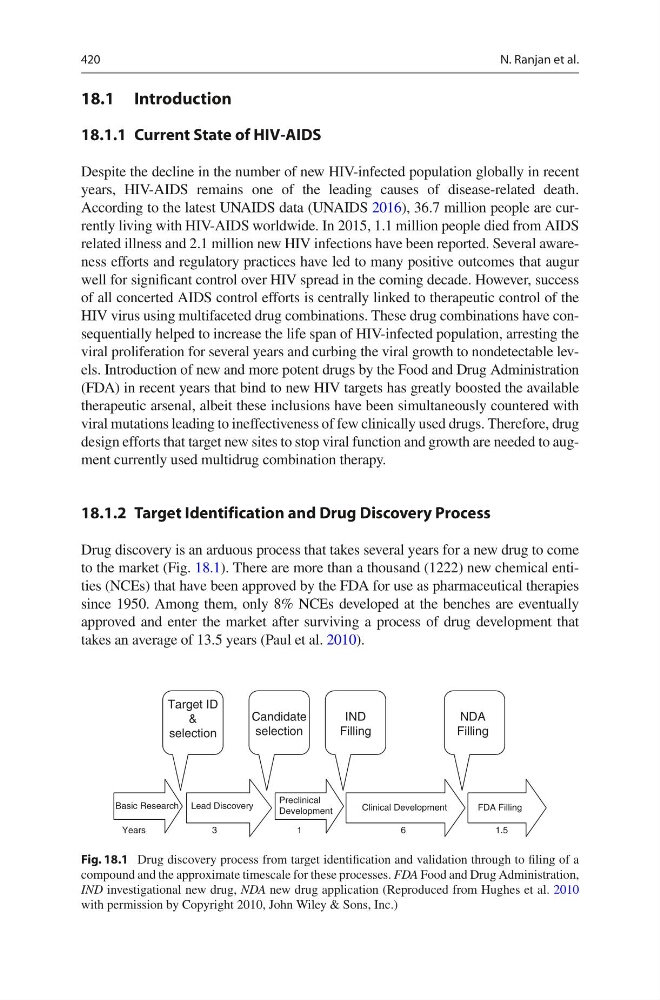
Drug discovery is an arduous process that takes several years for a new drug to come
to the market (Fig. 18.1). There are more than a thousand (1222) new chemical entities (NCEs) that have been approved by the FDA for use as pharmaceutical therapies
since 1950. Among them, only 8% NCEs developed at the benches are eventually
approved and enter the market after surviving a process of drug development that
takes an average of 13.5 years (Paul et al. 2010).
Target ID
&
selection
Basic Research
Years
3
1
6
1 .5
Lead Discovery
Preclinical
Development
Clinical Development
F DA Filling
Candidate
selection
IND
Filling
NDA
Filling
Fig. 18.1 Drug discovery process from target identification and validation through to filing of a
compound and the approximate timescale for these processes. FDA Food and Drug Administration,
IND investigational new drug, NDA new drug application (Reproduced from Hughes et al. 2010
with permission by Copyright 2010, John Wiley & Sons, Inc.)
N. Ranjan et al.
18.1 Introduction
18.1.1 Current State of HIV-AIDS
Despite the decline in the number of new HIV-infected population globally in recent
years, HIV-AIDS remains one of the leading causes of disease-related death.
According to the latest UNAIDS data (UNAIDS 2016), 36.7 million people are currently living with HIV-AIDS worldwide. In 2015, 1.1 million people died from AIDS
related illness and 2.1 million new HIV infections have been reported. Several awareness efforts and regulatory practices have led to many positive outcomes that augur
well for significant control over HIV spread in the coming decade. However, success
of all concerted AIDS control efforts is centrally linked to therapeutic control of the
HIV virus using multifaceted drug combinations. These drug combinations have consequentially helped to increase the life span of HIV-infected population, arresting the
viral proliferation for several years and curbing the viral growth to nondetectable levels. Introduction of new and more potent drugs by the Food and Drug Administration
(FDA) in recent years that bind to new HIV targets has greatly boosted the available
therapeutic arsenal, albeit these inclusions have been simultaneously countered with
viral mutations leading to ineffectiveness of few clinically used drugs. Therefore, drug
design efforts that target new sites to stop viral function and growth are needed to augment currently used multidrug combination therapy.
18.1.2 Target Identification and Drug Discovery Process
Drug discovery is an arduous process that takes several years for a new drug to come
to the market (Fig. 18.1). There are more than a thousand (1222) new chemical entities (NCEs) that have been approved by the FDA for use as pharmaceutical therapies
since 1950. Among them, only 8% NCEs developed at the benches are eventually
approved and enter the market after surviving a process of drug development that
takes an average of 13.5 years (Paul et al. 2010).
Target ID
&
selection
Basic Research
Years
3
1
6
1 .5
Lead Discovery
Preclinical
Development
Clinical Development
F DA Filling
Candidate
selection
IND
Filling
NDA
Filling
Fig. 18.1 Drug discovery process from target identification and validation through to filing of a
compound and the approximate timescale for these processes. FDA Food and Drug Administration,
IND investigational new drug, NDA new drug application (Reproduced from Hughes et al. 2010
with permission by Copyright 2010, John Wiley & Sons, Inc.)
N. Ranjan et al.