

148
High Fructose Syrups Production of high-fructose glucose syrups, by glucose
isomerase, was one of the earliest biotransformation processes done by immobilized enzyme technology, and it has been operating now since 1972. It is used in the
soft drinks and confectionary industries as it has health advantages over the conventional sugar, sucrose, i.e. fructose is twice as sweet, lower in calories and not
absorbed into the bloodstream as quickly as sucrose (Collins and Kennedy 1999).
Antibiotics Many antibiotics synthesized from their precursors are produced by the
biotransformation process catalysed by the respective enzymes. Some examples
include semi-synthetic penicillin produced from its precursor 6-amino-penicillanic
acid. This is done by using the immobilized penicillin acylase (amidase), which has
been operational since 1973.
Vitamins From the economic point of view, microbial biotransformations are
widely used to produce vitamin B 12 , riboflavin, ascorbic acid and p-carotene. For
example, oxidation of sorbitol by Acetobacter suboxydans or Acetobacter xylinum
yields ascorbic acid (vitamin C).
D-Glucose D-Sorbitol L-Sorbose L-Ascorbic acid vitamin C
®
®
®
(
) .
Ac cetobacter suboxydans
Flavours and Fragrances The role of biotransformation technologies in the flavours and fragrances industry is becoming more prominent for its ability to produce
single enantiomers. For example, the (l) enantiomer of carvone tastes of spearmint,
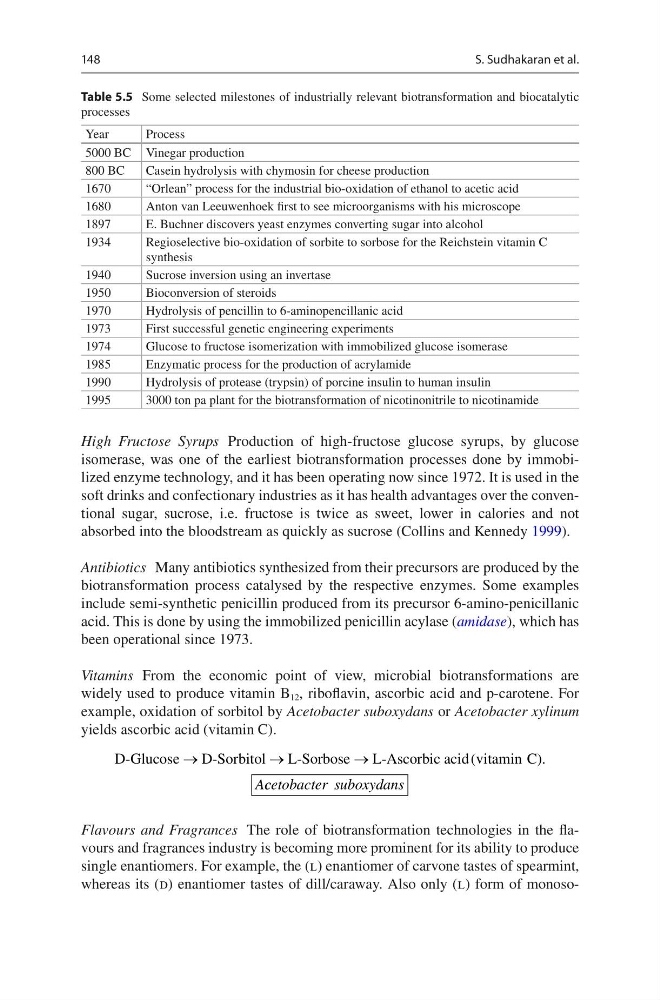
whereas its (d) enantiomer tastes of dill/caraway. Also only (l) form of monosoTable 5.5 Some selected milestones of industrially relevant biotransformation and biocatalytic
processes
Year
Process
5000 BC Vinegar production
800 BC
Casein hydrolysis with chymosin for cheese production
1670
“Orlean” process for the industrial bio-oxidation of ethanol to acetic acid
1680
Anton van Leeuwenhoek first to see microorganisms with his microscope
1897
E. Buchner discovers yeast enzymes converting sugar into alcohol
1934
Regioselective bio-oxidation of sorbite to sorbose for the Reichstein vitamin C
synthesis
1940
Sucrose inversion using an invertase
1950
Bioconversion of steroids
1970
Hydrolysis of pencillin to 6-aminopencillanic acid
1973
First successful genetic engineering experiments
1974
Glucose to fructose isomerization with immobilized glucose isomerase
1985
Enzymatic process for the production of acrylamide
1990
Hydrolysis of protease (trypsin) of porcine insulin to human insulin
1995
3000 ton pa plant for the biotransformation of nicotinonitrile to nicotinamide
S. Sudhakaran et al.
High Fructose Syrups Production of high-fructose glucose syrups, by glucose
isomerase, was one of the earliest biotransformation processes done by immobilized enzyme technology, and it has been operating now since 1972. It is used in the
soft drinks and confectionary industries as it has health advantages over the conventional sugar, sucrose, i.e. fructose is twice as sweet, lower in calories and not
absorbed into the bloodstream as quickly as sucrose (Collins and Kennedy 1999).
Antibiotics Many antibiotics synthesized from their precursors are produced by the
biotransformation process catalysed by the respective enzymes. Some examples
include semi-synthetic penicillin produced from its precursor 6-amino-penicillanic
acid. This is done by using the immobilized penicillin acylase (amidase), which has
been operational since 1973.
Vitamins From the economic point of view, microbial biotransformations are
widely used to produce vitamin B 12 , riboflavin, ascorbic acid and p-carotene. For
example, oxidation of sorbitol by Acetobacter suboxydans or Acetobacter xylinum
yields ascorbic acid (vitamin C).
D-Glucose D-Sorbitol L-Sorbose L-Ascorbic acid vitamin C
®
®
®
(
) .
Ac cetobacter suboxydans
Flavours and Fragrances The role of biotransformation technologies in the flavours and fragrances industry is becoming more prominent for its ability to produce
single enantiomers. For example, the (l) enantiomer of carvone tastes of spearmint,
whereas its (d) enantiomer tastes of dill/caraway. Also only (l) form of monosoTable 5.5 Some selected milestones of industrially relevant biotransformation and biocatalytic
processes
Year
Process
5000 BC Vinegar production
800 BC
Casein hydrolysis with chymosin for cheese production
1670
“Orlean” process for the industrial bio-oxidation of ethanol to acetic acid
1680
Anton van Leeuwenhoek first to see microorganisms with his microscope
1897
E. Buchner discovers yeast enzymes converting sugar into alcohol
1934
Regioselective bio-oxidation of sorbite to sorbose for the Reichstein vitamin C
synthesis
1940
Sucrose inversion using an invertase
1950
Bioconversion of steroids
1970
Hydrolysis of pencillin to 6-aminopencillanic acid
1973
First successful genetic engineering experiments
1974
Glucose to fructose isomerization with immobilized glucose isomerase
1985
Enzymatic process for the production of acrylamide
1990
Hydrolysis of protease (trypsin) of porcine insulin to human insulin
1995
3000 ton pa plant for the biotransformation of nicotinonitrile to nicotinamide
S. Sudhakaran et al.