

136
Xanthine Dehydrogenase–Xanthine Oxidase Xanthine dehydrogenase (XD) and
xanthine oxidase (XO) are two forms of the same enzyme that differ in the electron
acceptor used in the final step of catalysis. In the case of XD, the final electron
acceptor is NAD
+
(dehydrogenase activity), whereas in the case of XO it is oxygen
(oxidase activity). XD is converted to XO by reversible oxidation of cysteine residues (Cys993 and Cys1326 of the human enzyme) and/or by proteolytic cleavage.
Under normal physiologic conditions, XD is the predominant form of the enzyme
found in vivo (Parkinson et al. 2013). However, during tissue processing, XO or a
combination of XO and XD is involved. The induction of XD and/or the conversion
of XD to XO in vivo are thought to play a crucial role in ischemia-reperfusion
injury, lip polysaccharide (LPS)-mediated tissue injury, and alcohol-induced hepatotoxicity. During ischemia, XO levels increase because hypoxia induces XD/XO
gene transcription and because XD is converted to XO. During reperfusion, XO
contributes to oxidative stress and lipid peroxidation because the oxidase activity of
XO involves the reduction of molecular oxygen, which results in the generation of
reactive oxygen species.
5.2.2 Hydrolytic Enzymes
Primary hydrolytic enzymes are carboxylesterases, peptidases and epoxide hydrolase. Other enzymes are cholinesterases and paraoxonases. Hydrolysis involves
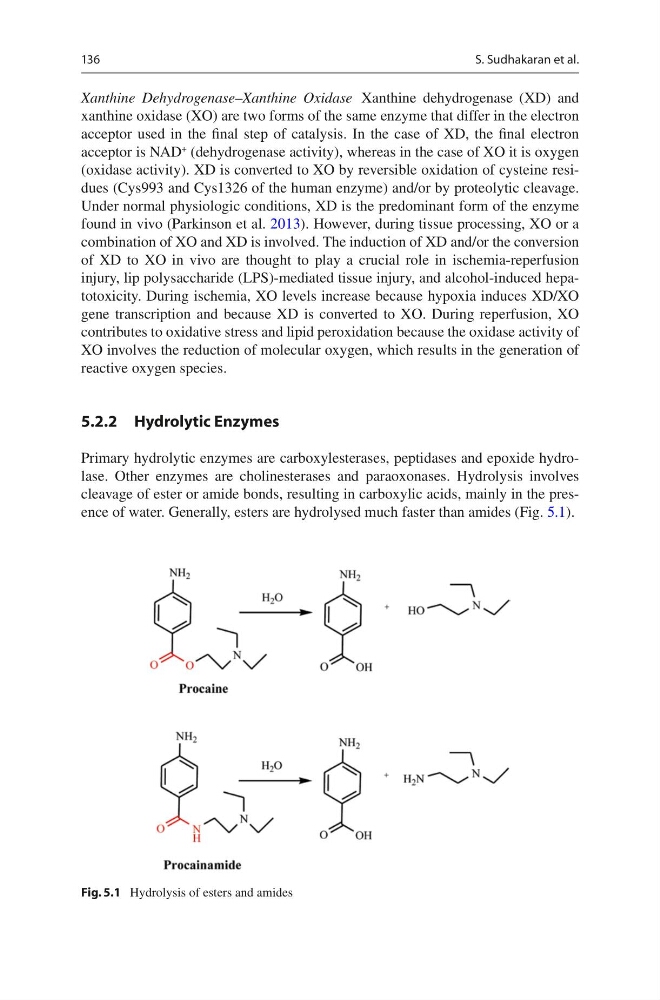
cleavage of ester or amide bonds, resulting in carboxylic acids, mainly in the presence of water. Generally, esters are hydrolysed much faster than amides (Fig. 5.1).
Fig. 5.1 Hydrolysis of esters and amides
S. Sudhakaran et al.
Xanthine Dehydrogenase–Xanthine Oxidase Xanthine dehydrogenase (XD) and
xanthine oxidase (XO) are two forms of the same enzyme that differ in the electron
acceptor used in the final step of catalysis. In the case of XD, the final electron
acceptor is NAD
+
(dehydrogenase activity), whereas in the case of XO it is oxygen
(oxidase activity). XD is converted to XO by reversible oxidation of cysteine residues (Cys993 and Cys1326 of the human enzyme) and/or by proteolytic cleavage.
Under normal physiologic conditions, XD is the predominant form of the enzyme
found in vivo (Parkinson et al. 2013). However, during tissue processing, XO or a
combination of XO and XD is involved. The induction of XD and/or the conversion
of XD to XO in vivo are thought to play a crucial role in ischemia-reperfusion
injury, lip polysaccharide (LPS)-mediated tissue injury, and alcohol-induced hepatotoxicity. During ischemia, XO levels increase because hypoxia induces XD/XO
gene transcription and because XD is converted to XO. During reperfusion, XO
contributes to oxidative stress and lipid peroxidation because the oxidase activity of
XO involves the reduction of molecular oxygen, which results in the generation of
reactive oxygen species.
5.2.2 Hydrolytic Enzymes
Primary hydrolytic enzymes are carboxylesterases, peptidases and epoxide hydrolase. Other enzymes are cholinesterases and paraoxonases. Hydrolysis involves
cleavage of ester or amide bonds, resulting in carboxylic acids, mainly in the presence of water. Generally, esters are hydrolysed much faster than amides (Fig. 5.1).
Fig. 5.1 Hydrolysis of esters and amides
S. Sudhakaran et al.