

135
enzyme involved in the S-oxygenation of cimetidine, an H 2 -antagonist widely used
in the treatment of gastric ulcers and other acid-related disorders.
Monoamine Oxidase, Diamine Oxidase and Polyamine Oxidase Monoamine oxidase (MAO), diamine oxidase (DAO) and polyamine oxidase (PAO) – all these
three enzymes are principally involved in the oxidative deamination of primary,
secondary and tertiary amines. Many of the naturally occurring amines, such as the
monoamine serotonin (5-hydroxytryptamine), the diamine putrescine and histamine, and monoacetylated derivatives of the polyamines spermine and spermidine
form the substrate for these enzymes. Of the three enzymes, MAO is particularly
involved in xenobiotic metabolism. Oxidative deamination of a primary amine produces ammonia and an aldehyde, whereas oxidative deamination of a secondary
amine produces a primary amine and an aldehyde. The products of the former reaction, an aldehyde and ammonia, are those produced during the reductive biotransformation of certain oximes by aldehyde oxidase. The two forms of monoamine
oxidase are MAO-A and MAO-B. The genetical information suggests that the genes
coding MAO-A and -B are of common ancestral origin but encoded by two distinct
genes, both localized on the X chromosome and both comprising 15 exons with a
similar intron–exon organization. The amino acid sequence of MAO-A (Mr 59.7
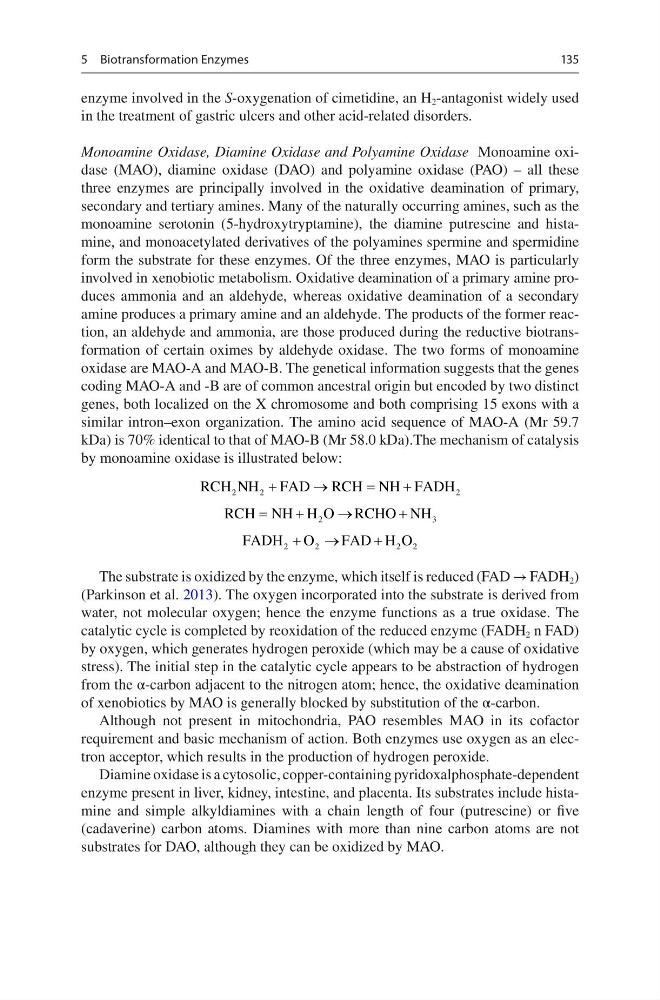
kDa) is 70% identical to that of MAO-B (Mr 58.0 kDa).The mechanism of catalysis
by monoamine oxidase is illustrated below:
RCH NH FAD RCH NH FADH
2
2
2
+
®
=
+
RCH NH H O RCHO NH
=
+
®
+
2
3
FADH O
FAD H O
2
2
2 2
+
®
+
The substrate is oxidized by the enzyme, which itself is reduced (FAD → FADH 2 )
(Parkinson et al. 2013). The oxygen incorporated into the substrate is derived from
water, not molecular oxygen; hence the enzyme functions as a true oxidase. The
catalytic cycle is completed by reoxidation of the reduced enzyme (FADH 2 n FAD)
by oxygen, which generates hydrogen peroxide (which may be a cause of oxidative
stress). The initial step in the catalytic cycle appears to be abstraction of hydrogen
from the α-carbon adjacent to the nitrogen atom; hence, the oxidative deamination
of xenobiotics by MAO is generally blocked by substitution of the α-carbon.
Although not present in mitochondria, PAO resembles MAO in its cofactor
requirement and basic mechanism of action. Both enzymes use oxygen as an electron acceptor, which results in the production of hydrogen peroxide.
Diamine oxidase is a cytosolic, copper-containing pyridoxalphosphate- dependent
enzyme present in liver, kidney, intestine, and placenta. Its substrates include histamine and simple alkyldiamines with a chain length of four (putrescine) or five
(cadaverine) carbon atoms. Diamines with more than nine carbon atoms are not
substrates for DAO, although they can be oxidized by MAO.
5 Biotransformation Enzymes
enzyme involved in the S-oxygenation of cimetidine, an H 2 -antagonist widely used
in the treatment of gastric ulcers and other acid-related disorders.
Monoamine Oxidase, Diamine Oxidase and Polyamine Oxidase Monoamine oxidase (MAO), diamine oxidase (DAO) and polyamine oxidase (PAO) – all these
three enzymes are principally involved in the oxidative deamination of primary,
secondary and tertiary amines. Many of the naturally occurring amines, such as the
monoamine serotonin (5-hydroxytryptamine), the diamine putrescine and histamine, and monoacetylated derivatives of the polyamines spermine and spermidine
form the substrate for these enzymes. Of the three enzymes, MAO is particularly
involved in xenobiotic metabolism. Oxidative deamination of a primary amine produces ammonia and an aldehyde, whereas oxidative deamination of a secondary
amine produces a primary amine and an aldehyde. The products of the former reaction, an aldehyde and ammonia, are those produced during the reductive biotransformation of certain oximes by aldehyde oxidase. The two forms of monoamine
oxidase are MAO-A and MAO-B. The genetical information suggests that the genes
coding MAO-A and -B are of common ancestral origin but encoded by two distinct
genes, both localized on the X chromosome and both comprising 15 exons with a
similar intron–exon organization. The amino acid sequence of MAO-A (Mr 59.7
kDa) is 70% identical to that of MAO-B (Mr 58.0 kDa).The mechanism of catalysis
by monoamine oxidase is illustrated below:
RCH NH FAD RCH NH FADH
2
2
2
+
®
=
+
RCH NH H O RCHO NH
=
+
®
+
2
3
FADH O
FAD H O
2
2
2 2
+
®
+
The substrate is oxidized by the enzyme, which itself is reduced (FAD → FADH 2 )
(Parkinson et al. 2013). The oxygen incorporated into the substrate is derived from
water, not molecular oxygen; hence the enzyme functions as a true oxidase. The
catalytic cycle is completed by reoxidation of the reduced enzyme (FADH 2 n FAD)
by oxygen, which generates hydrogen peroxide (which may be a cause of oxidative
stress). The initial step in the catalytic cycle appears to be abstraction of hydrogen
from the α-carbon adjacent to the nitrogen atom; hence, the oxidative deamination
of xenobiotics by MAO is generally blocked by substitution of the α-carbon.
Although not present in mitochondria, PAO resembles MAO in its cofactor
requirement and basic mechanism of action. Both enzymes use oxygen as an electron acceptor, which results in the production of hydrogen peroxide.
Diamine oxidase is a cytosolic, copper-containing pyridoxalphosphate- dependent
enzyme present in liver, kidney, intestine, and placenta. Its substrates include histamine and simple alkyldiamines with a chain length of four (putrescine) or five
(cadaverine) carbon atoms. Diamines with more than nine carbon atoms are not
substrates for DAO, although they can be oxidized by MAO.
5 Biotransformation Enzymes