

137
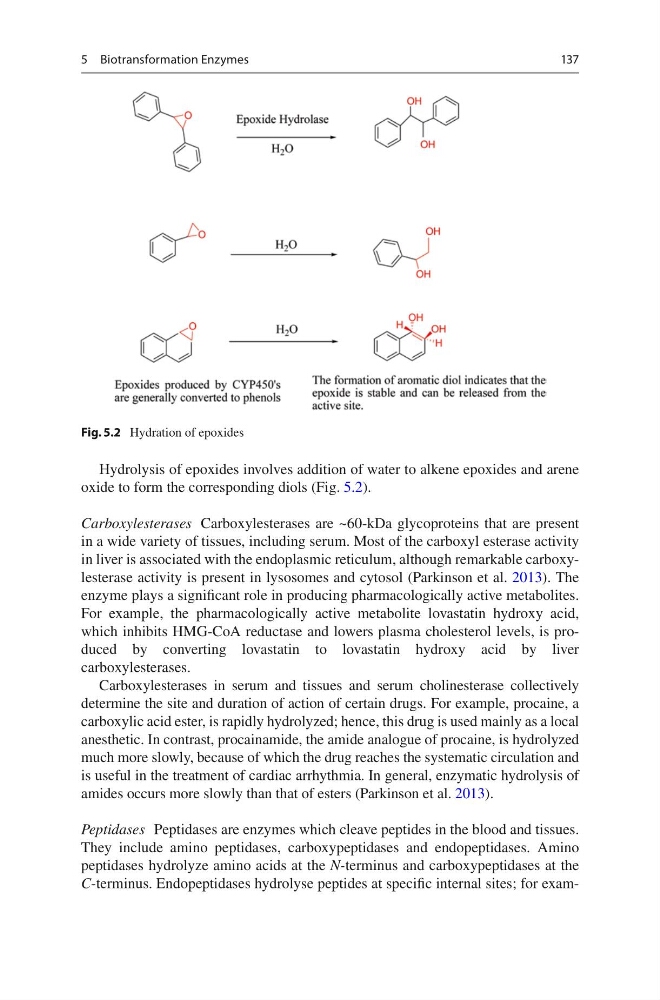
Hydrolysis of epoxides involves addition of water to alkene epoxides and arene
oxide to form the corresponding diols (Fig. 5.2).
Carboxylesterases Carboxylesterases are ~60-kDa glycoproteins that are present
in a wide variety of tissues, including serum. Most of the carboxyl esterase activity
in liver is associated with the endoplasmic reticulum, although remarkable carboxylesterase activity is present in lysosomes and cytosol (Parkinson et al. 2013). The
enzyme plays a significant role in producing pharmacologically active metabolites.
For example, the pharmacologically active metabolite lovastatin hydroxy acid,
which inhibits HMG-CoA reductase and lowers plasma cholesterol levels, is produced by converting lovastatin to lovastatin hydroxy acid by liver
carboxylesterases.
Carboxylesterases in serum and tissues and serum cholinesterase collectively
determine the site and duration of action of certain drugs. For example, procaine, a
carboxylic acid ester, is rapidly hydrolyzed; hence, this drug is used mainly as a local
anesthetic. In contrast, procainamide, the amide analogue of procaine, is hydrolyzed
much more slowly, because of which the drug reaches the systematic circulation and
is useful in the treatment of cardiac arrhythmia. In general, enzymatic hydrolysis of
amides occurs more slowly than that of esters (Parkinson et al. 2013).
Peptidases Peptidases are enzymes which cleave peptides in the blood and tissues.
They include amino peptidases, carboxypeptidases and endopeptidases. Amino
peptidases hydrolyze amino acids at the N-terminus and carboxypeptidases at the
C-terminus. Endopeptidases hydrolyse peptides at specific internal sites; for examFig. 5.2 Hydration of epoxides
5 Biotransformation Enzymes
Hydrolysis of epoxides involves addition of water to alkene epoxides and arene
oxide to form the corresponding diols (Fig. 5.2).
Carboxylesterases Carboxylesterases are ~60-kDa glycoproteins that are present
in a wide variety of tissues, including serum. Most of the carboxyl esterase activity
in liver is associated with the endoplasmic reticulum, although remarkable carboxylesterase activity is present in lysosomes and cytosol (Parkinson et al. 2013). The
enzyme plays a significant role in producing pharmacologically active metabolites.
For example, the pharmacologically active metabolite lovastatin hydroxy acid,
which inhibits HMG-CoA reductase and lowers plasma cholesterol levels, is produced by converting lovastatin to lovastatin hydroxy acid by liver
carboxylesterases.
Carboxylesterases in serum and tissues and serum cholinesterase collectively
determine the site and duration of action of certain drugs. For example, procaine, a
carboxylic acid ester, is rapidly hydrolyzed; hence, this drug is used mainly as a local
anesthetic. In contrast, procainamide, the amide analogue of procaine, is hydrolyzed
much more slowly, because of which the drug reaches the systematic circulation and
is useful in the treatment of cardiac arrhythmia. In general, enzymatic hydrolysis of
amides occurs more slowly than that of esters (Parkinson et al. 2013).
Peptidases Peptidases are enzymes which cleave peptides in the blood and tissues.
They include amino peptidases, carboxypeptidases and endopeptidases. Amino
peptidases hydrolyze amino acids at the N-terminus and carboxypeptidases at the
C-terminus. Endopeptidases hydrolyse peptides at specific internal sites; for examFig. 5.2 Hydration of epoxides
5 Biotransformation Enzymes