

Apoptosis and Cell Culture Technology
229
Stimulated, eg.
by cyclins, cdks, myc,
Stimulated, eg.
signals from environment
by TNF, anti-Fas
!
!
Proliferation
,,
Cell Population
,~
Cell Death
(numbers increase)
(numbers decrease)
!
!
Inhibited, e.g.,
Inhibited, eg.
by serum and growth factor
by bd-2, bcr-abl,
starvation
signals from environment
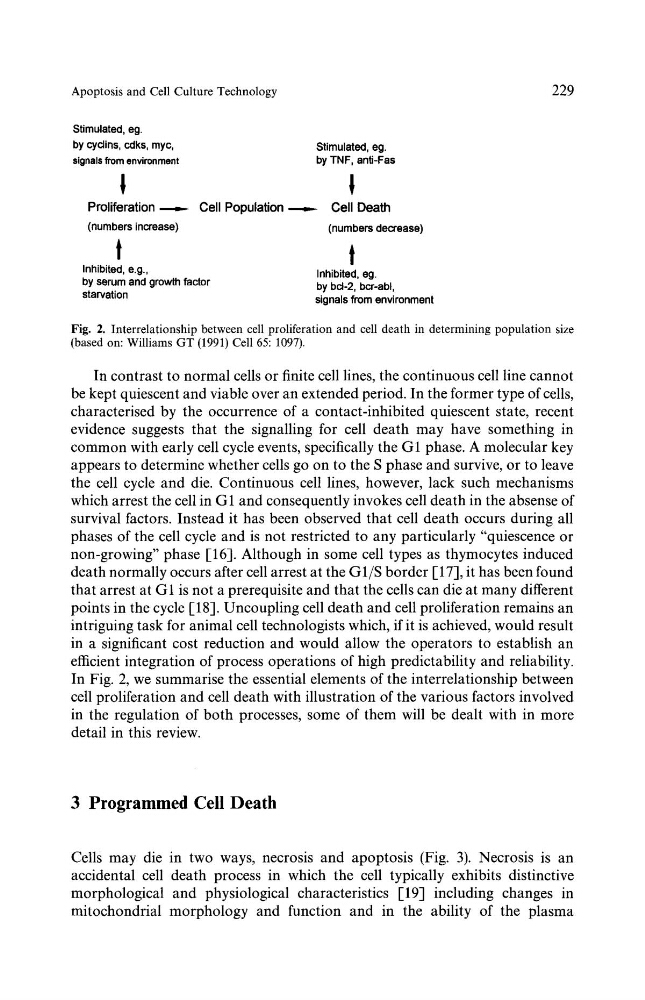
Fig. 2. Interrelationship between cell proliferation and cell death in determining population size
(based on: Williams GT (1991) Cell 65: 1097).
In contrast to normal cells or finite cell lines, the continuous cell line cannot
be kept quiescent and viable over an extended period. In the former type of cells,
characterised by the occurrence of a contact-inhibited quiescent state, recent
evidence suggests that the signalling for cell death may have something in
common with early cell cycle events, specifically the G1 phase. A molecular key
appears to determine whether cells go on to the S phase and survive, or to leave
the cell cycle and die. Continuous cell lines, however, lack such mechanisms
which arrest the cell in G1 and consequently invokes cell death in the absense of
survival factors. Instead it has been observed that cell death occurs during all
phases of the cell cycle and is not restricted to any particularly "quiescence or
non-growing" phase [16]. Although in some cell types as thymocytes induced
death normally occurs after cell arrest at the G1/S border [17], it has been found
that arrest at G1 is not a prerequisite and that the cells can die at many different
points in the cycle [18]. Uncoupling cell death and cell proliferation remains an
intriguing task for animal cell technologists which, if it is achieved, would result
in a significant cost reduction and would allow the operators to establish an
efficient integration of process operations of high predictability and reliability.
In Fig. 2, we summarise the essential elements of the interrelationship between
cell proliferation and cell death with illustration of the various factors involved
in the regulation of both processes, some of them will be dealt with in more
detail in this review.
3 Programmed Cell Death
Cells may die in two ways, necrosis and apoptosis (Fig. 3). Necrosis is an
accidental cell death process in which the cell typically exhibits distinctive
morphological and physiological characteristics [19] including changes in
mitochondrial morphology and function and in the ability of the plasma
229
Stimulated, eg.
by cyclins, cdks, myc,
Stimulated, eg.
signals from environment
by TNF, anti-Fas
!
!
Proliferation
,,
Cell Population
,~
Cell Death
(numbers increase)
(numbers decrease)
!
!
Inhibited, e.g.,
Inhibited, eg.
by serum and growth factor
by bd-2, bcr-abl,
starvation
signals from environment
Fig. 2. Interrelationship between cell proliferation and cell death in determining population size
(based on: Williams GT (1991) Cell 65: 1097).
In contrast to normal cells or finite cell lines, the continuous cell line cannot
be kept quiescent and viable over an extended period. In the former type of cells,
characterised by the occurrence of a contact-inhibited quiescent state, recent
evidence suggests that the signalling for cell death may have something in
common with early cell cycle events, specifically the G1 phase. A molecular key
appears to determine whether cells go on to the S phase and survive, or to leave
the cell cycle and die. Continuous cell lines, however, lack such mechanisms
which arrest the cell in G1 and consequently invokes cell death in the absense of
survival factors. Instead it has been observed that cell death occurs during all
phases of the cell cycle and is not restricted to any particularly "quiescence or
non-growing" phase [16]. Although in some cell types as thymocytes induced
death normally occurs after cell arrest at the G1/S border [17], it has been found
that arrest at G1 is not a prerequisite and that the cells can die at many different
points in the cycle [18]. Uncoupling cell death and cell proliferation remains an
intriguing task for animal cell technologists which, if it is achieved, would result
in a significant cost reduction and would allow the operators to establish an
efficient integration of process operations of high predictability and reliability.
In Fig. 2, we summarise the essential elements of the interrelationship between
cell proliferation and cell death with illustration of the various factors involved
in the regulation of both processes, some of them will be dealt with in more
detail in this review.
3 Programmed Cell Death
Cells may die in two ways, necrosis and apoptosis (Fig. 3). Necrosis is an
accidental cell death process in which the cell typically exhibits distinctive
morphological and physiological characteristics [19] including changes in
mitochondrial morphology and function and in the ability of the plasma