

228
2 Growth, Survival and Death
Mohamed A1-Rubeai
Large scale production of biopharmaceuticals normally utilise "transformed"
cell lines that are characterized by a finite lifespan, less dependency on surface
adherance and a lower requirement for serum. These continuous cell lines have
the advantages of greater growth rates, higher cell densities, higher yield and
general ease of maintenance in simple media ['9]. Generally, in all cell lines, the
growth rate and growth extent are determined by the cell cycle duration,
number of cell divisions and cell deaths. The molecular machinery of the cell
cycle and the checkpoints that help to ensure proper progression of cells from
G1 to M have been extensively studied in the last few years [10-13]. The
progression from G1 to M is controlled at least in part by a family of enzymes
called the cyclin-dependent kinases (CDKs) which, in turn, are activated by
a group of positive regulators called cyclines [14-15]. Several of these cell cycle
regulators have been shown to play an important role in the development of
cancer, a disease characterised by loss of cellular growth control. Like cancer
cells, "transformed" or continue cell lines do not stop dividing for the purpose of
repairing lesions but cell division continue as long as there is sufficient nutrients
and that other suitable chemical and physical conditions for survival are
maintained. Depletion of nutrients results in a reduction of DNA and protein
synthesis, thereby including cell death. The cells respond to chemical and
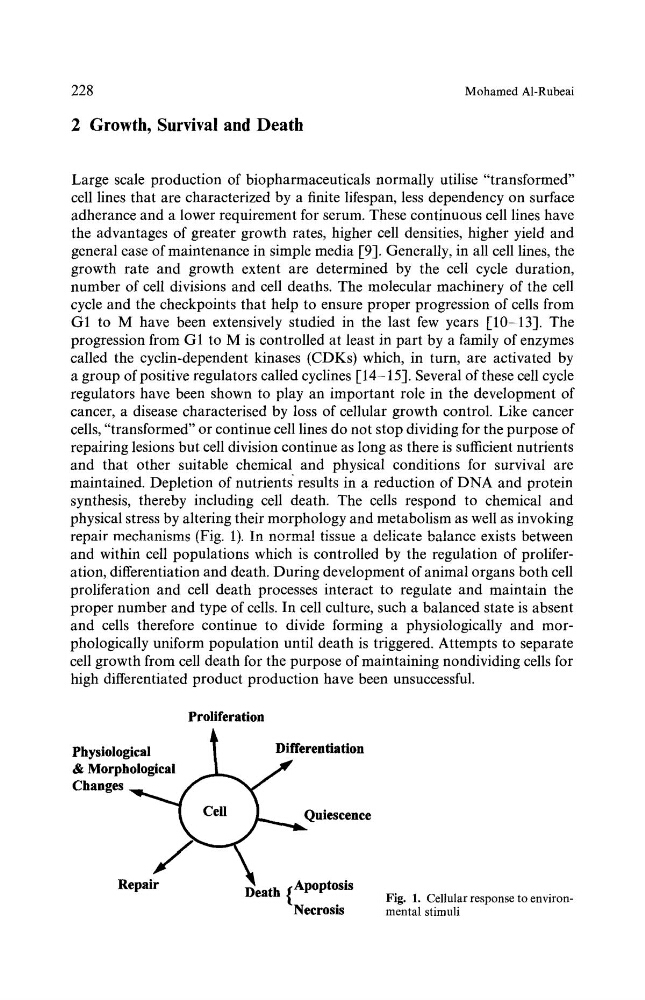
physical stress by altering their morphology and metabolism as well as invoking
renair mechani~m~ (Fig. 1~ In ~,,~rn,~l t~ ...... ,~e!icate v,~l .... exists between
and within cell populations which is controlled by the regulation of proliferation, differentiation and death. During development of animal organs both cell
proliferation and cell death processes interact to regulate and maintain the
proper number and type of cells. In cell culture, such a balanced state is absent
and cells therefore continue to divide forming a physiologically and morphologically uniform population until death is triggered. Attempts to separate
cell growth from cell death for the purpose of maintaining nondividing cells for
high differentiated product production have been unsuccessful.
Proliferation
Physi ol ogi Cal changes
& Morphological~~q~Q/~.~ Di fferenti ati on
niescence
Repai r
~eath Apoptosis
{Necrosis
Fig. 1. Cellular response to environmental stimuli
2 Growth, Survival and Death
Mohamed A1-Rubeai
Large scale production of biopharmaceuticals normally utilise "transformed"
cell lines that are characterized by a finite lifespan, less dependency on surface
adherance and a lower requirement for serum. These continuous cell lines have
the advantages of greater growth rates, higher cell densities, higher yield and
general ease of maintenance in simple media ['9]. Generally, in all cell lines, the
growth rate and growth extent are determined by the cell cycle duration,
number of cell divisions and cell deaths. The molecular machinery of the cell
cycle and the checkpoints that help to ensure proper progression of cells from
G1 to M have been extensively studied in the last few years [10-13]. The
progression from G1 to M is controlled at least in part by a family of enzymes
called the cyclin-dependent kinases (CDKs) which, in turn, are activated by
a group of positive regulators called cyclines [14-15]. Several of these cell cycle
regulators have been shown to play an important role in the development of
cancer, a disease characterised by loss of cellular growth control. Like cancer
cells, "transformed" or continue cell lines do not stop dividing for the purpose of
repairing lesions but cell division continue as long as there is sufficient nutrients
and that other suitable chemical and physical conditions for survival are
maintained. Depletion of nutrients results in a reduction of DNA and protein
synthesis, thereby including cell death. The cells respond to chemical and
physical stress by altering their morphology and metabolism as well as invoking
renair mechani~m~ (Fig. 1~ In ~,,~rn,~l t~ ...... ,~e!icate v,~l .... exists between
and within cell populations which is controlled by the regulation of proliferation, differentiation and death. During development of animal organs both cell
proliferation and cell death processes interact to regulate and maintain the
proper number and type of cells. In cell culture, such a balanced state is absent
and cells therefore continue to divide forming a physiologically and morphologically uniform population until death is triggered. Attempts to separate
cell growth from cell death for the purpose of maintaining nondividing cells for
high differentiated product production have been unsuccessful.
Proliferation
Physi ol ogi Cal changes
& Morphological~~q~Q/~.~ Di fferenti ati on
niescence
Repai r
~eath Apoptosis
{Necrosis
Fig. 1. Cellular response to environmental stimuli