

Apoptosis and Cell Culture Technology
Table 2. Control and improvement of product expression
227
1. Transfection and expression
2. Metabolic engineering
a. Design or redirection of metabolic pathways
1. Reduction of toxic metabolic production
2. Increase in the rate of substrate uptake and product formation
3. Creation of novel pathways
b. Controlling proliferation/improving adaptability
c. Controlling cell death/increasing viability
3. Process engineering
Table 3. Increased cell viability and survivability: The advantages
1. Increased number of cell factories
2. Enhanced adaptation to nutrient limited conditions and protein-free medium
3. Reduced DNA and proteases contamination
4. Efficient control of cell division
5. Prolonged and increased viral replication
6. Improved efficacy and fidelity of products
involves the direct modification of the function of metabolic networks. The
improvement of cellular activities by metabolic engineering of enzymatic, transport and regulatory functions of cells have been widely accepted as a way
forward for integrated process development I-6]. The use of rDNA technologies
to achieve controlled proliferation, enhanced survival and improved cellular
responses to the external environment by manipulating the regulatory pathways
of cell death and cell division should enable more effective and more specific
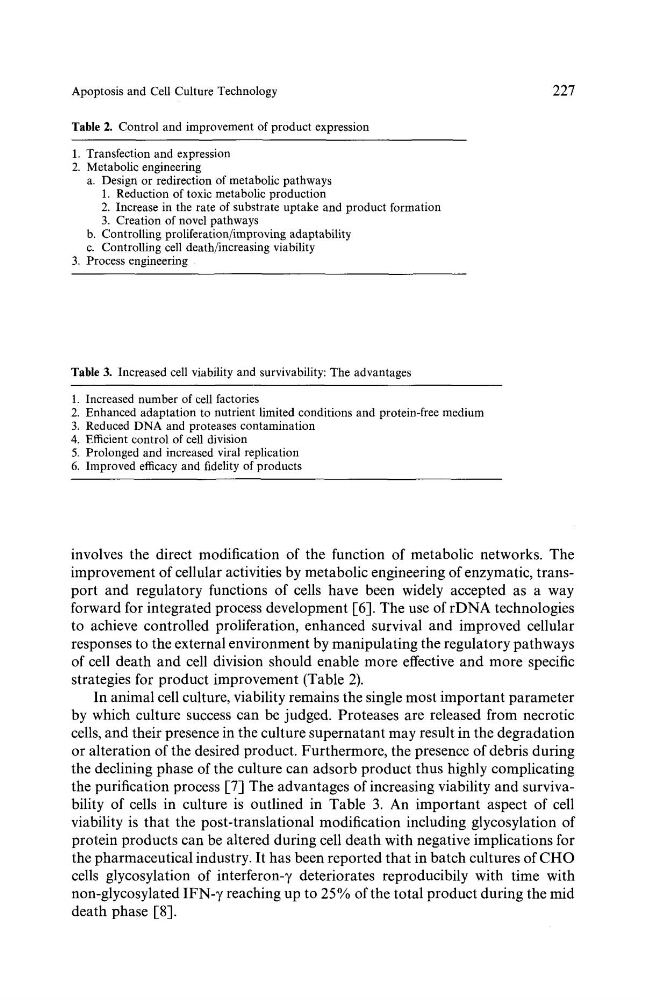
strategies for product improvement (Table 2).
In animal cell culture, viability remains the single most important parameter
by which culture success can be judged. Proteases are released from necrotic
cells, and their presence in the culture supernatant may result in the degradation
or alteration of the desired product. Furthermore, the presence of debris during
the declining phase of the culture can adsorb product thus highly complicating
the purification process [-7] The advantages of increasing viability and survivability of cells in culture is outlined in Table 3. An important aspect of cell
viability is that the post-translational modification including glycosylation of
protein products can be altered during cell death with negative implications for
the pharmaceutical industry. It has been reported that in batch cultures of CHO
cells glycosylation of interferon-y deteriorates reproducibily with time with
non-glycosylated IFN-y reaching up to 25% of the total product during the mid
death phase [8].
Table 2. Control and improvement of product expression
227
1. Transfection and expression
2. Metabolic engineering
a. Design or redirection of metabolic pathways
1. Reduction of toxic metabolic production
2. Increase in the rate of substrate uptake and product formation
3. Creation of novel pathways
b. Controlling proliferation/improving adaptability
c. Controlling cell death/increasing viability
3. Process engineering
Table 3. Increased cell viability and survivability: The advantages
1. Increased number of cell factories
2. Enhanced adaptation to nutrient limited conditions and protein-free medium
3. Reduced DNA and proteases contamination
4. Efficient control of cell division
5. Prolonged and increased viral replication
6. Improved efficacy and fidelity of products
involves the direct modification of the function of metabolic networks. The
improvement of cellular activities by metabolic engineering of enzymatic, transport and regulatory functions of cells have been widely accepted as a way
forward for integrated process development I-6]. The use of rDNA technologies
to achieve controlled proliferation, enhanced survival and improved cellular
responses to the external environment by manipulating the regulatory pathways
of cell death and cell division should enable more effective and more specific
strategies for product improvement (Table 2).
In animal cell culture, viability remains the single most important parameter
by which culture success can be judged. Proteases are released from necrotic
cells, and their presence in the culture supernatant may result in the degradation
or alteration of the desired product. Furthermore, the presence of debris during
the declining phase of the culture can adsorb product thus highly complicating
the purification process [-7] The advantages of increasing viability and survivability of cells in culture is outlined in Table 3. An important aspect of cell
viability is that the post-translational modification including glycosylation of
protein products can be altered during cell death with negative implications for
the pharmaceutical industry. It has been reported that in batch cultures of CHO
cells glycosylation of interferon-y deteriorates reproducibily with time with
non-glycosylated IFN-y reaching up to 25% of the total product during the mid
death phase [8].