

226
1 Introduction
Mohamed A1-Rubeai
Today, the biotechnology industries are searching for and executing strategies
to sustain themselves as they enter the new millennium. The survival time for
biotech companies is getting shorter, which means fewer of them can afford the
time and money involved in bringing new products to the market. There are
more than 400 human health care products in development and over 40
therapeutic biologics have been approved and a significant number of these
products are produced in animal cells. It is therefore not surprising to see animal
cell culture continuing to play an increasingly important role in the production
of biopharmaceuticals.
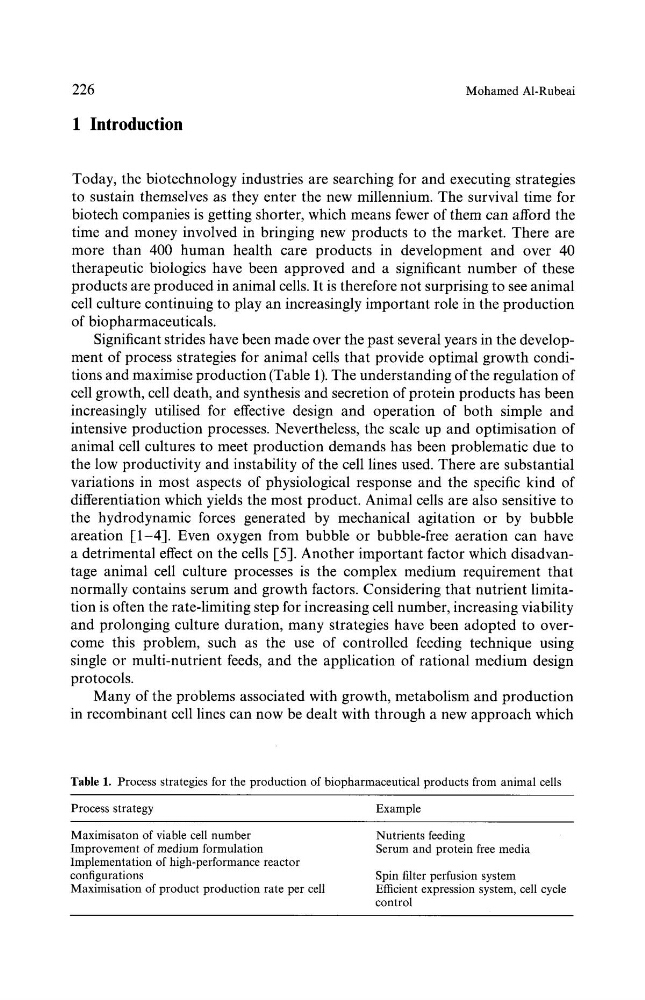
Significant strides have been made over the past several years in the development of process strategies for animal cells that provide optimal growth conditions and maximise production (Table 1). The understanding of the regulation of
cell growth, cell death, and synthesis and secretion of protein products has been
increasingly utilised for effective design and operation of both simple and
intensive production processes. Nevertheless, the scale up and optimisation of
animal cell cultures to meet production demands has been problematic due to
the low productivity and instability of the cell lines used. There are substantial
variations in most aspects of physiological response and the specific kind of
differentiation which yields the most product. Animal cells are also sensitive to
the hydrodynamic forces generated by mechanical agitation or by bubble
areation [1-4]. Even oxygen from bubble or bubble-free aeration can have
a detrimental effect on the cells [5]. Another important factor which disadvantage animal cell culture processes is the complex medium requirement that
normally contains serum and growth factors. Considering that nutrient limitation is often the rate-limiting step for increasing cell number, increasing viability
and prolonging culture duration, many strategies have been adopted to overcome this problem, such as the use of controlled feeding technique using
single or multi-nutrient feeds, and the application of rational medium design
protocols.
Many of the problems associated with growth, metabolism and production
in recombinant cell lines can now be dealt with through a new approach which
Table 1. Process strategies for the production of biopharmaceutical products from animal cells
Process strategy
Example
Maximisaton of viable cell number
Improvement of medium formulation
Implementation of high-performance reactor
configurations
Maximisation of product production rate per cell
Nutrients feeding
Serum and protein free media
Spin filter perfusion system
Efficient expression system, cell cycle
control
1 Introduction
Mohamed A1-Rubeai
Today, the biotechnology industries are searching for and executing strategies
to sustain themselves as they enter the new millennium. The survival time for
biotech companies is getting shorter, which means fewer of them can afford the
time and money involved in bringing new products to the market. There are
more than 400 human health care products in development and over 40
therapeutic biologics have been approved and a significant number of these
products are produced in animal cells. It is therefore not surprising to see animal
cell culture continuing to play an increasingly important role in the production
of biopharmaceuticals.
Significant strides have been made over the past several years in the development of process strategies for animal cells that provide optimal growth conditions and maximise production (Table 1). The understanding of the regulation of
cell growth, cell death, and synthesis and secretion of protein products has been
increasingly utilised for effective design and operation of both simple and
intensive production processes. Nevertheless, the scale up and optimisation of
animal cell cultures to meet production demands has been problematic due to
the low productivity and instability of the cell lines used. There are substantial
variations in most aspects of physiological response and the specific kind of
differentiation which yields the most product. Animal cells are also sensitive to
the hydrodynamic forces generated by mechanical agitation or by bubble
areation [1-4]. Even oxygen from bubble or bubble-free aeration can have
a detrimental effect on the cells [5]. Another important factor which disadvantage animal cell culture processes is the complex medium requirement that
normally contains serum and growth factors. Considering that nutrient limitation is often the rate-limiting step for increasing cell number, increasing viability
and prolonging culture duration, many strategies have been adopted to overcome this problem, such as the use of controlled feeding technique using
single or multi-nutrient feeds, and the application of rational medium design
protocols.
Many of the problems associated with growth, metabolism and production
in recombinant cell lines can now be dealt with through a new approach which
Table 1. Process strategies for the production of biopharmaceutical products from animal cells
Process strategy
Example
Maximisaton of viable cell number
Improvement of medium formulation
Implementation of high-performance reactor
configurations
Maximisation of product production rate per cell
Nutrients feeding
Serum and protein free media
Spin filter perfusion system
Efficient expression system, cell cycle
control