

Kinetics and Energetics of Photosynthetic Micro-Organisms in Photobioreactors
215
Aco F [1,28,98,99];
JATP = LAAAATP + LAcAcoF
(137)
JCOF = LAcAATP + LccAcoF
(138)
It is stressed that the cross-coefficients LAC must be equal according to the
Onsager reciprocity relationships which are assumed to apply. This formalism
applies to the near equilibrium domain which normally requires A ~ RT for
linearity. The free energy transduction between photophosphorylation and
cofactor reduction obviously operates at far-from-equilibrium conditions. However, the linear relationships are still considered valid for some steady-state
region of linear behaviour. This extension of the linear domain to far-fromequilibrium conditions is still debated [100] though Onsager reciprocity relationships are demonstrated to apply even at far-from-equilibrium conditions for
an arbitrary steady state [101]. The most valid rationale is that, for a stable and
adaptative functioning of cell machinery, the time-average values of the rates
and affinities must follow the linear energy converter formalisation [28].
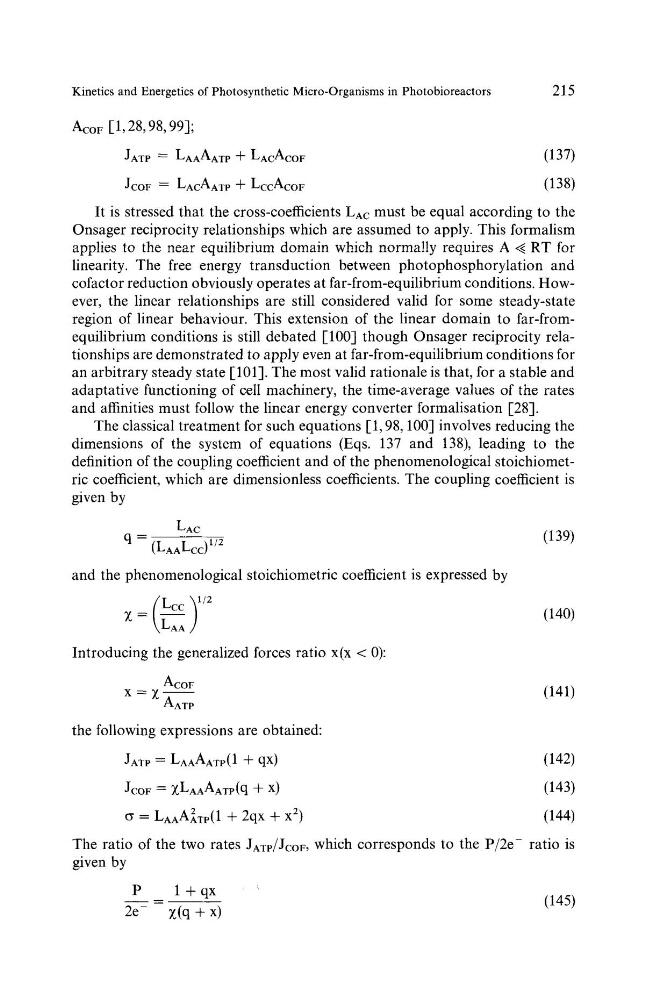
The classical treatment for such equations [1, 98, 100] involves reducing the
dimensions of the system of equations (Eqs. 137 and 138), leading to the
definition of the coupling coefficient and of the phenomenological stoichiomettic coefficient, which are dimensionless coefficients. The coupling coefficient is
given by
LAC
q - (LAALcc)I/2
(139)
and the phenomenological stoichiometric coefficient is expressed by
(Lcc)
Z = \LAA
(140)
Introducing the generalized forces ratio x(x < 0):
Acov
(141)
X = Z AATP
the following expressions are obtained:
JATp = LAAAATp(1 + qx)
(142)
Jcov = ZLAAAATp(q + X)
(143)
CY ---- LAAA2Tp(1 + 2qx + x 2)
(144)
The ratio of the two rates JATP/JcoF, which corresponds to the P/2e- ratio is
given by
P _ 1 +qx
(145)
2ez(q + x)
215
Aco F [1,28,98,99];
JATP = LAAAATP + LAcAcoF
(137)
JCOF = LAcAATP + LccAcoF
(138)
It is stressed that the cross-coefficients LAC must be equal according to the
Onsager reciprocity relationships which are assumed to apply. This formalism
applies to the near equilibrium domain which normally requires A ~ RT for
linearity. The free energy transduction between photophosphorylation and
cofactor reduction obviously operates at far-from-equilibrium conditions. However, the linear relationships are still considered valid for some steady-state
region of linear behaviour. This extension of the linear domain to far-fromequilibrium conditions is still debated [100] though Onsager reciprocity relationships are demonstrated to apply even at far-from-equilibrium conditions for
an arbitrary steady state [101]. The most valid rationale is that, for a stable and
adaptative functioning of cell machinery, the time-average values of the rates
and affinities must follow the linear energy converter formalisation [28].
The classical treatment for such equations [1, 98, 100] involves reducing the
dimensions of the system of equations (Eqs. 137 and 138), leading to the
definition of the coupling coefficient and of the phenomenological stoichiomettic coefficient, which are dimensionless coefficients. The coupling coefficient is
given by
LAC
q - (LAALcc)I/2
(139)
and the phenomenological stoichiometric coefficient is expressed by
(Lcc)
Z = \LAA
(140)
Introducing the generalized forces ratio x(x < 0):
Acov
(141)
X = Z AATP
the following expressions are obtained:
JATp = LAAAATp(1 + qx)
(142)
Jcov = ZLAAAATp(q + X)
(143)
CY ---- LAAA2Tp(1 + 2qx + x 2)
(144)
The ratio of the two rates JATP/JcoF, which corresponds to the P/2e- ratio is
given by
P _ 1 +qx
(145)
2ez(q + x)