

216
J.-F. Cornet et al.
Therefore, the theory of linear energy converters enables one to express the ratio
of the two rates as a function of the three variables (q, Z and x). The theoretical
calculation of q, Z and x is then performed in two steps.
First, the fixed coefficients q and ~ are assumed to be determined by the
internal regulation of metabolism, which leads to a minimal rate of entropy
production (which still remains positive) ensuring a maximum power output
[1,28, 102]. This gives the value of the degree of coupling q = 0.910 and the
expression of the phenomenological stoichiometric coefficient:
Z = qnAc
(146)
where nAc stands for the mechanistic stoichiometry, i.e. the stoichiometry which
is deduced from the analysis of the reaction scheme. Typically in the case of
coupling between photophosphorylation and water photolysis, nAc = 1 mole
NADP + reduced/mole ATP produced, leading to
X = q
(147)
The second step concerns the determination of force ratio x the value of
which is calculated as a function of the external conditions applied to the system.
More precisely, it is shown that for an isolated system, the stability principle
[98, 99] directs the system towards its thermodynamic equilibrium states, i.e. to
a zero affinities state. For an open system, the dissipation function is optimized
considering the external constraints applied. This, in turn, leads to expressing
the optimization of the dissipation function as a variational problem using
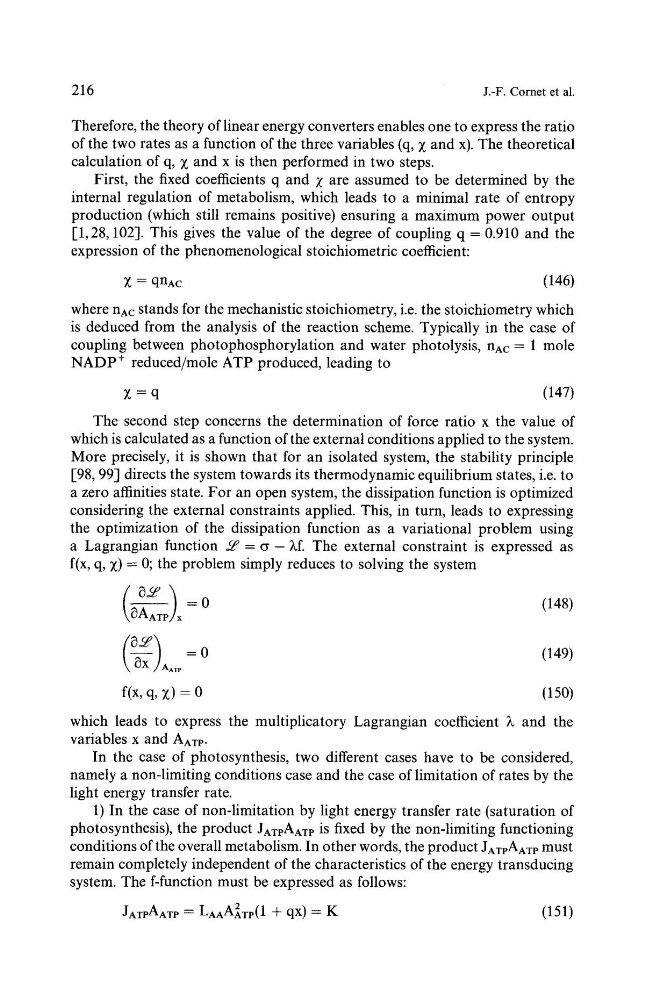
a Lagrangian function s = cy- )ft. The external constraint is expressed as
f(x, q, Z) = 0; the problem simply reduces to solving the system
(~~
=0
(149)
-X AATP
f(x, q, Z) = 0
(150)
which leads to express the multiplicatory Lagrangian coefficient )~ and the
variables x and AAxp.
In the case of photosynthesis, two different cases have to be considered,
namely a non-limiting conditions case and the case of limitation of rates by the
light energy transfer rate.
1) In the case of non-limitation by light energy transfer rate (saturation of
photosynthesis), the product JAa'pAATp is fixed by the non-limiting functioning
conditions of the overall metabolism. In other words, the product JATpAA~p must
remain completely independent of the characteristics of the energy transducing
system. The f-function must be expressed as follows:
JATpAATP = LAAA2Tp(1 + qx) = K
(151)
J.-F. Cornet et al.
Therefore, the theory of linear energy converters enables one to express the ratio
of the two rates as a function of the three variables (q, Z and x). The theoretical
calculation of q, Z and x is then performed in two steps.
First, the fixed coefficients q and ~ are assumed to be determined by the
internal regulation of metabolism, which leads to a minimal rate of entropy
production (which still remains positive) ensuring a maximum power output
[1,28, 102]. This gives the value of the degree of coupling q = 0.910 and the
expression of the phenomenological stoichiometric coefficient:
Z = qnAc
(146)
where nAc stands for the mechanistic stoichiometry, i.e. the stoichiometry which
is deduced from the analysis of the reaction scheme. Typically in the case of
coupling between photophosphorylation and water photolysis, nAc = 1 mole
NADP + reduced/mole ATP produced, leading to
X = q
(147)
The second step concerns the determination of force ratio x the value of
which is calculated as a function of the external conditions applied to the system.
More precisely, it is shown that for an isolated system, the stability principle
[98, 99] directs the system towards its thermodynamic equilibrium states, i.e. to
a zero affinities state. For an open system, the dissipation function is optimized
considering the external constraints applied. This, in turn, leads to expressing
the optimization of the dissipation function as a variational problem using
a Lagrangian function s = cy- )ft. The external constraint is expressed as
f(x, q, Z) = 0; the problem simply reduces to solving the system
(~~
=0
(149)
-X AATP
f(x, q, Z) = 0
(150)
which leads to express the multiplicatory Lagrangian coefficient )~ and the
variables x and AAxp.
In the case of photosynthesis, two different cases have to be considered,
namely a non-limiting conditions case and the case of limitation of rates by the
light energy transfer rate.
1) In the case of non-limitation by light energy transfer rate (saturation of
photosynthesis), the product JAa'pAATp is fixed by the non-limiting functioning
conditions of the overall metabolism. In other words, the product JATpAA~p must
remain completely independent of the characteristics of the energy transducing
system. The f-function must be expressed as follows:
JATpAATP = LAAA2Tp(1 + qx) = K
(151)