

214
J.-F. Cornet et al.
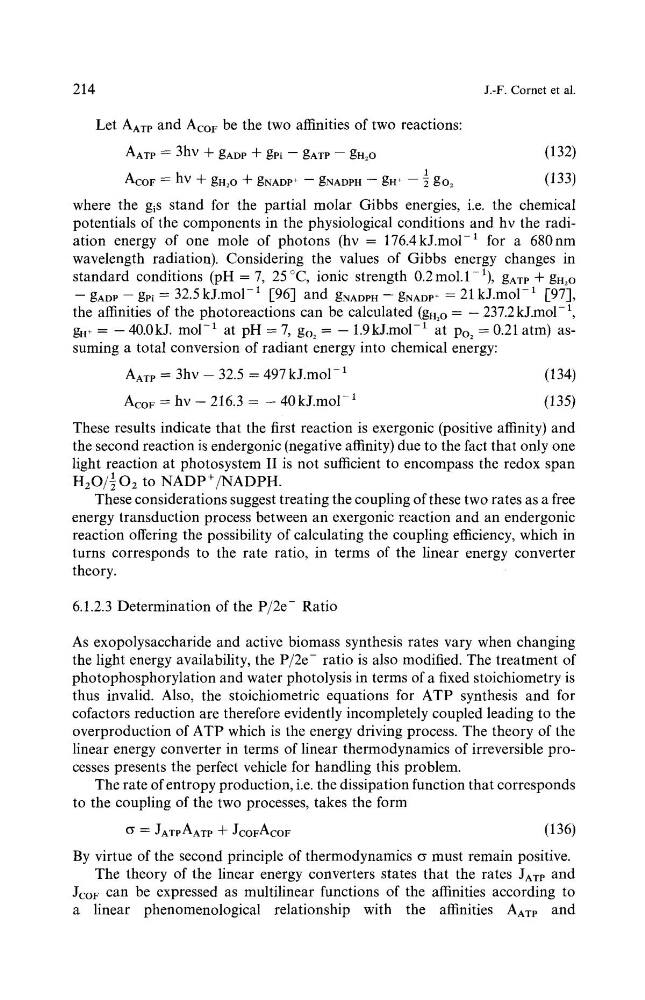
Let AAT P and Acov be the two affinities of two reactions:
AAT P = 3hv + gADP + gPi -- gATP -- gn2o
(132)
1
ACOF = hv + gHzO + gNADP + -- gNADPH -- gH + -- y go2
(133)
where the gis stand for the partial molar Gibbs energies, i.e. the chemical
potentials of the components in the physiological conditions and hv the radiation energy of one mole of photons (hv = 176.4kJ.mo1-1 for a 680nm
wavelength radiation). Considering the values of Gibbs energy changes in
standard conditions (pH = 7, 25~
ionic strength 0.2mo1.1-l), gATP + gH20
-gADP -- gPi = 32.5 kJ.mol- i [96] and gNADPH -- gNADP § = 21 kJ.mol- 1 [97],
the affinities of the photoreactions can be calculated (gn~o = - 237.2 kJ.mol-1,
gH + = -- 40.0kJ. mo1-1 at pH = 7, go2 = -- 1.9kJ.mol-1 at Po2 = 0.21 atm) assuming a total conversion of radiant energy into chemical energy:
AATP = 3by -- 32.5 = 497 kJ.mol- a
(134)
AcoF = hv -- 216.3 = - 40 kJ.mol-1
(135)
These results indicate that the first reaction is exergonic (positive affinity) and
the second reaction is endergonic (negative affinity) due to the fact that only one
light reaction at photosystem II is not sufficient to encompass the redox span
H20/102 to NADP+/NADPH.
These considerations suggest treating the coupling of these two rates as a free
energy transduction process between an exergonic reaction and an endergonic
reaction offering the possibility of calculating the coupling efficiency, which in
turns corresponds to the rate ratio, in terms of the linear energy converter
theory.
6.1.2.3 Determination of the P/2e- Ratio
As exopolysaccharide and active biomass synthesis rates vary when changing
the light energy availability, the P/2e- ratio is also modified. The treatment of
photophosphorylation and water photolysis in terms of a fixed stoichiometry is
thus invalid. Also, the stoichiometric equations for ATP synthesis and for
cofactors reduction are therefore evidently incompletely coupled leading to the
overproduction of ATP which is the energy driving process. The theory of the
linear energy converter in terms of linear thermodynamics of irreversible processes presents the perfect vehicle for handling this problem.
The rate of entropy production, i.e. the dissipation function that corresponds
to the coupling of the two processes, takes the form
(3" = JATpAATP -F- JcoFAcoF
(136)
By virtue of the second principle of thermodynamics cy must remain positive.
The theory of the linear energy converters states that the rates JATP and
Jcov can be expressed as multilinear functions of the affinities according to
a linear phenomenological relationship with the affinities AarP and
J.-F. Cornet et al.
Let AAT P and Acov be the two affinities of two reactions:
AAT P = 3hv + gADP + gPi -- gATP -- gn2o
(132)
1
ACOF = hv + gHzO + gNADP + -- gNADPH -- gH + -- y go2
(133)
where the gis stand for the partial molar Gibbs energies, i.e. the chemical
potentials of the components in the physiological conditions and hv the radiation energy of one mole of photons (hv = 176.4kJ.mo1-1 for a 680nm
wavelength radiation). Considering the values of Gibbs energy changes in
standard conditions (pH = 7, 25~
ionic strength 0.2mo1.1-l), gATP + gH20
-gADP -- gPi = 32.5 kJ.mol- i [96] and gNADPH -- gNADP § = 21 kJ.mol- 1 [97],
the affinities of the photoreactions can be calculated (gn~o = - 237.2 kJ.mol-1,
gH + = -- 40.0kJ. mo1-1 at pH = 7, go2 = -- 1.9kJ.mol-1 at Po2 = 0.21 atm) assuming a total conversion of radiant energy into chemical energy:
AATP = 3by -- 32.5 = 497 kJ.mol- a
(134)
AcoF = hv -- 216.3 = - 40 kJ.mol-1
(135)
These results indicate that the first reaction is exergonic (positive affinity) and
the second reaction is endergonic (negative affinity) due to the fact that only one
light reaction at photosystem II is not sufficient to encompass the redox span
H20/102 to NADP+/NADPH.
These considerations suggest treating the coupling of these two rates as a free
energy transduction process between an exergonic reaction and an endergonic
reaction offering the possibility of calculating the coupling efficiency, which in
turns corresponds to the rate ratio, in terms of the linear energy converter
theory.
6.1.2.3 Determination of the P/2e- Ratio
As exopolysaccharide and active biomass synthesis rates vary when changing
the light energy availability, the P/2e- ratio is also modified. The treatment of
photophosphorylation and water photolysis in terms of a fixed stoichiometry is
thus invalid. Also, the stoichiometric equations for ATP synthesis and for
cofactors reduction are therefore evidently incompletely coupled leading to the
overproduction of ATP which is the energy driving process. The theory of the
linear energy converter in terms of linear thermodynamics of irreversible processes presents the perfect vehicle for handling this problem.
The rate of entropy production, i.e. the dissipation function that corresponds
to the coupling of the two processes, takes the form
(3" = JATpAATP -F- JcoFAcoF
(136)
By virtue of the second principle of thermodynamics cy must remain positive.
The theory of the linear energy converters states that the rates JATP and
Jcov can be expressed as multilinear functions of the affinities according to
a linear phenomenological relationship with the affinities AarP and