

Kinetics and Energetics of Photosynthetic Micro-Organisms in Photobioreactors
199
0.8
I
E
0.6
Z
0
0.4
rr
z
klJ
u
0.2
Z
0
U
0
100
200
300
4.00
o
o
o
!
TIME (h)
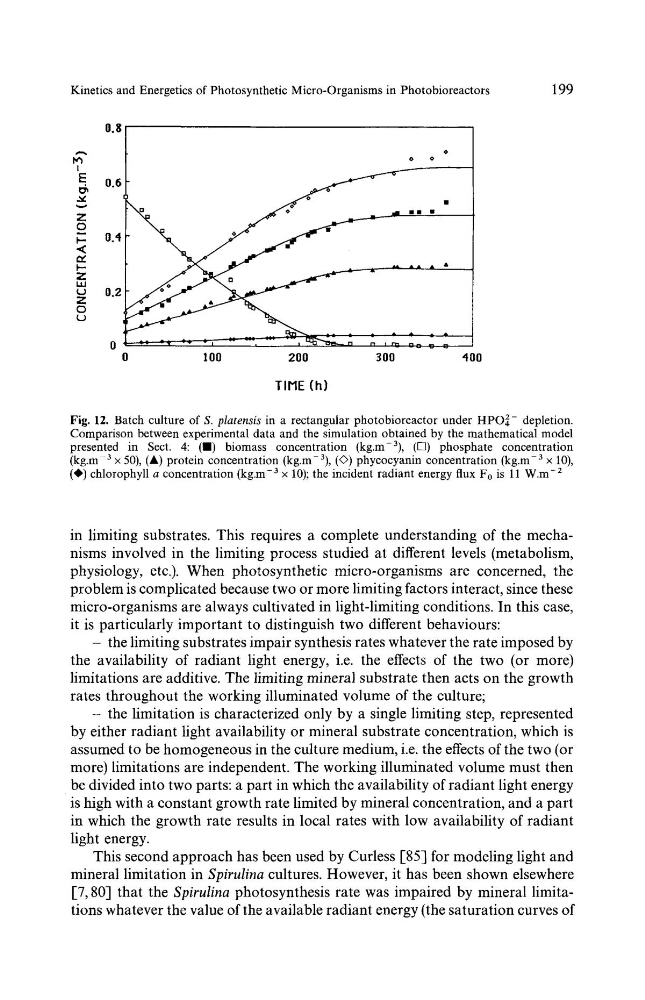
Fig. 12. Batch culture of S. platensis in a rectangular photobioreactor under HPO4 z- depletion.
Comparison between experimental data and the simulation obtained by the mathematical model
presented in Sect. 4: (I) biomass concentration (kg.m-3), (D) phosphate concentration
(kg.m -3 x 50), (A) protein concentration (kg.m-3), (~) phycocyanin concentration (kg.m -3 x 10),
(~) chlorophyll a concentration (kg.m -3 x 10); the incident radiant energy flux F0 is 11 W.m -2
in limiting substrates. This requires a complete understanding of the mechanisms involved in the limiting process studied at different levels (metabolism,
physiology, etc.). When photosynthetic micro-organisms are concerned, the
problem is complicated because two or more limiting factors interact, since these
micro-organisms are always cultivated in light-limiting conditions. In this case,
it is particularly important to distinguish two different behaviours:
-
the limiting substrates impair synthesis rates whatever the rate imposed by
the availability of radiant light energy, i.e. the effects of the two (or more)
limitations are additive. The limiting mineral substrate then acts on the growth
rates throughout the working illuminated volume of the culture;
-
the limitation is characterized only by a single limiting step, represented
by either radiant light availability or mineral substrate concentration, which is
assumed to he homogeneous in the culture medium, i.e. the effects of the two (or
more) limitations are independent. The working illuminated volume must then
be divided into two parts: a part in which the availability of radiant light energy
is high with a constant growth rate limited by mineral concentration, and a part
in which the growth rate results in local rates with low availability of radiant
light energy.
This second approach has been used by Curless [85] for modeling light and
mineral limitation in Spirulina cultures. However, it has been shown elsewhere
[7, 80] that the Spirulina photosynthesis rate was impaired by mineral limitations whatever the value of the available radiant energy (the saturation curves of
199
0.8
I
E
0.6
Z
0
0.4
rr
z
klJ
u
0.2
Z
0
U
0
100
200
300
4.00
o
o
o
!
TIME (h)
Fig. 12. Batch culture of S. platensis in a rectangular photobioreactor under HPO4 z- depletion.
Comparison between experimental data and the simulation obtained by the mathematical model
presented in Sect. 4: (I) biomass concentration (kg.m-3), (D) phosphate concentration
(kg.m -3 x 50), (A) protein concentration (kg.m-3), (~) phycocyanin concentration (kg.m -3 x 10),
(~) chlorophyll a concentration (kg.m -3 x 10); the incident radiant energy flux F0 is 11 W.m -2
in limiting substrates. This requires a complete understanding of the mechanisms involved in the limiting process studied at different levels (metabolism,
physiology, etc.). When photosynthetic micro-organisms are concerned, the
problem is complicated because two or more limiting factors interact, since these
micro-organisms are always cultivated in light-limiting conditions. In this case,
it is particularly important to distinguish two different behaviours:
-
the limiting substrates impair synthesis rates whatever the rate imposed by
the availability of radiant light energy, i.e. the effects of the two (or more)
limitations are additive. The limiting mineral substrate then acts on the growth
rates throughout the working illuminated volume of the culture;
-
the limitation is characterized only by a single limiting step, represented
by either radiant light availability or mineral substrate concentration, which is
assumed to he homogeneous in the culture medium, i.e. the effects of the two (or
more) limitations are independent. The working illuminated volume must then
be divided into two parts: a part in which the availability of radiant light energy
is high with a constant growth rate limited by mineral concentration, and a part
in which the growth rate results in local rates with low availability of radiant
light energy.
This second approach has been used by Curless [85] for modeling light and
mineral limitation in Spirulina cultures. However, it has been shown elsewhere
[7, 80] that the Spirulina photosynthesis rate was impaired by mineral limitations whatever the value of the available radiant energy (the saturation curves of