

198
J.-F. Cornet et al.
0.6
A
0.5
~ o
o
I
E
o
0.4
o
Q
~-0.3
o o
<
I-z
0.2
<>
U,
z
o
o
O.l
u
0
0
100
200
300
TIME (h)
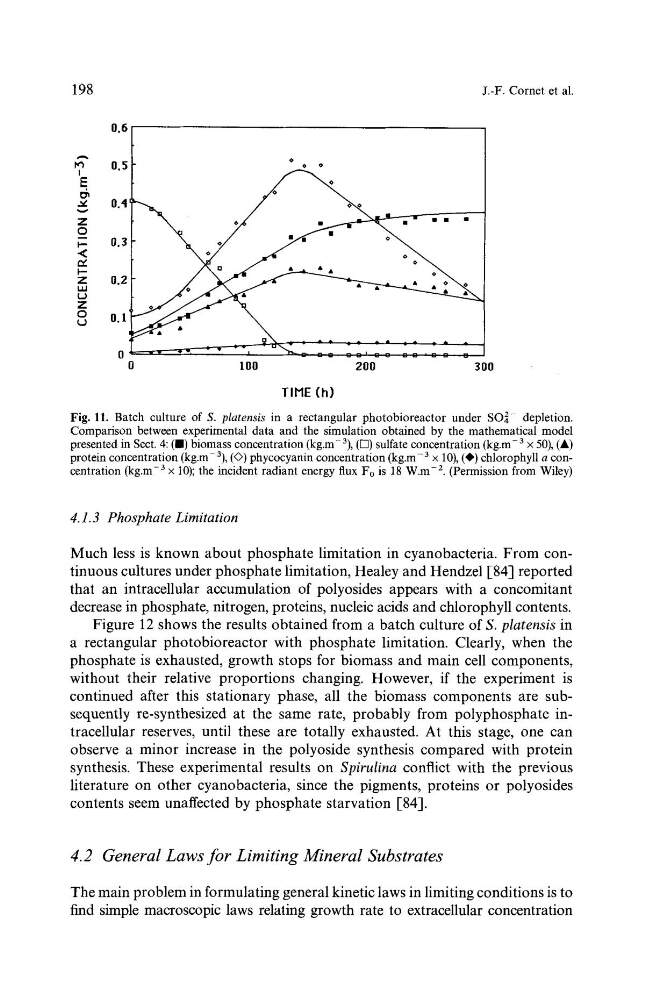
Fig. 11. Batch culture of S. platensis in a rectangular photobioreactor under SO~- depletion.
Comparison between experimental data and the simulation obtained by the mathematical model
presented in Sect. 4: (11) biomass concentration (kg.m - 3), (N) sulfate concentration (kg.m- 3 x 50), (&)
protein concentration (kg.m a), (~) phycocyanin concentration (kg.m -3 x 10), (0) chlorophyll a concentration (kg.m-3 x I0); the incident radiant energy flux F0 is 18 W.m -1. (Permission from Wiley)
4.1.3 Phosphate Limitation
Much less is known about phosphate limitation in cyanobacteria. From continuous cultures under phosphate limitation, Healey and Hendzel [84] reported
that an intracellular accumulation of polyosides appears with a concomitant
decrease in phosphate, nitrogen, proteins, nucleic acids and chlorophyll contents.
Figure 12 shows the results obtained from a batch culture of S. platensis in
a rectangular photobioreactor with phosphate limitation. Clearly, when the
phosphate is exhausted, growth stops for biomass and main cell components,
without their relative proportions changing. However, if the experiment is
continued after this stationary phase, all the biomass components are subsequently re-synthesized at the same rate, probably from polyphosphate intracellular reserves, until these are totally exhausted. At this stage, one can
observe a minor increase in the polyoside synthesis compared with protein
synthesis. These experimental results on Spirulina conflict with the previous
literature on other cyanobacteria, since the pigments, proteins or polyosides
contents seem unaffected by phosphate starvation [84].
4.2 General Laws for Limiting Mineral Substrates
The main problem in formulating general kinetic laws in limiting conditions is to
find simple macroscopic laws relating growth rate to extracellular concentration
J.-F. Cornet et al.
0.6
A
0.5
~ o
o
I
E
o
0.4
o
Q
~-0.3
o o
<
I-z
0.2
<>
U,
z
o
o
O.l
u
0
0
100
200
300
TIME (h)
Fig. 11. Batch culture of S. platensis in a rectangular photobioreactor under SO~- depletion.
Comparison between experimental data and the simulation obtained by the mathematical model
presented in Sect. 4: (11) biomass concentration (kg.m - 3), (N) sulfate concentration (kg.m- 3 x 50), (&)
protein concentration (kg.m a), (~) phycocyanin concentration (kg.m -3 x 10), (0) chlorophyll a concentration (kg.m-3 x I0); the incident radiant energy flux F0 is 18 W.m -1. (Permission from Wiley)
4.1.3 Phosphate Limitation
Much less is known about phosphate limitation in cyanobacteria. From continuous cultures under phosphate limitation, Healey and Hendzel [84] reported
that an intracellular accumulation of polyosides appears with a concomitant
decrease in phosphate, nitrogen, proteins, nucleic acids and chlorophyll contents.
Figure 12 shows the results obtained from a batch culture of S. platensis in
a rectangular photobioreactor with phosphate limitation. Clearly, when the
phosphate is exhausted, growth stops for biomass and main cell components,
without their relative proportions changing. However, if the experiment is
continued after this stationary phase, all the biomass components are subsequently re-synthesized at the same rate, probably from polyphosphate intracellular reserves, until these are totally exhausted. At this stage, one can
observe a minor increase in the polyoside synthesis compared with protein
synthesis. These experimental results on Spirulina conflict with the previous
literature on other cyanobacteria, since the pigments, proteins or polyosides
contents seem unaffected by phosphate starvation [84].
4.2 General Laws for Limiting Mineral Substrates
The main problem in formulating general kinetic laws in limiting conditions is to
find simple macroscopic laws relating growth rate to extracellular concentration