

Kinetics and Energetics of Photosynthetic Micro-Organisms in Photobioreactors
197
1.2
1.0
E
0.8
Z
o
0.6
,<
e,,,.
~0.4
z
t_)
o
0.2
u
0
0
o
r
r
o
9
o
r
o
~.
++
i
.i
~
-
100
200
300
400
500
TIME (h)
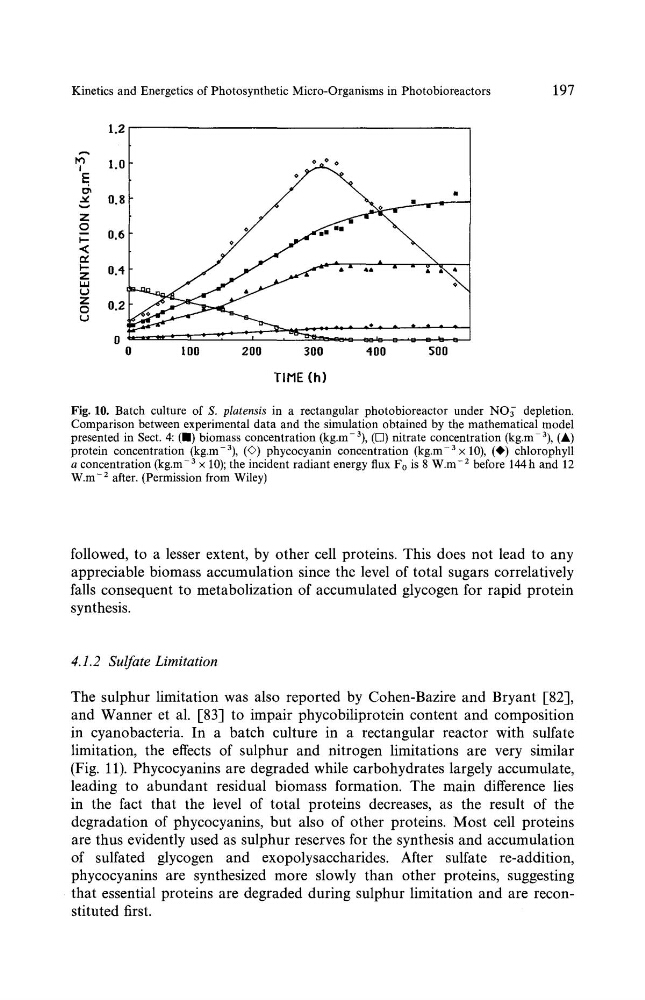
Fig. 10. Batch culture of S. platensis in a rectangular photobioreactor under NO;- depletion.
Comparison between experimental data and the simulation obtained by the mathematical model
presented in Sect. 4: (1) biomass concentration (kg.m-a), (K3) nitrate concentration (kg.m 3), (&)
protein concentration (kg.m-3), (~) phycocyanin concentration (kg.m-3x 10), (0) chlorophyll
a concentration (kg.m -3 x 10); the incident radiant energy flux Fo is 8 W.m -2 before 144h and 12
W.m-2 after. (Permission from Wiley)
followed, to a lesser extent, by other cell proteins. This does not lead to any
appreciable biomass accumulation since the level of total sugars correlatively
falls consequent to metabolization of accumulated glycogen for rapid protein
synthesis.
4.1.2 Sulfate Limitation
The sulphur limitation was also reported by Cohen-Bazire and Bryant [82],
and Wanner et al. [83] to impair phycobiliprotein content and composition
in cyanobacteria. In a batch culture in a rectangular reactor with sulfate
limitation, the effects of sulphur and nitrogen limitations are very similar
(Fig. 11). Phycocyanins are degraded while carbohydrates largely accumulate,
leading to abundant residual biomass formation. The main difference lies
in the fact that the level of total proteins decreases, as the result of the
degradation of phycocyanins, but also of other proteins. Most cell proteins
are thus evidently used as sulphur reserves for the synthesis and accumulation
of sulfated glycogen and exopolysaccharides. After sulfate re-addition,
phycocyanins are synthesized more slowly than other proteins, suggesting
that essential proteins are degraded during sulphur limitation and are reconstituted first.
197
1.2
1.0
E
0.8
Z
o
0.6
,<
e,,,.
~0.4
z
t_)
o
0.2
u
0
0
o
r
r
o
9
o
r
o
~.
++
i
.i
~
-
100
200
300
400
500
TIME (h)
Fig. 10. Batch culture of S. platensis in a rectangular photobioreactor under NO;- depletion.
Comparison between experimental data and the simulation obtained by the mathematical model
presented in Sect. 4: (1) biomass concentration (kg.m-a), (K3) nitrate concentration (kg.m 3), (&)
protein concentration (kg.m-3), (~) phycocyanin concentration (kg.m-3x 10), (0) chlorophyll
a concentration (kg.m -3 x 10); the incident radiant energy flux Fo is 8 W.m -2 before 144h and 12
W.m-2 after. (Permission from Wiley)
followed, to a lesser extent, by other cell proteins. This does not lead to any
appreciable biomass accumulation since the level of total sugars correlatively
falls consequent to metabolization of accumulated glycogen for rapid protein
synthesis.
4.1.2 Sulfate Limitation
The sulphur limitation was also reported by Cohen-Bazire and Bryant [82],
and Wanner et al. [83] to impair phycobiliprotein content and composition
in cyanobacteria. In a batch culture in a rectangular reactor with sulfate
limitation, the effects of sulphur and nitrogen limitations are very similar
(Fig. 11). Phycocyanins are degraded while carbohydrates largely accumulate,
leading to abundant residual biomass formation. The main difference lies
in the fact that the level of total proteins decreases, as the result of the
degradation of phycocyanins, but also of other proteins. Most cell proteins
are thus evidently used as sulphur reserves for the synthesis and accumulation
of sulfated glycogen and exopolysaccharides. After sulfate re-addition,
phycocyanins are synthesized more slowly than other proteins, suggesting
that essential proteins are degraded during sulphur limitation and are reconstituted first.