

200
J.-F. Cornet et al.
oxygen evolution and the CO2 fixation rates are affected as well as the mineral
limitation increases and the phycocyanin content decreases in the cells). This
confirms the first hypothesis, which can be used for modeling both light and
mineral limitations.
If limitation by light only is assumed, Eqs. (47) and (48) can be used to obtain
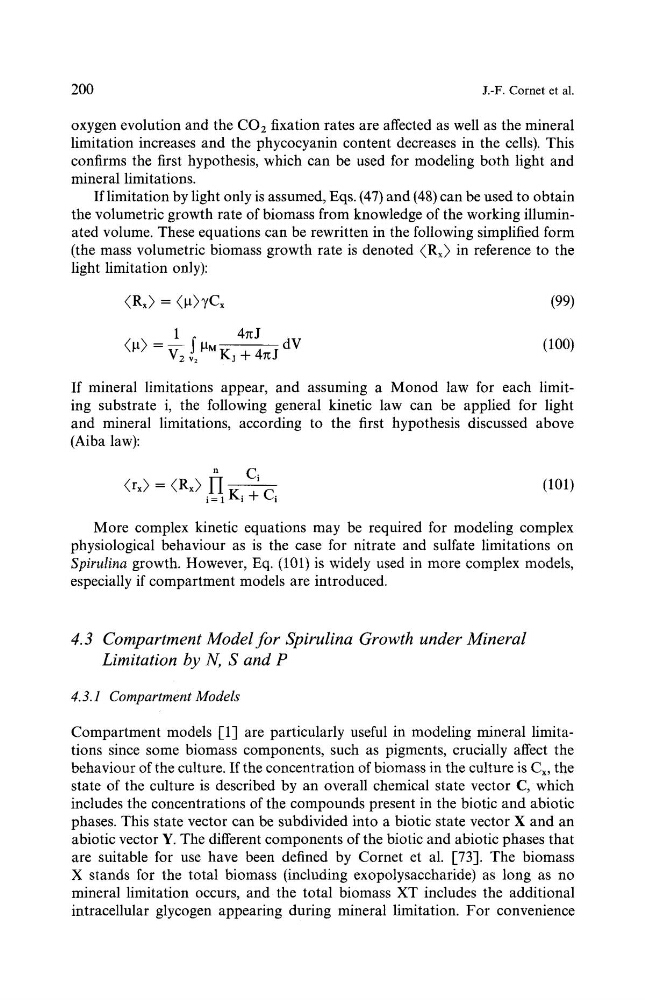
the volumetric growth rate of biomass from knowledge of the working illuminated volume. These equations can be rewritten in the following simplified form
(the mass volumetric biomass growth rate is denoted (Rx) in reference to the
light limitation only):
(R~) = (P)yCx
(99)
@)
~ v~ ~
4nJ
dV
(100)
=
I-tM Kj + 4~J
If mineral limitations appear, and assuming a Monod law for each limiting substrate i, the following general kinetic law can be applied for light
and mineral limitations, according to the first hypothesis discussed above
(Aiba law):
n
C.
(rx) = (Rx) I] -- __Z'
i = 1 14~i -}- Ci
(lol)
More complex kinetic equations may be required for modeling complex
physiological behaviour as is the case for nitrate and sulfate limitations on
Spirulina growth. However, Eq. (101) is widely used in more complex models,
especially if compartment models are introduced.
4.3 Compartment Model for Spirulina Growth under Mineral
Limitation by N, S and P
4.3.1 Compartment Models
Compartment models [1] are particularly useful in modeling mineral limitations since some biomass components, such as pigments, crucially affect the
behaviour of the culture. If the concentration of biomass in the culture is Cx, the
state of the culture is described by an overall chemical state vector C, which
includes the concentrations of the compounds present in the biotic and abiotic
phases. This state vector can be subdivided into a biotic state vector X and an
abiotic vector Y. The different components of the biotic and abiotic phases that
are suitable for use have been defined by Cornet et al. [73]. The biomass
X stands for the total biomass (including exopolysaccharide) as long as no
mineral limitation occurs, and the total biomass XT includes the additional
intracellular glycogen appearing during mineral limitation. For convenience
J.-F. Cornet et al.
oxygen evolution and the CO2 fixation rates are affected as well as the mineral
limitation increases and the phycocyanin content decreases in the cells). This
confirms the first hypothesis, which can be used for modeling both light and
mineral limitations.
If limitation by light only is assumed, Eqs. (47) and (48) can be used to obtain
the volumetric growth rate of biomass from knowledge of the working illuminated volume. These equations can be rewritten in the following simplified form
(the mass volumetric biomass growth rate is denoted (Rx) in reference to the
light limitation only):
(R~) = (P)yCx
(99)
@)
~ v~ ~
4nJ
dV
(100)
=
I-tM Kj + 4~J
If mineral limitations appear, and assuming a Monod law for each limiting substrate i, the following general kinetic law can be applied for light
and mineral limitations, according to the first hypothesis discussed above
(Aiba law):
n
C.
(rx) = (Rx) I] -- __Z'
i = 1 14~i -}- Ci
(lol)
More complex kinetic equations may be required for modeling complex
physiological behaviour as is the case for nitrate and sulfate limitations on
Spirulina growth. However, Eq. (101) is widely used in more complex models,
especially if compartment models are introduced.
4.3 Compartment Model for Spirulina Growth under Mineral
Limitation by N, S and P
4.3.1 Compartment Models
Compartment models [1] are particularly useful in modeling mineral limitations since some biomass components, such as pigments, crucially affect the
behaviour of the culture. If the concentration of biomass in the culture is Cx, the
state of the culture is described by an overall chemical state vector C, which
includes the concentrations of the compounds present in the biotic and abiotic
phases. This state vector can be subdivided into a biotic state vector X and an
abiotic vector Y. The different components of the biotic and abiotic phases that
are suitable for use have been defined by Cornet et al. [73]. The biomass
X stands for the total biomass (including exopolysaccharide) as long as no
mineral limitation occurs, and the total biomass XT includes the additional
intracellular glycogen appearing during mineral limitation. For convenience