

Kinetics and Energetics of Photosynthetic Micro-Organisms in Photobioreactors
191
ratio (d)/(Jo),
i.e. the volumetric rate of radiant energy absorbed divided by
the potential maximum volumetric rate of radiant incident energy. This has been
done on rectangular photoreactors to compare results obtained from the exact
three-dimensional solution and from various one-dimensional approximations.
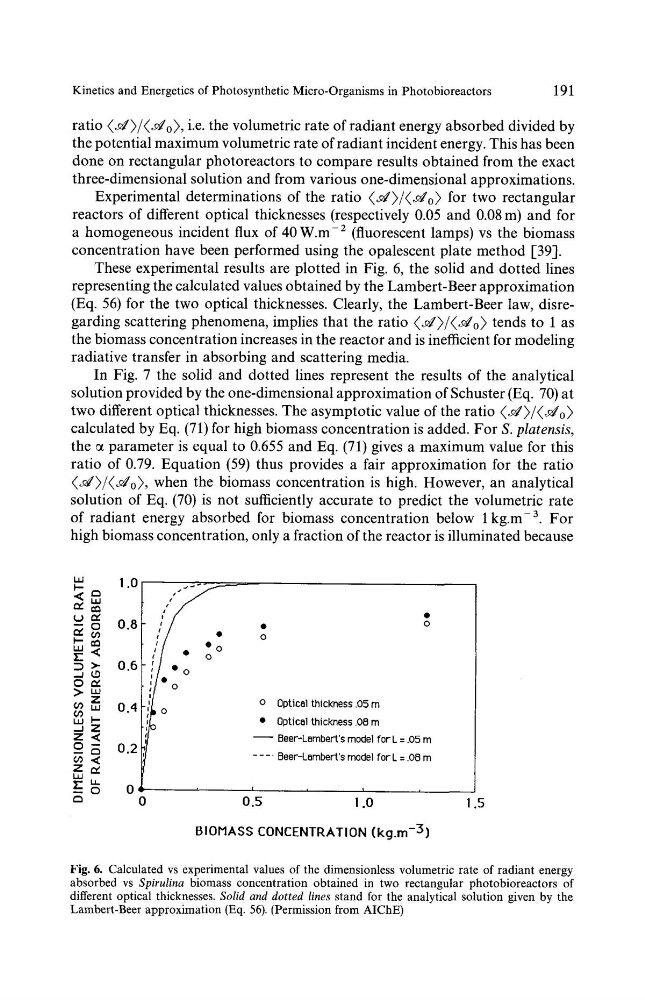
Experimental determinations of the ratio (d)/(~r
for two rectangular
reactors of different optical thicknesses (respectively 0.05 and 0.08 m) and for
a homogeneous incident flux of 40 W.m-2 (fluorescent lamps) vs the biomass
concentration have been performed using the opalescent plate method [39].
These experimental results are plotted in Fig. 6, the solid and dotted lines
representing the calculated values obtained by the Lambert-Beer approximation
(Eq. 56) for the two optical thicknesses. Clearly, the Lambert-Beer law, disregarding scattering phenomena, implies that the ratio (d)/(do)
tends to 1 as
the biomass concentration increases in the reactor and is inefficient for modeling
radiative transfer in absorbing and scattering media.
In Fig. 7 the solid and dotted lines represent the results of the analytical
solution provided by the one-dimensional approximation of Schuster (Eq. 70) at
two different optical thicknesses. The asymptotic value of the ratio (~r162
calculated by Eq. (71) for high biomass concentration is added. For S. platensis,
the a parameter is equal to 0.655 and Eq. (71) gives a maximum value for this
ratio of 0.79. Equation (59) thus provides a fair approximation for the ratio
<~r
when the biomass concentration is high. However, an analytical
solution of Eq. (70) is not sufficiently accurate to predict the volumetric rate
of radiant energy absorbed for biomass concentration below 1 kg.m-3. For
high biomass concentration, only a fraction of the reactor is illuminated because
1.0
/
o
0.6
z ~, 0.2
o"
0
o
Optical thickness.OSm
9
Optical thickness.08 m
-Beer-Lambert's model for L = .05 m
.... Beer-Lambert's model for L = .08 m
i
i
0.5
1.0
1.5
BIOMASS CONCENTRATION (kg.m -3)
Fig. 6. Calculated vs experimental values of the dimensionless volumetric rate of radiant energy
absorbed vs Spirulina biomass concentration obtained in two rectangular photobioreactors of
different optical thicknesses. Solid and dotted lines stand for the analytical solution given by the
Lambert-Beer approximation (Eq. 56). (Permission from AIChE)
191
ratio (d)/(Jo),
i.e. the volumetric rate of radiant energy absorbed divided by
the potential maximum volumetric rate of radiant incident energy. This has been
done on rectangular photoreactors to compare results obtained from the exact
three-dimensional solution and from various one-dimensional approximations.
Experimental determinations of the ratio (d)/(~r
for two rectangular
reactors of different optical thicknesses (respectively 0.05 and 0.08 m) and for
a homogeneous incident flux of 40 W.m-2 (fluorescent lamps) vs the biomass
concentration have been performed using the opalescent plate method [39].
These experimental results are plotted in Fig. 6, the solid and dotted lines
representing the calculated values obtained by the Lambert-Beer approximation
(Eq. 56) for the two optical thicknesses. Clearly, the Lambert-Beer law, disregarding scattering phenomena, implies that the ratio (d)/(do)
tends to 1 as
the biomass concentration increases in the reactor and is inefficient for modeling
radiative transfer in absorbing and scattering media.
In Fig. 7 the solid and dotted lines represent the results of the analytical
solution provided by the one-dimensional approximation of Schuster (Eq. 70) at
two different optical thicknesses. The asymptotic value of the ratio (~r162
calculated by Eq. (71) for high biomass concentration is added. For S. platensis,
the a parameter is equal to 0.655 and Eq. (71) gives a maximum value for this
ratio of 0.79. Equation (59) thus provides a fair approximation for the ratio
<~r
when the biomass concentration is high. However, an analytical
solution of Eq. (70) is not sufficiently accurate to predict the volumetric rate
of radiant energy absorbed for biomass concentration below 1 kg.m-3. For
high biomass concentration, only a fraction of the reactor is illuminated because
1.0
/
o
0.6
z ~, 0.2
o"
0
o
Optical thickness.OSm
9
Optical thickness.08 m
-Beer-Lambert's model for L = .05 m
.... Beer-Lambert's model for L = .08 m
i
i
0.5
1.0
1.5
BIOMASS CONCENTRATION (kg.m -3)
Fig. 6. Calculated vs experimental values of the dimensionless volumetric rate of radiant energy
absorbed vs Spirulina biomass concentration obtained in two rectangular photobioreactors of
different optical thicknesses. Solid and dotted lines stand for the analytical solution given by the
Lambert-Beer approximation (Eq. 56). (Permission from AIChE)