

192
J.-F. Cornet et al.
1.0
~,,=,
tv,~
__. o ~
o.o
evth
. ~ ~
0.6
o
,,, ~
0.4
-J
o.9_=-,
z ,','
0.2
/ "~J~e o ~
"1o o
'%
I
-
o
Optical thickness.O5 m
i o
9
Optical thickness .08 m
-Schuster's model for L = .05 m
.... Schuster's model forL = .08 m
0
i
i
0
0.5
I .0
1.5
BIOMASS CONCENTRATION
(kg.m m3)
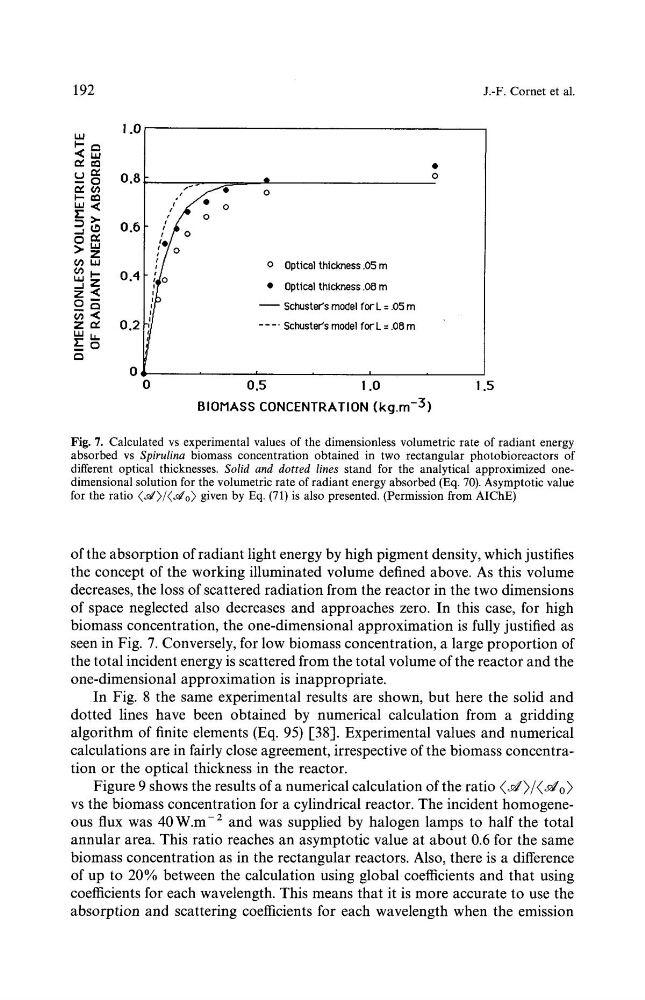
Fig. 7. Calculated vs experimental values of the dimensionless volumetric rate of radiant energy
absorbed vs Spirulina biomass concentration obtained in two rectangular photobioreactors of
different optical thicknesses. Solid and dotted lines stand for the analytical approximized onedimensional solution for the volumetric rate of radiant energy absorbed (Eq. 70). Asymptotic value
for the ratio (d)/(~o) given by Eq. (71) is also presented. (Permission from AIChE)
of the absorption of radiant light energy by high pigment density, which justifies
the concept of the working illuminated volume defined above. As this volume
decreases, the loss of scattered radiation from the reactor in the two dimensions
of space neglected also decreases and approaches zero. In this case, for high
biomass concentration, the one-dimensional approximation is fully justified as
seen in Fig. 7. Conversely, for low biomass concentration, a large proportion of
the total incident energy is scattered from the total volume of the reactor and the
one-dimensional approximation is inappropriate.
In Fig. 8 the same experimental results are shown, but here the solid and
dotted lines have been obtained by numerical calculation from a gridding
algorithm of finite elements (Eq. 95) [38]. Experimental values and numerical
calculations are in fairly close agreement, irrespective of the biomass concentration or the optical thickness in the reactor.
Figure 9 shows the results of a numerical calculation of the ratio (d)/(~r
vs the biomass concentration for a cylindrical reactor. The incident homogeneous flux was 40 W.m-2 and was supplied by halogen lamps to half the total
annular area. This ratio reaches an asymptotic value at about 0.6 for the same
biomass concentration as in the rectangular reactors. Also, there is a difference
of up to 20% between the calculation using global coefficients and that using
coefficients for each wavelength. This means that it is more accurate to use the
absorption and scattering coefficients for each wavelength when the emission
J.-F. Cornet et al.
1.0
~,,=,
tv,~
__. o ~
o.o
evth
. ~ ~
0.6
o
,,, ~
0.4
-J
o.9_=-,
z ,','
0.2
/ "~J~e o ~
"1o o
'%
I
-
o
Optical thickness.O5 m
i o
9
Optical thickness .08 m
-Schuster's model for L = .05 m
.... Schuster's model forL = .08 m
0
i
i
0
0.5
I .0
1.5
BIOMASS CONCENTRATION
(kg.m m3)
Fig. 7. Calculated vs experimental values of the dimensionless volumetric rate of radiant energy
absorbed vs Spirulina biomass concentration obtained in two rectangular photobioreactors of
different optical thicknesses. Solid and dotted lines stand for the analytical approximized onedimensional solution for the volumetric rate of radiant energy absorbed (Eq. 70). Asymptotic value
for the ratio (d)/(~o) given by Eq. (71) is also presented. (Permission from AIChE)
of the absorption of radiant light energy by high pigment density, which justifies
the concept of the working illuminated volume defined above. As this volume
decreases, the loss of scattered radiation from the reactor in the two dimensions
of space neglected also decreases and approaches zero. In this case, for high
biomass concentration, the one-dimensional approximation is fully justified as
seen in Fig. 7. Conversely, for low biomass concentration, a large proportion of
the total incident energy is scattered from the total volume of the reactor and the
one-dimensional approximation is inappropriate.
In Fig. 8 the same experimental results are shown, but here the solid and
dotted lines have been obtained by numerical calculation from a gridding
algorithm of finite elements (Eq. 95) [38]. Experimental values and numerical
calculations are in fairly close agreement, irrespective of the biomass concentration or the optical thickness in the reactor.
Figure 9 shows the results of a numerical calculation of the ratio (d)/(~r
vs the biomass concentration for a cylindrical reactor. The incident homogeneous flux was 40 W.m-2 and was supplied by halogen lamps to half the total
annular area. This ratio reaches an asymptotic value at about 0.6 for the same
biomass concentration as in the rectangular reactors. Also, there is a difference
of up to 20% between the calculation using global coefficients and that using
coefficients for each wavelength. This means that it is more accurate to use the
absorption and scattering coefficients for each wavelength when the emission