

190
J.-F. Cornet et al.
250
I
200
C4
E
~! 50
Z
laJ
U
IJ.
',
!00
0
U
50
~
g
mass coefficient
0
i
I
I
I
350
450
550
650
750
WAVELENGTH (nm)
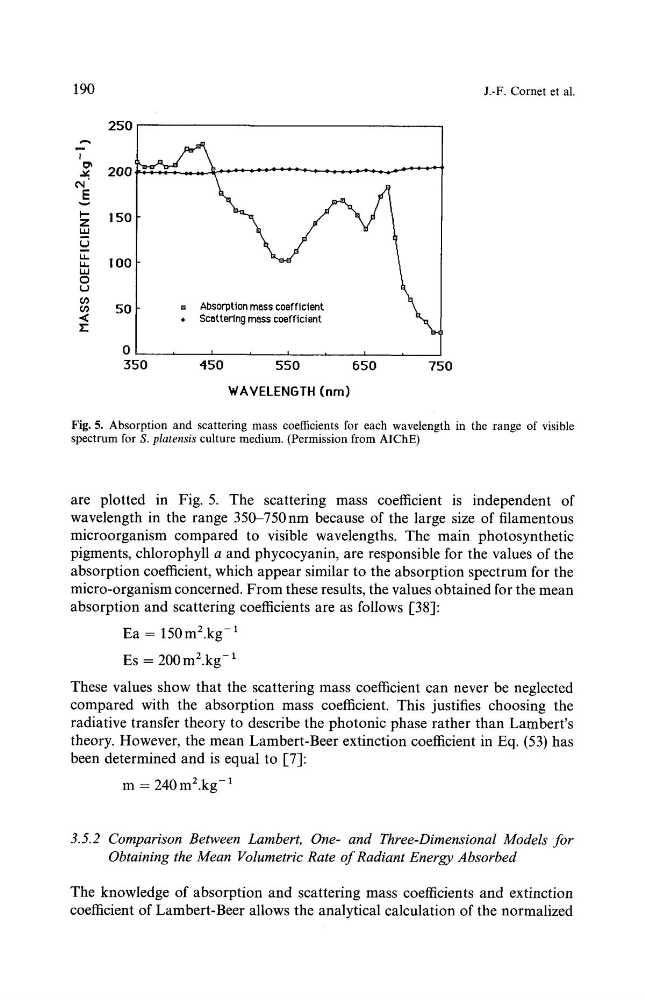
Fig. 5. Absorption and scattering mass coefficients for each wavelength in the range of visible
spectrum for S. platensis culture medium. (Permission from AIChE)
are plotted in Fig. 5. The scattering mass coefficient is independent of
wavelength in the range 350-750nm because of the large size of filamentous
microorganism compared to visible wavelengths. The main photosynthetic
pigments, chlorophyll a and phycocyanin, are responsible for the values of the
absorption coefficient, which appear similar to the absorption spectrum for the
micro-organism concerned. From these results, the values obtained for the mean
absorption and scattering coefficients are as follows [38]:
Ea = 150m2.kg -1
Es = 200 m2.kg- 1
These values show that the scattering mass coefficient can never be neglected
compared with the absorption mass coefficient. This justifies choosing the
radiative transfer theory to describe the photonic phase rather than Lambert's
theory. However, the mean Lambert-Beer extinction coefficient in Eq. (53) has
been determined and is equal to [7]:
m = 240 m2.kg- 1
3.5.2 Comparison Between Lambert, One- and Three-Dimensional Models for
Obtaining the Mean Volumetric Rate of Radiant Energy Absorbed
The knowledge of absorption and scattering mass coefficients and extinction
coefficient of Lambert-Beer allows the analytical calculation of the normalized
J.-F. Cornet et al.
250
I
200
C4
E
~! 50
Z
laJ
U
IJ.
',
!00
0
U
50
~
g
mass coefficient
0
i
I
I
I
350
450
550
650
750
WAVELENGTH (nm)
Fig. 5. Absorption and scattering mass coefficients for each wavelength in the range of visible
spectrum for S. platensis culture medium. (Permission from AIChE)
are plotted in Fig. 5. The scattering mass coefficient is independent of
wavelength in the range 350-750nm because of the large size of filamentous
microorganism compared to visible wavelengths. The main photosynthetic
pigments, chlorophyll a and phycocyanin, are responsible for the values of the
absorption coefficient, which appear similar to the absorption spectrum for the
micro-organism concerned. From these results, the values obtained for the mean
absorption and scattering coefficients are as follows [38]:
Ea = 150m2.kg -1
Es = 200 m2.kg- 1
These values show that the scattering mass coefficient can never be neglected
compared with the absorption mass coefficient. This justifies choosing the
radiative transfer theory to describe the photonic phase rather than Lambert's
theory. However, the mean Lambert-Beer extinction coefficient in Eq. (53) has
been determined and is equal to [7]:
m = 240 m2.kg- 1
3.5.2 Comparison Between Lambert, One- and Three-Dimensional Models for
Obtaining the Mean Volumetric Rate of Radiant Energy Absorbed
The knowledge of absorption and scattering mass coefficients and extinction
coefficient of Lambert-Beer allows the analytical calculation of the normalized