

Kinetics and Energetics of Photosynthetic Micro-Organisms in Photobioreactors
189
solved in its three-dimensional form. This affords a high accuracy for the
calculation of the local available energy and at this level, the dependence of the
wavelength on this calculation may be taken into account. The general form of
the radiative transfer equation for direction u and wavelength X is then written
as [36, 38, 39, 50, 68]
Es(~,)
u" VIx = - [Ea(X) + Es(X)]Cxlx + ~
C~ j" p(u, u')Ix d~'
f~,
(95)
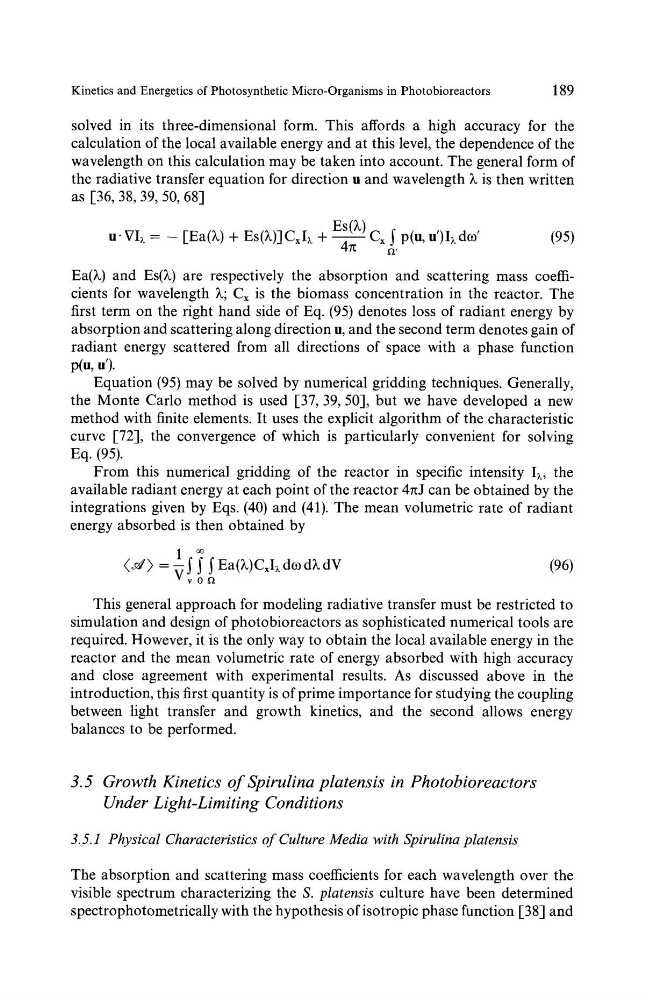
Ea()~) and Es0~) are respectively the absorption and scattering mass coefficients for wavelength )~; Cx is the biomass concentration in the reactor. The
first term on the right hand side of Eq. (95) denotes loss of radiant energy by
absorption and scattering along direction u, and the second term denotes gain of
radiant energy scattered from all directions of space with a phase function
p(u, u').
Equation (95) may be solved by numerical gridding techniques. Generally,
the Monte Carlo method is used [37, 39, 50], but we have developed a new
method with finite elements. It uses the explicit algorithm of the characteristic
curve [72], the convergence of which is particularly convenient for solving
Eq. (95).
From this numerical gridding of the reactor in specific intensity Ix, the
available radiant energy at each point of the reactor 4rd can be obtained by the
integrations given by Eqs. (40) and (41). The mean volumetric rate of radiant
energy absorbed is then obtained by
(~') = 1 SV, 0S ~ Ea0~)CxIx d~0 d)~ dV
(96)
This general approach for modeling radiative transfer must be restricted to
simulation and design of photobioreactors as sophisticated numerical tools are
required. However, it is the only way to obtain the local available energy in the
reactor and the mean volumetric rate of energy absorbed with high accuracy
and close agreement with experimental results. As discussed above in the
introduction, this first quantity is of prime importance for studying the coupling
between light transfer and growth kinetics, and the second allows energy
balances to be performed.
3.5 Growth Kinetics of Spirulina platensis in Photobioreactors
Under Light-Limiting Conditions
3.5.1 Physical Characteristics of Culture Media with Spirulina platensis
The absorption and scattering mass coefficients for each wavelength over the
visible spectrum characterizing the S. platensis culture have been determined
spectrophotometrically with the hypothesis of isotropic phase function [38] and
189
solved in its three-dimensional form. This affords a high accuracy for the
calculation of the local available energy and at this level, the dependence of the
wavelength on this calculation may be taken into account. The general form of
the radiative transfer equation for direction u and wavelength X is then written
as [36, 38, 39, 50, 68]
Es(~,)
u" VIx = - [Ea(X) + Es(X)]Cxlx + ~
C~ j" p(u, u')Ix d~'
f~,
(95)
Ea()~) and Es0~) are respectively the absorption and scattering mass coefficients for wavelength )~; Cx is the biomass concentration in the reactor. The
first term on the right hand side of Eq. (95) denotes loss of radiant energy by
absorption and scattering along direction u, and the second term denotes gain of
radiant energy scattered from all directions of space with a phase function
p(u, u').
Equation (95) may be solved by numerical gridding techniques. Generally,
the Monte Carlo method is used [37, 39, 50], but we have developed a new
method with finite elements. It uses the explicit algorithm of the characteristic
curve [72], the convergence of which is particularly convenient for solving
Eq. (95).
From this numerical gridding of the reactor in specific intensity Ix, the
available radiant energy at each point of the reactor 4rd can be obtained by the
integrations given by Eqs. (40) and (41). The mean volumetric rate of radiant
energy absorbed is then obtained by
(~') = 1 SV, 0S ~ Ea0~)CxIx d~0 d)~ dV
(96)
This general approach for modeling radiative transfer must be restricted to
simulation and design of photobioreactors as sophisticated numerical tools are
required. However, it is the only way to obtain the local available energy in the
reactor and the mean volumetric rate of energy absorbed with high accuracy
and close agreement with experimental results. As discussed above in the
introduction, this first quantity is of prime importance for studying the coupling
between light transfer and growth kinetics, and the second allows energy
balances to be performed.
3.5 Growth Kinetics of Spirulina platensis in Photobioreactors
Under Light-Limiting Conditions
3.5.1 Physical Characteristics of Culture Media with Spirulina platensis
The absorption and scattering mass coefficients for each wavelength over the
visible spectrum characterizing the S. platensis culture have been determined
spectrophotometrically with the hypothesis of isotropic phase function [38] and