

Kinetics and Energetics of Photosynthetic Micro-Organisms in Photobioreactors
183
In the general case, the phase function may be obtained experimentally and
empirically expanded as a series in a Legendre polynomial of the form [36]
p(0, 0') = p(cos| = ~, r174
(61)
/=0
For particular applications to micro-organisms, the phase function has been
shown to be sharply peaked in the forward direction [62-64]. So, it is possible
to use an approximation given by geometrical optics for large specularly
reflecting surfaces [37], or use empirical approximate phase functions such as
the forward-scattering phase function or the Henyey-Greenstein phase function
[37].
In all case, the more rigorous approach is to compute the "exact" series given
by the Lorentz-Mie theory if all the electromagnetic constants of the microorganism are known [63].
The performances and the respective accuracies of these different approaches
have been investigated by different authors [54, 59, 65-69] with the conclusion
that, for micro-organisms, the best engineering approach is to use any approximate phase function giving a marked forward scattering diagram. Nevertheless,
the use of is|
phase function is possible as a first approximation with
a sufficient accuracy [39, 59].
3.4.1.3 Incident Radiant Energy Fluxes
One of the most important problem in describing the radiant energy transfer in
a photobioreactor is to express correctly the boundary conditions, that is the
incident radiant energy flux onto the reactor. Different cases exist, still depending on model complexity.
If the incident flux is really homogeneous, it may be easily measured, but if
the homogeneity is only a first approximation, experimental difficulties arise in
the correct assessment of the mean incident flux. Different methods may then be
used as for example chemical actinometry [39, 59, 70], or integral measures with
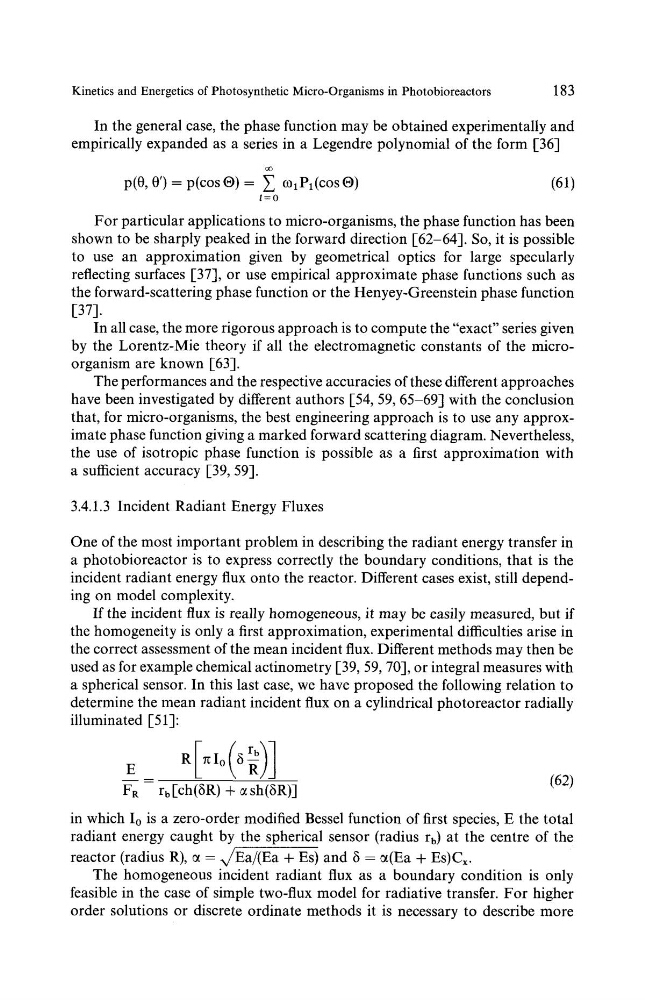
a spherical sensor. In this last case, we have proposed the following relation to
determine the mean radiant incident flux on a cylindrical photoreactor radially
illuminated [-51]:
FR rb [ch(~R) + c~ sh(gR)]
(62)
in which Io is a zero-order modified Bessel function of first species, E the total
radiant energy caught by the spherical sensor (radius rb) at the centre of the
reactor (radius R), ~ = ,,/Ea/(Ea + Es) and 8 = ~(Ea + Es)Cx.
The homogeneous incident radiant flux as a boundary condition is only
feasible in the case of simple two-flux model for radiative transfer. For higher
order solutions or discrete ordinate methods it is necessary to describe more
183
In the general case, the phase function may be obtained experimentally and
empirically expanded as a series in a Legendre polynomial of the form [36]
p(0, 0') = p(cos| = ~, r174
(61)
/=0
For particular applications to micro-organisms, the phase function has been
shown to be sharply peaked in the forward direction [62-64]. So, it is possible
to use an approximation given by geometrical optics for large specularly
reflecting surfaces [37], or use empirical approximate phase functions such as
the forward-scattering phase function or the Henyey-Greenstein phase function
[37].
In all case, the more rigorous approach is to compute the "exact" series given
by the Lorentz-Mie theory if all the electromagnetic constants of the microorganism are known [63].
The performances and the respective accuracies of these different approaches
have been investigated by different authors [54, 59, 65-69] with the conclusion
that, for micro-organisms, the best engineering approach is to use any approximate phase function giving a marked forward scattering diagram. Nevertheless,
the use of is|
phase function is possible as a first approximation with
a sufficient accuracy [39, 59].
3.4.1.3 Incident Radiant Energy Fluxes
One of the most important problem in describing the radiant energy transfer in
a photobioreactor is to express correctly the boundary conditions, that is the
incident radiant energy flux onto the reactor. Different cases exist, still depending on model complexity.
If the incident flux is really homogeneous, it may be easily measured, but if
the homogeneity is only a first approximation, experimental difficulties arise in
the correct assessment of the mean incident flux. Different methods may then be
used as for example chemical actinometry [39, 59, 70], or integral measures with
a spherical sensor. In this last case, we have proposed the following relation to
determine the mean radiant incident flux on a cylindrical photoreactor radially
illuminated [-51]:
FR rb [ch(~R) + c~ sh(gR)]
(62)
in which Io is a zero-order modified Bessel function of first species, E the total
radiant energy caught by the spherical sensor (radius rb) at the centre of the
reactor (radius R), ~ = ,,/Ea/(Ea + Es) and 8 = ~(Ea + Es)Cx.
The homogeneous incident radiant flux as a boundary condition is only
feasible in the case of simple two-flux model for radiative transfer. For higher
order solutions or discrete ordinate methods it is necessary to describe more