

184
J.-F. Cornet et al.
accurately the incident radiation. It is then possible from tedious experimental
measurements or from modeling the emission of light sources [68] (as an
example, natural photobioreactors illuminated by sun have well-known boundary conditions for incident fluxes [54, 65]).
3.4.2 Analytical Approximized One-Dimensional Solutions for the Radiative
Transfer Equation." Schuster's Hypotheses
Analytical solutions for the equation of radiative transfer are possible from only
two main assumptions:
- the incident flux is considered as homogeneous;
- the phase function is isotropic.
With an isotropic radiation field, the intensities do not depend on the azimuthal
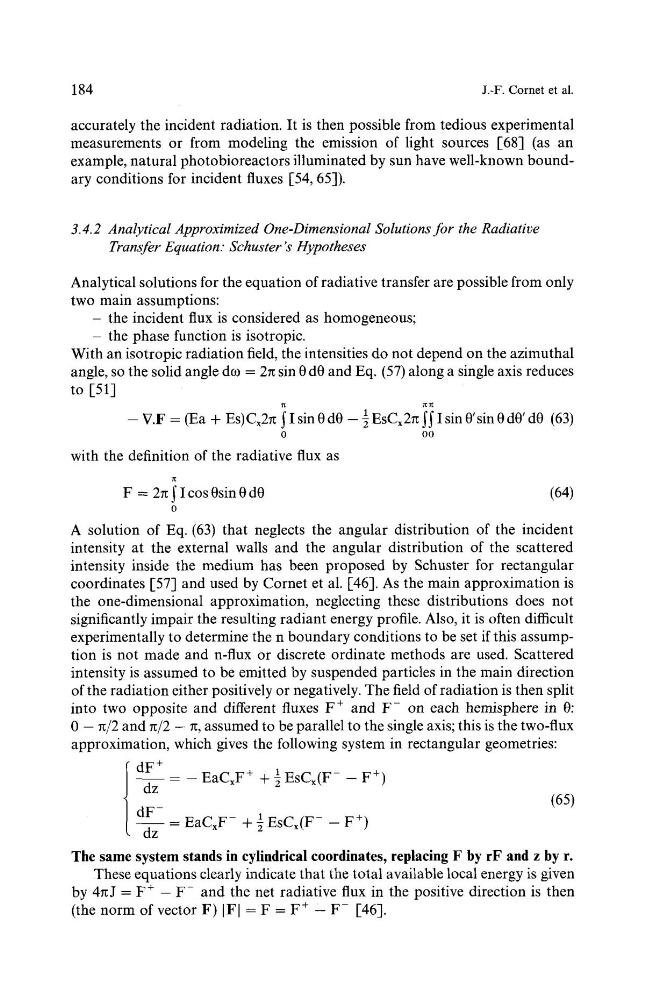
angle, so the solid angle do = 2r~ sin 0 dO and Eq. (57) along a single axis reduces
to [51]
grc
- V.F = (Ea + Es)Cx2r~ ~Isin0d0
i
- 5 EsCx2rC II i sin 0'sin 0 dO' dO (63)
0
O0
with the definition of the radiative flux as
F = 2re ~ I cos 0sin 0 dO
(64)
0
A solution of Eq. (63) that neglects the angular distribution of the incident
intensity at the external walls and the angular distribution of the scattered
intensity inside the medium has been proposed by Schuster for rectangular
coordinates [57] and used by Cornet et al. [46]. As the main approximation is
the one-dimensional approximation, neglecting these distributions does not
significantly impair the resulting radiant energy profile. Also, it is often difficult
experimentally to determine the n boundary conditions to be set if this assumption is not made and n-flux or discrete ordinate methods are used. Scattered
intensity is assumed to be emitted by suspended particles in the main direction
of the radiation either positively or negatively. The field of radiation is then split
into two opposite and different fluxes F + and F- on each hemisphere in 0:
0 - 7t/2 and rt/2 - re, assumed to be parallel to the single axis; this is the two-flux
approximation, which gives the following system in rectangular geometries:
dF +
i EsCx(FF +)
d~ -
EaCxF + + 5
(65)
dF1 EsCx(FF +)
= EaCxF- + 7
The same system stands in cylindrical coordinates, replacing F by rF and z by r.
These equations clearly indicate that the total available local energy is given
by 4~zJ = F + - F- and the net radiative flux in the positive direction is then
(the norm of vector F) IFI = F = F + - F- [46].
J.-F. Cornet et al.
accurately the incident radiation. It is then possible from tedious experimental
measurements or from modeling the emission of light sources [68] (as an
example, natural photobioreactors illuminated by sun have well-known boundary conditions for incident fluxes [54, 65]).
3.4.2 Analytical Approximized One-Dimensional Solutions for the Radiative
Transfer Equation." Schuster's Hypotheses
Analytical solutions for the equation of radiative transfer are possible from only
two main assumptions:
- the incident flux is considered as homogeneous;
- the phase function is isotropic.
With an isotropic radiation field, the intensities do not depend on the azimuthal
angle, so the solid angle do = 2r~ sin 0 dO and Eq. (57) along a single axis reduces
to [51]
grc
- V.F = (Ea + Es)Cx2r~ ~Isin0d0
i
- 5 EsCx2rC II i sin 0'sin 0 dO' dO (63)
0
O0
with the definition of the radiative flux as
F = 2re ~ I cos 0sin 0 dO
(64)
0
A solution of Eq. (63) that neglects the angular distribution of the incident
intensity at the external walls and the angular distribution of the scattered
intensity inside the medium has been proposed by Schuster for rectangular
coordinates [57] and used by Cornet et al. [46]. As the main approximation is
the one-dimensional approximation, neglecting these distributions does not
significantly impair the resulting radiant energy profile. Also, it is often difficult
experimentally to determine the n boundary conditions to be set if this assumption is not made and n-flux or discrete ordinate methods are used. Scattered
intensity is assumed to be emitted by suspended particles in the main direction
of the radiation either positively or negatively. The field of radiation is then split
into two opposite and different fluxes F + and F- on each hemisphere in 0:
0 - 7t/2 and rt/2 - re, assumed to be parallel to the single axis; this is the two-flux
approximation, which gives the following system in rectangular geometries:
dF +
i EsCx(FF +)
d~ -
EaCxF + + 5
(65)
dF1 EsCx(FF +)
= EaCxF- + 7
The same system stands in cylindrical coordinates, replacing F by rF and z by r.
These equations clearly indicate that the total available local energy is given
by 4~zJ = F + - F- and the net radiative flux in the positive direction is then
(the norm of vector F) IFI = F = F + - F- [46].