

182
J.-F. Cornet et al.
3.4.1 Light Transfer Parameters and Incident Fluxes Determinations
3.4.1.1 Absorption and Scattering Coefficients Ea, Es
The absorption and scattering coefficients for a given photosynthetic
micro-organism can be determined spectrophotometrically for each wavelength
or by direct radiation measurements for mean coefficients on the visible
spectrum.
The general procedure requires the measurement of both transmission T0~ )
and reflexion R0~) of the sample [58, 59]. The two unknowns Ea0~) and Es0~)
can then be calculated from the two non-linear equations giving T0~) and R0~ )
with the chosen level of complexity. This means that the values of coefficients Ea
and Es depend on the degree of sophistication chosen for describing the
radiative transfer problem (one dimension, three dimensions, phase function and
so on). Thus the consistency of the model relies on using together, correctly,
coefficients and assumptions. With regard to the great difficulty in measuring
spectrophotometrically the reflexion of a sample, different simplications of the
preceding approach may be made.
If the characteristic size of the micro-organism (e.g. its diameter) is very large
compared to the wavelength, one can apply the hypothesis of Shibata [58], i.e.
the ratio of the transmission to the reflexion is independent of the wavelength.
This method was used by different authors [39, 46] for a great number of
micro-organisms. Practically, this hypothesis would be reasonable only for
characteristic sizes greater than 100 gm, i.e. it does not apply for most of the
photosynthetic micro-organisms.
In a more general approach, a new relation between transmission and
reflexion is needed. For example, we have proposed a relation based on the
Lorentz-Mie theory for light scattering by particles [60, 61].
The radiative transfer problem can then be solved using the resulting
wavelength-dependent coefficients or using mean coefficients, averaged on the
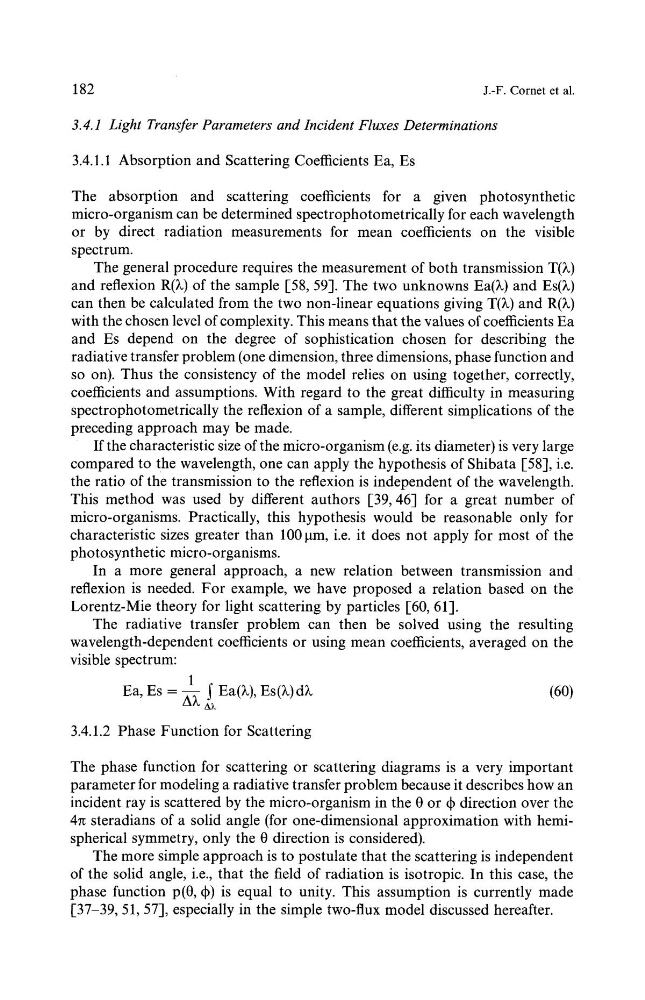
visible spectrum:
1
Ea, Es = ~ ~ Ea0~), Es0~)d)~
(60)
3.4.1.2 Phase Function for Scattering
The phase function for scattering or scattering diagrams is a very important
parameter for modeling a radiative transfer problem because it describes how an
incident ray is scattered by the micro-organism in the 0 or qb direction over the
4re steradians of a solid angle (for one-dimensional approximation with hemispherical symmetry, only the 0 direction is considered).
The more simple approach is to postulate that the scattering is independent
of the solid angle, i.e., that the field of radiation is isotropic. In this case, the
phase function p(0, qb) is equal to unity. This assumption is currently made
[37-39, 51, 57], especially in the simple two-flux model discussed hereafter.
J.-F. Cornet et al.
3.4.1 Light Transfer Parameters and Incident Fluxes Determinations
3.4.1.1 Absorption and Scattering Coefficients Ea, Es
The absorption and scattering coefficients for a given photosynthetic
micro-organism can be determined spectrophotometrically for each wavelength
or by direct radiation measurements for mean coefficients on the visible
spectrum.
The general procedure requires the measurement of both transmission T0~ )
and reflexion R0~) of the sample [58, 59]. The two unknowns Ea0~) and Es0~)
can then be calculated from the two non-linear equations giving T0~) and R0~ )
with the chosen level of complexity. This means that the values of coefficients Ea
and Es depend on the degree of sophistication chosen for describing the
radiative transfer problem (one dimension, three dimensions, phase function and
so on). Thus the consistency of the model relies on using together, correctly,
coefficients and assumptions. With regard to the great difficulty in measuring
spectrophotometrically the reflexion of a sample, different simplications of the
preceding approach may be made.
If the characteristic size of the micro-organism (e.g. its diameter) is very large
compared to the wavelength, one can apply the hypothesis of Shibata [58], i.e.
the ratio of the transmission to the reflexion is independent of the wavelength.
This method was used by different authors [39, 46] for a great number of
micro-organisms. Practically, this hypothesis would be reasonable only for
characteristic sizes greater than 100 gm, i.e. it does not apply for most of the
photosynthetic micro-organisms.
In a more general approach, a new relation between transmission and
reflexion is needed. For example, we have proposed a relation based on the
Lorentz-Mie theory for light scattering by particles [60, 61].
The radiative transfer problem can then be solved using the resulting
wavelength-dependent coefficients or using mean coefficients, averaged on the
visible spectrum:
1
Ea, Es = ~ ~ Ea0~), Es0~)d)~
(60)
3.4.1.2 Phase Function for Scattering
The phase function for scattering or scattering diagrams is a very important
parameter for modeling a radiative transfer problem because it describes how an
incident ray is scattered by the micro-organism in the 0 or qb direction over the
4re steradians of a solid angle (for one-dimensional approximation with hemispherical symmetry, only the 0 direction is considered).
The more simple approach is to postulate that the scattering is independent
of the solid angle, i.e., that the field of radiation is isotropic. In this case, the
phase function p(0, qb) is equal to unity. This assumption is currently made
[37-39, 51, 57], especially in the simple two-flux model discussed hereafter.