

Kinetics and Energetics of Photosynthetic Micro-Organisms in Photobioreactors
179
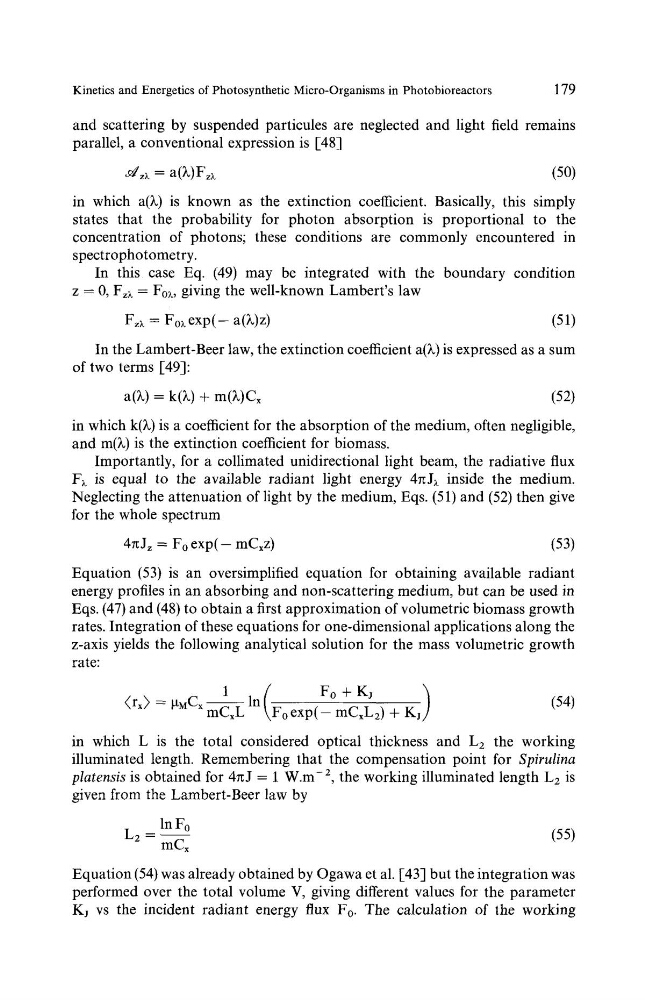
and scattering by suspended particules are neglected and light field remains
parallel, a conventional expression is [48]
dzZ = a0~)Fzx
(50)
in which a0~) is known as the extinction coefficient. Basically, this simply
states that the probability for photon absorption is proportional to the
concentration of photons; these conditions are commonly encountered in
spectrophotometry.
In this case Eq. (49) may be integrated with the boundary condition
z = 0, Fzx = Fox, giving the well-known Lambert's law
Fzx = Fo~exp(- a0~)z)
(51)
In the Lambert-Beer law, the extinction coefficient a0~) is expressed as a sum
of two terms [49]:
a(~.) = k(k) + m00Cx
(52)
in which k00 is a coefficient for the absorption of the medium, often negligible,
and m(k) is the extinction coefficient for biomass.
Importantly, for a collimated unidirectional light beam, the radiative flux
Fx is equal to the available radiant light energy 4~Jx inside the medium.
Neglecting the attenuation of light by the medium, Eqs. (51) and (52) then give
for the whole spectrum
4~Jz - Fo exp(- mCxz)
(53)
Equation (53) is an oversimplified equation for obtaining available radiant
energy profiles in an absorbing and non-scattering medium, but can be used in
Eqs. (47) and (48) to obtain a first approximation of volumetric biomass growth
rates. Integration of these equations for one-dimensional applications along the
z-axis yields the following analytical solution for the mass volumetric growth
rate:
1 (.
Fo +Kj
)
(54)
(rx) = ~tMCx ~
In \Fo exp(-- mCxL2) + Kj
in which L is the total considered optical thickness and L2 the working
illuminated length. Remembering that the compensation point for Spirulina
platensis is obtained for 4nJ = 1 W.m -2, the working illuminated length L2 is
given from the Lambert-Beer law by
lnFo
L 2 -
(55)
mCx
Equation (54) was already obtained by Ogawa et al. [43] but the integration was
performed over the total volume V, giving different values for the parameter
Kj vs the incident radiant energy flux Fo. The calculation of the working
179
and scattering by suspended particules are neglected and light field remains
parallel, a conventional expression is [48]
dzZ = a0~)Fzx
(50)
in which a0~) is known as the extinction coefficient. Basically, this simply
states that the probability for photon absorption is proportional to the
concentration of photons; these conditions are commonly encountered in
spectrophotometry.
In this case Eq. (49) may be integrated with the boundary condition
z = 0, Fzx = Fox, giving the well-known Lambert's law
Fzx = Fo~exp(- a0~)z)
(51)
In the Lambert-Beer law, the extinction coefficient a0~) is expressed as a sum
of two terms [49]:
a(~.) = k(k) + m00Cx
(52)
in which k00 is a coefficient for the absorption of the medium, often negligible,
and m(k) is the extinction coefficient for biomass.
Importantly, for a collimated unidirectional light beam, the radiative flux
Fx is equal to the available radiant light energy 4~Jx inside the medium.
Neglecting the attenuation of light by the medium, Eqs. (51) and (52) then give
for the whole spectrum
4~Jz - Fo exp(- mCxz)
(53)
Equation (53) is an oversimplified equation for obtaining available radiant
energy profiles in an absorbing and non-scattering medium, but can be used in
Eqs. (47) and (48) to obtain a first approximation of volumetric biomass growth
rates. Integration of these equations for one-dimensional applications along the
z-axis yields the following analytical solution for the mass volumetric growth
rate:
1 (.
Fo +Kj
)
(54)
(rx) = ~tMCx ~
In \Fo exp(-- mCxL2) + Kj
in which L is the total considered optical thickness and L2 the working
illuminated length. Remembering that the compensation point for Spirulina
platensis is obtained for 4nJ = 1 W.m -2, the working illuminated length L2 is
given from the Lambert-Beer law by
lnFo
L 2 -
(55)
mCx
Equation (54) was already obtained by Ogawa et al. [43] but the integration was
performed over the total volume V, giving different values for the parameter
Kj vs the incident radiant energy flux Fo. The calculation of the working